

A New Generation of Land Modeling: Dynamic Vegetation and Demography in E3SM
Key Takeaways
- ELM-FATES is advancing E3SM from prescribed vegetation distributions toward emergent vegetation dynamics and shifting biogeography based on bioclimatic response.
- FATES is planned to become the default vegetation model for E3SM v5, with the next major step being fully coupled E3SM simulations that activate higher resolution of vegetation processes by including cohort-based plant demography, disturbance, and competition-based successional trajectories.
- By representing how plant cohorts compete, die, and recover across patches with different disturbance histories, ELM-FATES can simulate dynamic landscape mosaics and ecosystem trajectories that are not represented by the current default ELM vegetation framework.
How does FATES fit into E3SM?
E3SM’s land component, the E3SM Land Model (ELM), represents vegetation, surface radiation, snow and soil hydrology, and terrestrial biogeochemistry, among other processes. To model prognostic vegetation in ELM, one can use the option of sunlit and shaded single canopy, with statically prescribed plant areas or the Functionally Assembled Terrestrial Ecosystem Simulator (FATES), an external model from the NGEE-Tropics project.
FATES interfaces with ELM and replaces the vegetation processes, including roots. ELM couples soil dynamics, soil hydrology, snow, and rivers together making the ELM-FATES land model. ELM-FATES introduces a finer-scale representation of sub-grid heterogeneity and additional hierarchy levels. Rather than dividing the land unit by PFT, as in the current default ELM scheme, ELM-FATES partitions the land unit into “patches” distinguished by time-since-disturbance (Fig. 1. top right), tracking age-classes. Each patch contains plant “cohorts” defined by PFT and size (Fig. 1. bottom right), tracking multi-level canopies of various sizes, leaf layers, and stem diameter or size-classes. Cohorts compete for light and other resources, while mechanistic rates of recruitment (the emergence of new plants), growth, and mortality determine how vegetation structure and composition change through time (Fig. 1, right). The ELM-FATES patch and cohort representation further refines ELM’s sub-grid structure and fundamentally changes how the land surface model responds to near surface weather and external drivers. This tractable, observation-connected level of ecological detail captures key demographic processes without requiring the model to track every individual plant. The resulting dynamic mosaic allows ecosystem structure, mechanistic ecosystem assembly over fixed PFT fractions, and associated trait distributions to emerge from model processes rather than being fixed in advance.
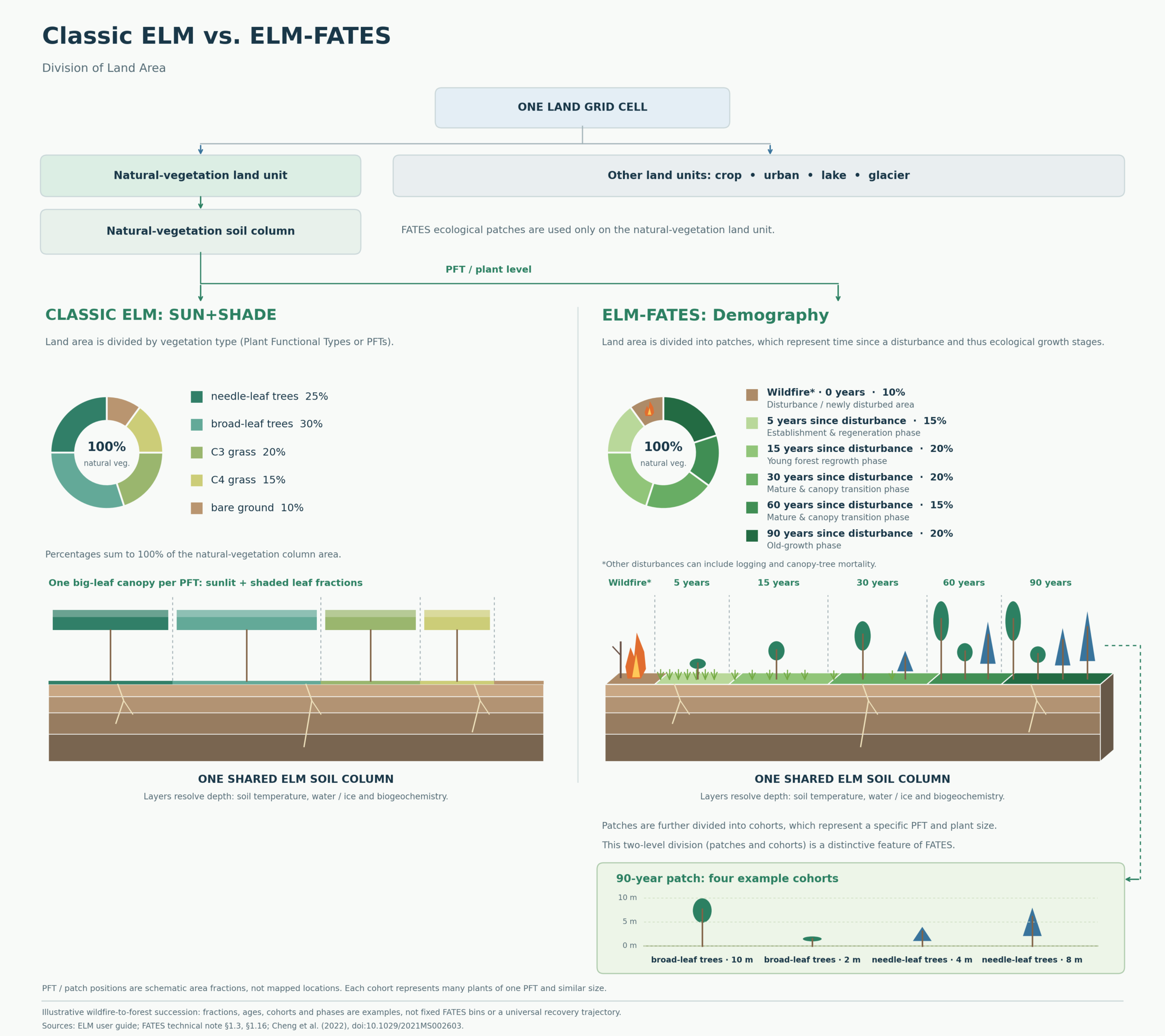
Figure 1. Comparing land-unit hierarchy in classic ELM and ELM-FATES. Left side: land area is divided into fractions of plant functional type (PFT) and single-canopy sunlit and shaded leaf fractions in classic ELM. In this example, the land-unit contains prescribed areas of bare ground, needleleaf trees, broadleaf trees, and grasses using different methods of photosynthesis (C3, C4). Right side: land area is divided into time-since-disturbance “patches” in ELM-FATES that tracks ecological growth stages divided into age-classes. Bottom right: “Cohorts” of different plant functional types, size classes of stem diameter, height, and multi-layer canopy structure, that sits within each patch. Notice how each sub-grid patch, contains multiple plant cohorts defined by both PFT and size, with the constituent mix depending on time-since-disturbance. ELM-FATES is able to model changes in PFTs composition via emerging cohort competition from dynamic recruitment, growth, and mortality (i.e., dynamic vegetation). Generated with ChatGPT.
Recent Progress, Readiness, and Why ELM-FATES Matters
ELM-FATES has progressed from a regional model-development effort to global application within E3SM (Shu et al. 2025, Needham et al. 2025). Ongoing work on nutrient-enabled functionality and global calibration further strengthens the model’s ability to represent interactions among plant traits, resource limitations, and seasonal growth dynamics. Initial “offline” (running ELM uncoupled to other model components) global simulations have demonstrated performance against observational and model-evaluation benchmarks, with ILAMB scores reported as comparable to or better than those (in a few categories) of the current default ELM (Friedlingstein et al., 2025). This provides an important basis for moving from offline and reduced-complexity testing toward more comprehensive coupled simulations.
The transition to ELM-FATES is more than an increase in model detail: it is a structural change in how E3SM represents vegetation heterogeneity and ecosystem change. By explicitly resolving disturbance history and demographic succession, ELM-FATES can test how ecosystems respond to extreme events and changing environmental conditions, and how those responses feed back on land-atmosphere interactions, water, and energy exchanges. With encouraging initial global benchmark performance and process improvement, the priority is now to complete calibration and demonstrate these capabilities in fully coupled E3SM configurations. Until then ELM-FATES will be included in the upcoming v4 E3SM as an optional mode for anyone to run and test, as it has been in previous model versions.
Seasonal-to-Decadal Prediction and Land Predictability
ELM-FATES also creates an opportunity to test how vegetation demographics influence seasonal-to-decadal (S2D) prediction over land, through dynamically changing vital rates (competition based recruitment, growth, mortality rates) and structured vegetation’s influences land memory. On S2D timescales, land conditions are not simply a fixed boundary condition: emergent inter-plant competition, varying canopy-structure, disturbance, and recovery can alter surface roughness, albedo, evapotranspiration, interception, and the partitioning of energy and water. These changes can affect near-surface temperature, humidity, boundary-layer development, and soil-moisture persistence, potentially changing both the strength and duration of land–atmosphere coupling (Fig. 2).
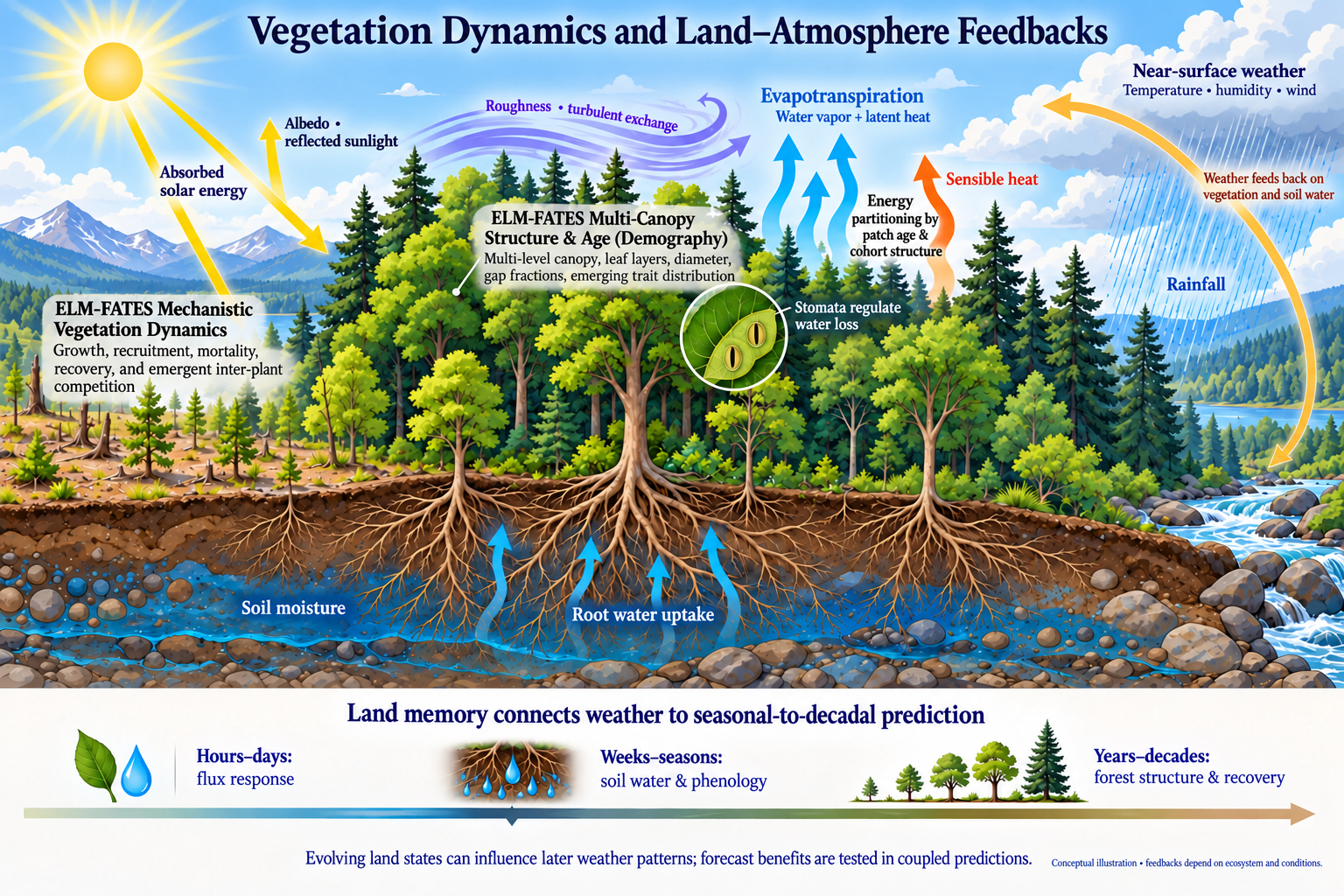
Figure 2. Vegetation dynamics and land-atmosphere feedbacks that are important for seasonal-to-decadal predictions. Generated by ChatGPT.
ELM-FATES provides a mechanistic process-based way to test whether representing vegetation demography and disturbance history improves the initial land state and its active, emergent response to seasonal change. For example, simulations can examine whether recent fire, windthrow, harvest, drought-related mortality, or post-disturbance regrowth changes the predictability of surface fluxes and near-surface conditions relative to a configuration with prescribed vegetation.
A central science question is:
“What are the relative contributions of terrestrial processes to predictability over land through local land–atmosphere interactions versus land-induced remote teleconnections?”
ELM-FATES can help address this question through coordinated coupled-ensemble experiments that separate local and remote pathways. For local effects, it is possible to compare hindcasts with contrasting land states or vegetation-process configurations and quantify changes in surface energy and water fluxes, soil moisture, canopy structure, and near-surface weather skill over and downwind of the perturbed land region. For remote effects, test whether land-driven anomalies—such as those associated with abrupt disturbance, vegetation recovery, or shoulder season changes in evapotranspiration—produce reproducible atmospheric circulation responses and skill changes in distant regions. Paired experiments, ensembles, and process diagnostics would help distinguish land-forced signals from internal atmospheric variability and from oceanic or other boundary-condition influences.
Next Steps for E3SM and Land Modeling
- Close the remaining gaps between all land features and ELM-FATES such as running with crops, irrigation, river modeling, and radiation downscaling so we can establish a production-ready globally calibrated model with process-by-process benchmarking.
- Move to fully coupled E3SM testing with emergent demographic and disturbance processes active.
- Use coupled experiments to test how emergent vegetation dynamics and demography alter surface fluxes, land–atmosphere interactions, and other Earth-system components.
- Set performance and process-level evaluations relative to the current ELM, to track and asses the addition of ELM-FATES in the v5 release.
Related Floating Points stories:
Contact
- Jennifer Holm, Lawrence Berkeley National Laboratory
This article is a part of the E3SM “Floating Points” Newsletter, to read the full Newsletter check:
- E3SM Floating Points, Nov ’26: New Emulators for Exploring Earth System Change
