

Field-based Canopy Gradients in Leaf Respiration Improve Canopy Structure in the ELM-FATES Demography Model
By updating model assumptions to align with field observations, scientists reduced bias in simulated forest dynamics.
The Science

Figure 1. Schematic of leaf layer carbon balance. See text for description. Note that leaf area index (LAI) is the independent variable and leaf carbon flux is the dependent variable. | Image courtesy of Jessica Needham, Lawrence Berkeley National Laboratory (LBNL).
Around half of all carbon that plants take up through photosynthesis is released back to the atmosphere by plant respiration. Despite its importance as a major component of the carbon cycle, most Earth system models represent plant respiration very simply. Leaf area index (LAI), a measure of the amount of leaf area in the forest canopy per unit ground area, is an important forest attribute, driving exchanges of carbon, water and energy between the land and atmosphere through impacts on photosynthesis and evapotranspiration. A high LAI indicates a deeper point in the canopy (towards the ground). The carbon balance at a particular LAI is the leaf carbon flux of photosynthesis minus the leaf carbon flux of leaf construction and respiration. In Figure 1, this can be interpreted as the horizontal distance between the photosynthesis curve (blue) and the construction+respiration curve (solid green). For high LAI (bottom of the plot; low in the canopy), the carbon flux of construction+respiration is higher, meaning the carbon balance is negative. For low LAI (top of the plot; high in the canopy), the carbon flux of photosynthesis is higher, meaning the carbon balance is positive. The LAI where the carbon fluxes intersect (i.e., carbon absorbed for photosynthesis equals the carbon used for leaf construction and respiration) is the LAI of maximum net canopy carbon balance (i.e., the canopy is providing the maximum amount of carbon to the rest of the plant, for use in growth). This intersection point moves lower in the canopy (towards higher LAI) as the canopy gradient of leaf maintenance respiration (Rdark) becomes steeper (i.e., when respiration decreases rapidly as LAI increases; dashed green).
The Impact
By updating model assumptions based on field observations, scientists were able to improve global modeled LAI using a demographic, dynamic vegetation model. This will further the understanding of the role of forest structure in the Earth system over the coming decades.
Summary
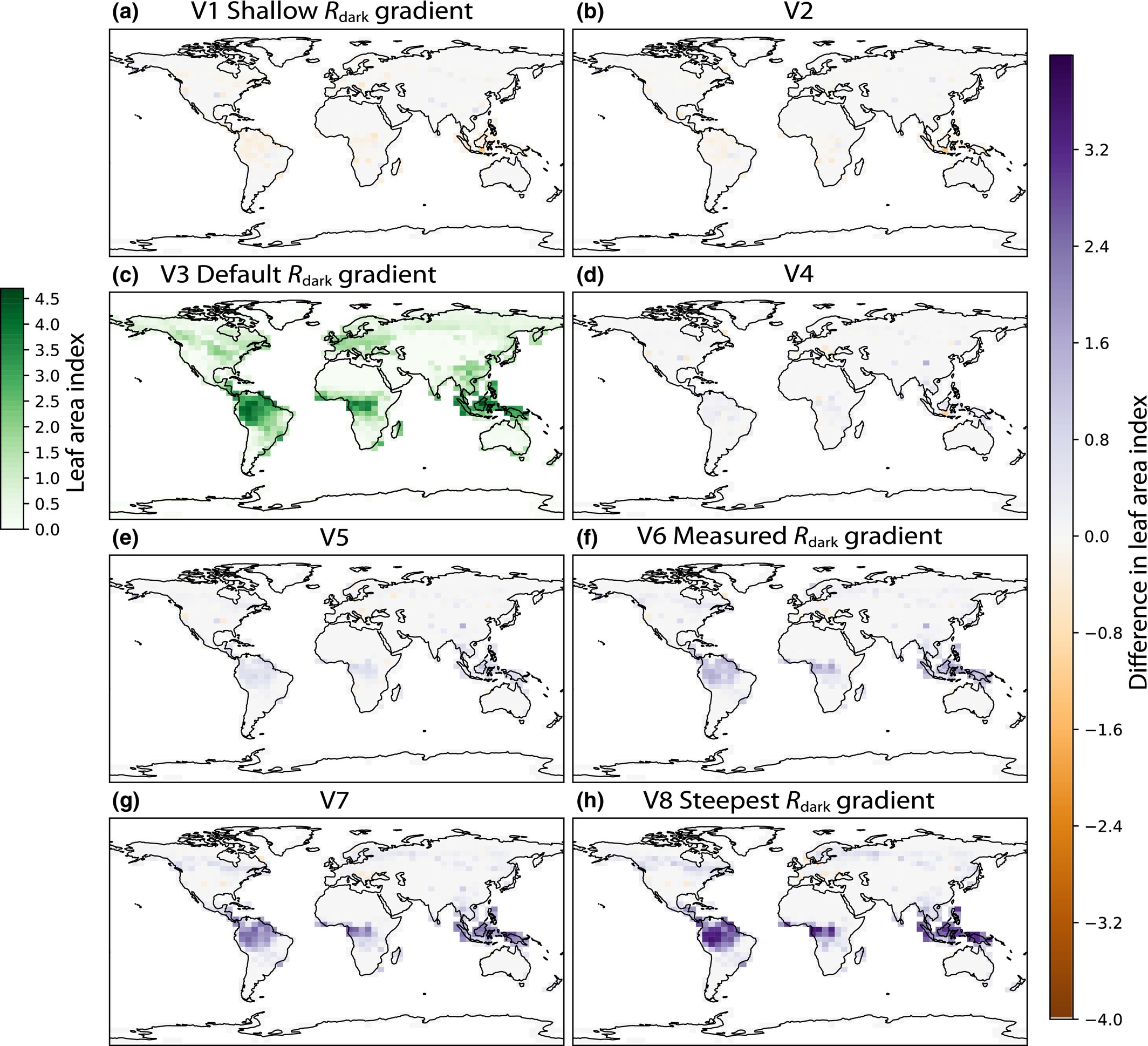
Figure 2. Effects of leaf maintenance respiration (Rdark) vertical gradients on LAI in ELM-FATES. V3 (which is distinct from E3SMv3) is the default simulation in ELM-FATES in which leaf maintenance respiration (Rdark) and maximum rate of carboxylation (Vcmax) are proportional through the canopy. The V3 panel shows the absolute values of leaf area index (LAI). Remaining panels show the difference between a given simulation and this default . (a) V1 and (b) V2 have less steep gradients of Rdark compared with the default (c). The canopy gradients of Rdark in (d) V4, (e) V5, (f) V6, (g) V7, and (h) V8 get progressively steeper. Purple indicates that a given simulation had higher LAI than the default simulation (V3), whereas orange indicates lower LAI than the default simulation (V3).
Scientists from the E3SM and Next-Generation Ecosystem Experiments Tropics (NGEE-T) projects updated the E3SM Land Model-Functionally Assembled Terrestrial Ecosystem Simulator (ELM-FATES) model to align with observations of vertical gradients in leaf respiration, specifically how respiration changes from sunlit leaves at the top of the canopy to shaded leaves deep in the forest understory, based on measurements from a field site in Panama. In ELM-FATES, leaves in negative carbon balance get removed. When respiration has a steeper canopy gradient and is lower in the understory, leaves deeper in the canopy remain in positive carbon balance (Fig. 1, Fig. 2). As a result, plants grow more leaves, which increases simulated rates of photosynthesis and evapotranspiration. Global simulations with the updated model were a better match to observations of forest structure. The updated parameterization of ELM-FATES led to an increased number of understory plants, and higher leaf area index, both of which improved alignment of simulations with ground and satellite observations.
Publication
- Needham, J. F., et al, “Vertical Canopy Gradients of Respiration Drive Plant Carbon Budgets and Leaf Area Index.” New Phytologist, (2025). [DOI: 10.1111/NPH.20423]
Funding
- This research was supported as part of the Next Generation Ecosystem Experiments-Tropics, funded by the U.S. Department of Energy, Office of Science, Office of Biological and Environmental Research and with partial support from the Energy Exascale Earth System Model (E3SM) project, funded by the U.S. Department of Energy, Office of Science, Office of Biological and Environmental Research Earth Systems Model Development Program area of Earth and Environmental System Modeling. LBNL is managed and operated by the Regents of the University of California under prime contract number DEAC02-05CH11231. R.F. also acknowledges support of the EU Horizon2020.
Contact
- Jessica Needham, Lawrence Berkeley National Laboratory
