

FATES (Functionally Assembled Terrestrial Ecosystem Simulator) Progress and Update
Key Point:
FATES (Functionally Assembled Terrestrial Ecosystem Simulator) brings plant demography via cohort based vegetation and time-since-disturbance patches, including trait-based competition, dynamic biogeography and explicit disturbance/recovery processes into E3SM’s land model, enabling more realistic and testable projections of ecosystem structure and carbon–Earth system feedbacks — particularly for disturbance-dominated and complex, heterogeneous systems.
Overview:
E3SM’s land model (ELM) is central to predicting land–atmosphere fluxes, ecosystem carbon and water stocks, and the biogeophysical feedbacks that control multi-decadal projections. However, ELM broadly represents vegetation as static plant functional types (PFTs) with single average properties. This simpler representation limits the model’s ability to capture demographic structure, successional change, disturbance sensitivity, trait-mediated competition, and emergent biogeography — all of which influence carbon, water and energy exchange on ecological timescales relevant to multi-decadal projections. The FATES model, embedded in ELM, introduces next-generation approaches that explicitly represent vegetation composition, size/age structure, and trait diversity to reduce large structural uncertainties in land-water-atmosphere projections.

Figure 1. Conceptual overview of ELM-FATES, with the FATES mechanistic processes contained in the green and light brown shading, which is embedded in the ELM land surface model. ELM-FATES represents multiple plant functional types (PFTs) of varying age and size structure, multi-layered canopies dynamically competing with each other, leading to differences in vegetation turnover, and energy, water, and carbon cycling. C,N,P stands for carbon, nitrogen, phosphorus cycling.
What is FATES?
FATES is a cohort-based (i.e., grouping plants into “cohorts” based on similar size and functional type rather than individual plants), vegetation demography module which runs inside the E3SM Land Model, ELM (Fig. 1). Key features include explicit cohorts that represent size and age classes rather than a single averaged canopy (i.e., vegetation demography). Trait-based, emergent competition in which PFTs are parameterized by traits and compete for light, water, and nutrients with dynamic recruitment, growth, and mortality rates. Thus community composition emerges from competition and disturbance. With the inclusion of patch-tiling disturbances can be represented (e.g., fire, hurricane, logging, stress-related mortality, land-use change) with post-disturbance specific recovery. Dynamic biogeography and succession which allows range shifts and successional transitions across environmental gradients and after disturbances. FATES is designed in a modular format so that multiple processes can be included or excluded. For example, nutrient dynamics, phenology and fine-root optimization frameworks have been developed to improve C–N interactions and nutrient-limited responses.

Figure 2. Schematic showing major differences of wood harvest between (a) sun-shade canopy land surface model (e.g., ELM) and (b) Functionally Assembled Terrestrial Ecosystem Simulator (FATES). Only a clear-cut wood harvest approach within a specific fraction of the gridcell is depicted. FATES is able to create a new secondary patch after the wood harvest of the primary patch and trace the demographic information of each patch separately. Illustration by Jeremy Snyder, Lawrence Berkeley National Laboratory.
Recent Accomplishments:
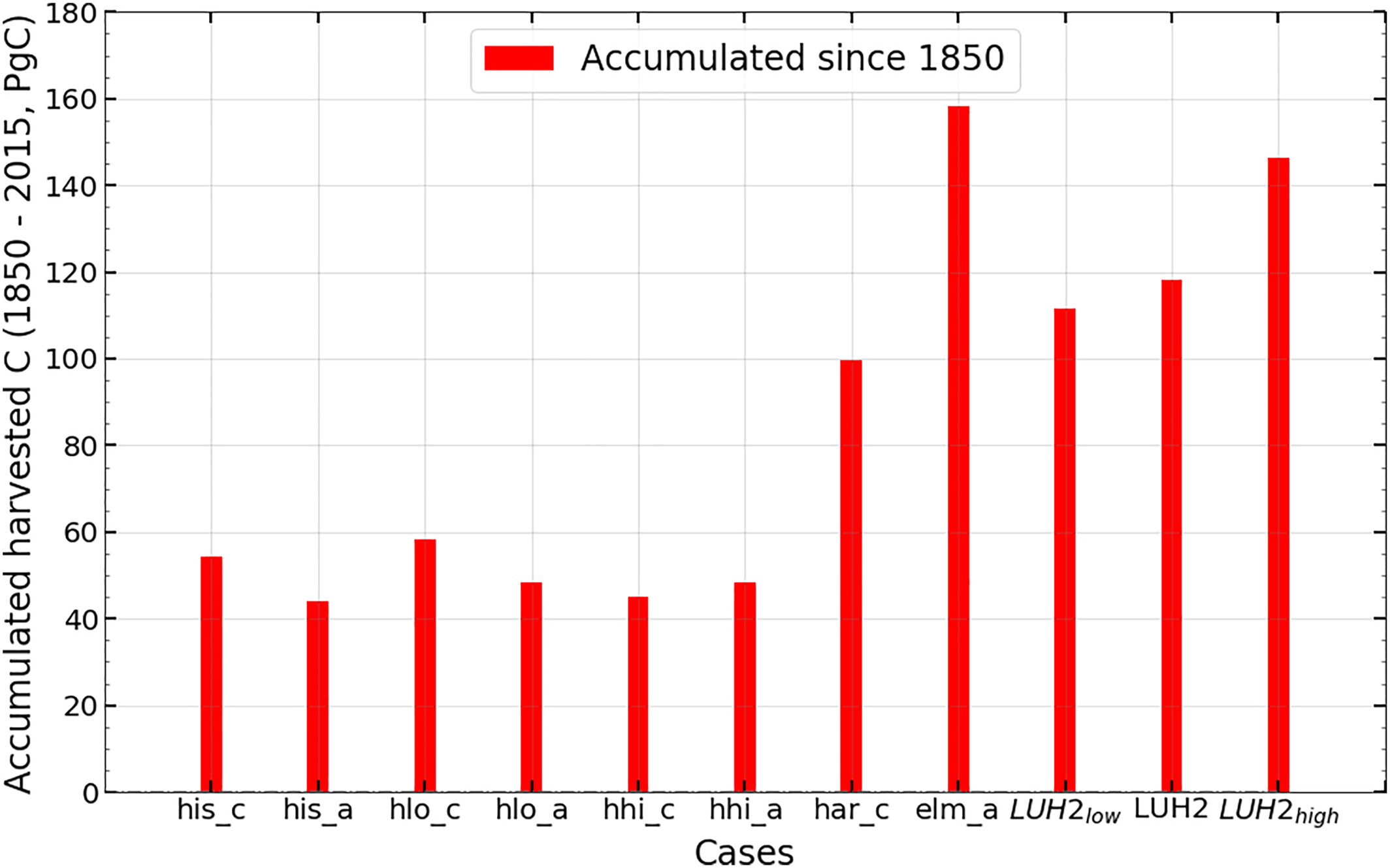
Figure 3. Historically harvested carbon since 1850 from eight modeled harvesting scenarios compared to three Land Use Harmonization v2 (LUH2) data sets. ELM-FATES was tested under different scenarios of harvesting (historical=his, low=hlo, or high=hhi harvesting), using either area-based vs. carbon-based harvesting (_a vs. _c), and the final harmonized carbon-based harvest (har_c), all compared to ELM-only area-based harvesting (elm_a).
Global application of FATES’ vegetation demography framework is able to play a crucial role in many scientific topics. For example quantifying the effects of wood harvesting on land surface properties, since the model takes into account the size, mass, and abundance of trees. Wood harvesting is a significant land use activity that affects the local environment, but its cumulative impact on the Earth’s global biogeophysical interactions is not well understood. The removal of trees through harvesting methods disrupts the land surface, altering physical properties like albedo, canopy coverage, and surface roughness (Fig. 2). This, in turn, influences local and regional weather patterns, but the magnitude and extent of these effects are unclear. Shu et al. (2025) found when FATES is forced with a reharmonized mass-based harvest dataset, the model’s accumulated harvested carbon closely aligns with the Land Use Harmonization 2 (LUH2) benchmark. By contrast, using an area-based harvest rate (i.e. specifying the fraction of area harvested, without the spatial harmonization) leads to ~50 % lower accumulated harvested carbon in FATES relative to the reharmonized mass-based case (Fig. 3). ELM-only overestimated harvested carbon compared to LUH2, yet its corresponding biogeophysical responses (e.g. changes in surface albedo, energy flux partitioning) were weaker than FATES. ELM’s stronger carbon removal was not matched by equally strong impacts on surface energy balance—suggesting that the demographic structure (patch-level gaps, canopy heterogeneity) in FATES allows more pronounced albedo or flux responses per unit harvest.
As noted in the August newsletter, sensitivity testing of global ELM-FATES simulations concluded that steeper canopy gradients of leaf respiration lead to increased understory survival and leaf biomass, which better matches observations and improves low biases in leaf area index (LAI) and understory canopy. Results show the importance of canopy gradients in leaf traits and fluxes for determining plant carbon budgets and emergent ecosystem properties such as competitive dynamics, LAI, and vegetation carbon (Needham et al. 2025).
Through a strong partnership with Department of Energy’s Next Generation Ecosystem Experiment – Tropics (NGEE-Tropics), many advancements to FATES have been made and thus incorporated into E3SM for application. For example, ELM-FATES has been extended to simulate canopy damage, defoliation, biomass reduction and mortality due to disturbances, such as hurricanes. Representations of hurricane disturbances were tested with ensemble simulations in Puerto Rican forests and evaluated against long-term forest observations to identify controls on post-hurricane recovery. Capturing the long-term forest canopy dynamics after both high and low-intensity hurricane disturbances is crucial for simulating dynamic forest recovery (Shi et al. 2025). FATES development through partnerships (also including NGEE-Arctic) demonstrates both mechanistic disturbance representation and provides workflows for model–data evaluation that can be utilized for testbed application in E3SM.
The team is actively testing, tuning, and analyzing the nutrient-enabled functionality (carbon-nitrogen-phosphorus) of ELM-FATES, and building upon previous work that optimized root uptake processes by integrating site-level measurements to constrain and test nutrient dynamics (Knox et al. 2024). These developments improve predictions where nutrients limit carbon uptake and change allocation/respiration tradeoffs.
Examples of other recent studies have shown FATES’ ability to capture links between fire disturbance regimes and fire management, allowing emergent patterns of vegetation composition and structure. Such work (Hanbury-Brown et al. 2025), conducted in California’s Sierra Nevada shows FATES predicted that thinning and fuel reduction treatments can help dry conifer forests persist in the short to medium term by delaying conifer loss, but they cannot prevent a long-term shift toward oak-dominated forests under changing temperatures and precipitation. This indicates that dry mixed conifer forests in California will be a carbon source under 2.5 °C of global mean warming in the late 21st century regardless of management.
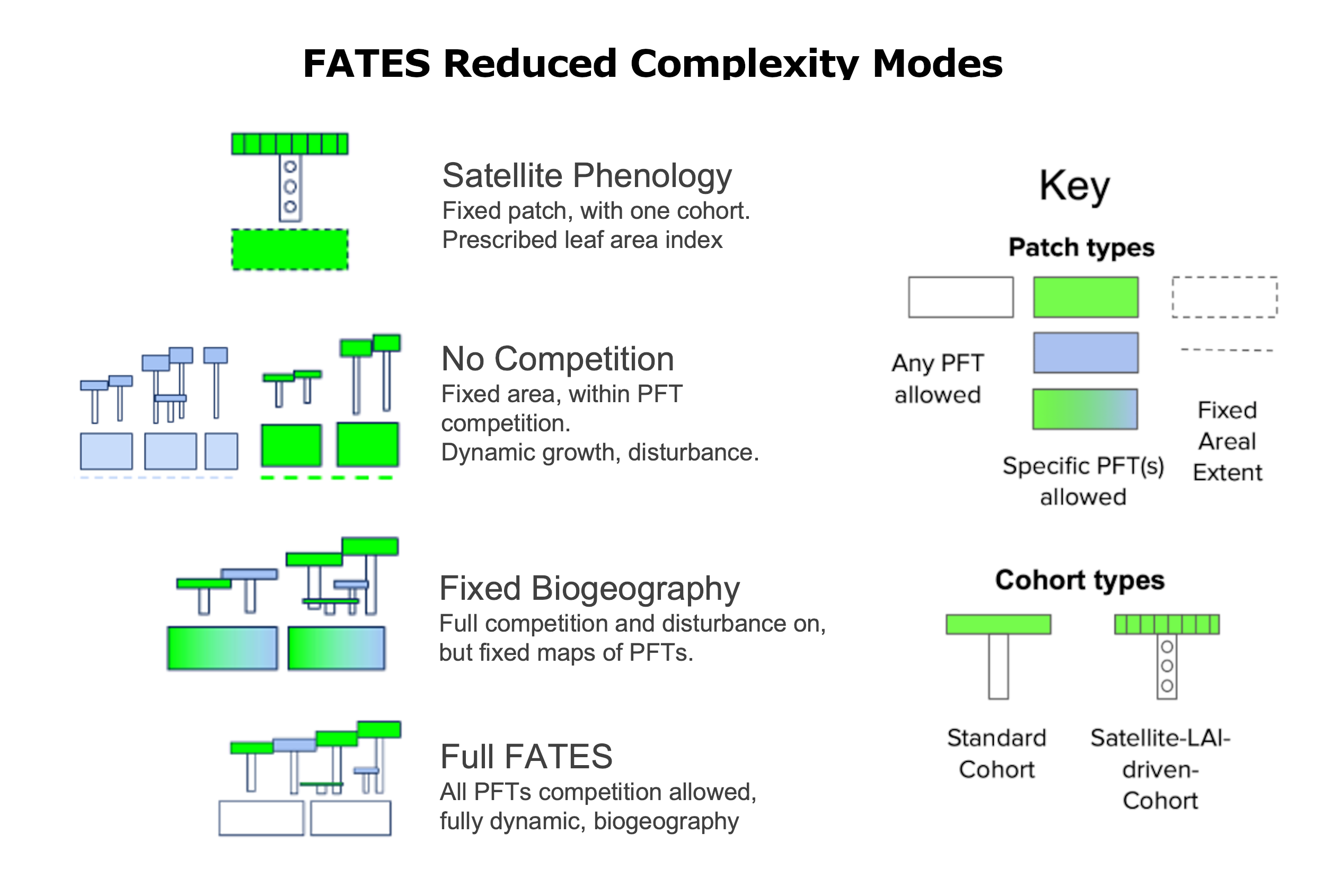
Figure 4. Visual representation of four reduced complexity modes that are available within FATES for various science testing capabilities. Each increasing in mechanistic complexity, such as introducing disturbance, dynamic growth, mortality, competition, and dynamic biogeography, and increasing feedbacks between model processes. Illustration by Charlie Koven, Lawrence Berkeley National Laboratory.
Integrating FATES into E3SM’s land model (ELM) yields traceable improvements and ecological realism. For example, more realistic carbon dynamics and stocks can be achieved due to cohort demography and size structure enabling explicit simulation of growth, mortality, and turnover (Fig. 4) — improving representation of biomass accumulation and turnover rates, which reduces bias in regional carbon budgets.
FATES can simulate transient responses (crown damage, mortality, recruitment) and recovery trajectories that affect carbon fluxes and albedo — important for capturing short-term environmental feedbacks after extreme events and dynamic responses to disturbances.
Trait-based competition produces emergent shifts in PFT abundance and range — enabling better projections of biome shifts under warming than static PFT methods. This changes long-term carbon and hydrology projections. Emergent vegetation distribution based on trait – tradeoff change will help to advance E3SM’s predictability of ecosystem change.
FATES is well positioned to be a robust model-data testbed, because the modeled cohort outputs (size distributions, age classes, cohort-level fluxes) align naturally with forest inventory, chronosequence and flux-tower datasets, enabling richer, mechanistic evaluation and targeted parameter constraint workflows.
Next Steps for E3SM FATES
To simplify experimentation, debugging, calibration, and hierarchical coupling into E3SM, FATES has a modular design to offers several “reduced complexity” configurations (e.g. Static Stand Structure, Prescribed Physiology, FATES-SP, no-competition modes, etc.) (Fig. 4). These modes essentially constrain or prescribe certain structural dynamics (e.g., patch dynamics, plant competition, physiology, dynamic biogeography) so that one can isolate particular processes or incrementally progress FATES integration into E3SM. Both the E3SM’s and wider FATES’ team members are utilizing the reduced complexity modes during global parameter calibration (e.g. tuning photosynthetic parameters, respiration, allocation fractions) because fewer interacting feedbacks mean more stable and interpretable responses. This also allow for “hierarchical calibration”, for example calibrating physiology under a simplified structure, then gradually free up more complexity (competition, dynamic vegetation) and refine tuning further.
On-going work is to finalize the calibration of global ELM-FATES simulations with the remaining modular functionally sequentially turned-on and calibrated one at a time. Examples include calibration and benchmarking of plant-soil nutrient competition, land-use land-cover change, and testing soil-plant-atmosphere interactions under various resolutions, as well as coupled with other ELM configurations (i.e., topographic downscaling, dynamic crops, GCAM interfacing). Future plans are to fine-tune the required steps for integration into E3SM v4.1 for human Earth system science capabilities. Efficient integration will rely in the continued strong partnership with ecosystem partners NGEE-Tropics and NGEE-Arctic, but also need more emphasis on coupled testing in E3SM to be successful.
