

E3SM Seasonal-to-Decadal (S2D) Prediction Effort – A Pilot Study
Key Points
- A collaborative effort between E3SM, Regional and Global Modeling and Analysis (RGMA)’s WACCEM/CATALYST, and other DOE ecosystem projects.
- A year-long pilot study with E3SMv3.LR, building up the E3SM S2D hindcast workflow and testing three initialization methods, including the “brute force”, FOSIRL, and weakly coupled data assimilation.
- 10-member ensemble seasonal-to-decadal hindcasts from 1960 to 2015+, driven by CMIP6 historical forcing.
Introduction
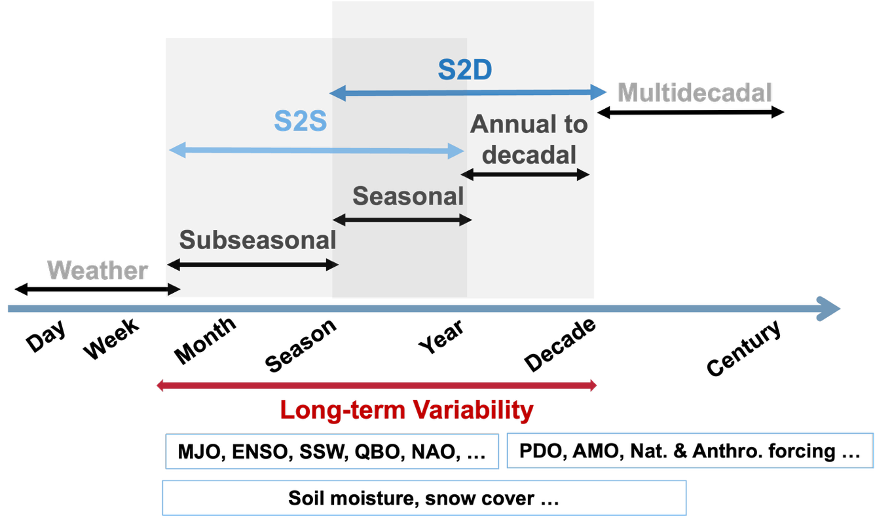
Figure 1. Forecasting timescale and key sources of predictability on target timescale. S2S refers to subseasonal-to-seasonal whereas S2D refers to seasonal-to-decadal. The boxes in the lower section of the figure describe modes of variability at the given scales. Madden-Julian Oscillation (MJO), El Niño-Southern Oscillation (ENSO), Sudden Stratospheric Warming (SSW), Quasi-Biennial Oscillation (QBO), North Atlantic Oscillation (NAO), Pacific Decadal Oscillation (PDO), Atlantic Multi-decadal Oscillation (AMO), natural and anthropogenic forcing.
Seasonal-to-Decadal (S2D) prediction offers critical information for decision-makers in weather-sensitive sectors such as energy, water, agriculture, and health. DOE mission needs for information on the environments and extreme events to support energy security and energy infrastructure planning span timescales ranging from sub-seasonal to multi-decadal (Fig. 1). However, such timescales fall in the transition zone between weather, which is primarily driven by initial conditions, and long-term environmental changes, which is influenced by boundary conditions. To address predictability at these timescales and develop skillful S2D predictions, E3SM has recently launched a pilot study to conclude at the end of 2026 to build up the workflow for E3SM S2D hindcast, with the long-term goal to further enhance S2D predictability with its next-generation models.
Research Plan
Given computational resource limitations, the pilot study uses E3SMv3.LR (“low-resolution”) with 100km resolution for the atmosphere model (EAMv3), 20-30km resolution for ocean and sea ice (MPAS-O), and 50km for land and river (ELM-MOSART) to build up the E3SM S2D workflow. It starts with an initial assessment of E3SM predictability on the timescale of seasonal to interannual. In this step, an ensemble of 2-yr hindcasts initialized twice a year in May and November, from 1980 to 2015, with 10 ensemble members, will be conducted with CMIP6 historical forcing, allowing comparison with previous hindcasts performed with CESM2 and E3SMv2 by CATALYST. Three initialization methods will be tested. The goal is to understand their impacts on E3SM S2D prediction skill to inform a suitable initialization procedure for skillful E3SM S2D predictions. The three initialization methods include (1) “Brute force” that initializes each component using reanalysis; (2) “Forced Ocean, Sea-ice, River, and Land (FOSIRL)” that runs ocean, sea ice, river, and land models offline with reanalysis atmospheric forcing to provide initial conditions; and (3) “weakly coupled Data Assimilation (DA) system (4DEnVAR)” that generates initial conditions from fully coupled E3SMv3 simulations in which reanalysis land and ocean states are continuously assimilated into the model. The next step is to extend the hindcasts to cover the decadal scale, which will be 10-yr hindcasts initialized once a year, either in May or November, with the selected initialization method, from 1960 to 2015 or later.
Through these efforts, the workflow and infrastructure to streamline S2D hindcast runs will be established and tested based on the codes and scripts developed from WACCEM/CATALYST project. E3SM S2D diagnostics will be developed by enhancing the community S2D standard metrics with a specific focus on E3SM-interested phenomena such as extreme events. The goal is to identify gaps and needs for further development with E3SMv4 (~13km atm, ~10km ocean and sea ice, and 3km over land regions) in Phase 4, which will also extensively explore Artificial Intelligence and Machine Learning (AI/ML) techniques with a particular focus on supporting DA, emulator, and bias correction.
Science questions
The E3SM S2D effort will answer the following science questions:
- How does the E3SM S2D prediction skill depend on the initialization methods and the initial states?
- Which modes of long-term variability and initial state variables are most critical for skillful S2D predictions using E3SM?
- To what extent does E3SM S2D prediction accurately capture environmental conditions and phenomena (e.g., extreme events) relevant to energy and water resources across different regions and timescales?
A new E3SM S2D group has been created with initial team members including Shaocheng Xie (Lead, LLNL), Ruby Leung (Lead, PNNL), Luke Van Roekel (LANL), Wuyin Lin (BNL), Qi Tang (LLNL), Shixuan Zhang (PNNL), Sha Feng (PNNL), and Darin Domeau (LANL). A close collaboration between E3SM and WACCEM/CATALYST projects on S2D is being established. The new S2D group and this pilot study will enable E3SM to develop its capabilities in the shorter timescale projections and fulfill the DOE mission needs in this area.
