

E3SM v3 Overview Paper on the Atmosphere Model (EAMv3.LR)
Key Takeaways
- EAMv3.LR (low-resolution) broadens the application of and realism of E3SM with major developments in the chemistry, aerosol, microphysics, and convection schemes
- Reduction in the aerosol radiative forcing help to resolve biases in the variation of global surface air temperature
- Various modes of variability (Quasi-Biennial Oscillation, Madden Julian Oscillation, and diurnal cycle of precipitation) are improved in EAMv3.LR.
Introduction
The overview manuscript of the atmosphere model of the Energy Exascale Earth System Model version 3 was recently published in JAMES, as part of a series of articles on E3SMv3, including the overview of the Coupled model system. The model builds on more than five years of developments, which started after the completion of E3SMv1 and aimed to enhance E3SM’s ability to reproduce historical changes of the Earth system and predict its response to future perturbations by improving the coupling of aerosol, atmospheric chemistry, and biogeochemistry and by ameliorating major model shortcoming seen in EAMv1.
What’s new in EAMv3?
EAMv3 represents the largest update in the atmospheric physics since the creation of EAMv1, and the changes are numerous; major developments went into the chemistry, aerosol, microphysics, and convection schemes and included an increase in the vertical layers from 72 to 80. The number of transported tracers was also increased from 40 to 82.
Enhancements in chemistry and aerosol processes
The new interactive troposphere-stratosphere gas chemistry module (Tang et al., 2025) enables simulations of ozone, methane, and nitrous oxide based on emission scenarios. Various updates in the aerosol-related processes now also allow for the prognostic treatment of stratospheric sulfate aerosols (Hu et al., 2025; Ke et al., 2025), an improved treatment of secondary organic aerosol (SOA) (Lou et al., 2020; Shrivastava et al., 2015), an improved dust emission scheme (Kok et al., 2014), an improved aerosol wet removal treatment in the convective microphysics (Shan et al., 2024), and an improved coupling between surface emissions and turbulent mixing (Wan et al., 2024). EAMv3 also includes the explicit treatment of nitrate and ammonium aerosols (Wu et al., 2022), although it is not turned on by default for computational performance reasons. All of these updates combined broaden the application of E3SM to study the Earth system response to both historical and future emission scenarios.
The full list of the new features and their impacts on the simulated dynamic, thermodynamic, radiative, and hydrologic state of the atmosphere (mean state) are summarized below (based on Table 6 of the article):
- chemUCI + Linoz v3 – Enables interactive tropospheric chemistry and enhances stratospheric chemistry. Improves simulation of Antarctic ozone hole, stratospheric water vapor, tropospheric ozone and radicals, and greenhouse gas radiative forcing. Minor impact on global mean state.
- 5‐mode version of the Modal Aerosol Module with Prognostic Stratospheric Aerosol (MAM5-PSA) – Enables prognostic sulfate aerosol from explosive volcanic eruptions. Improves stratospheric sulfate aerosol and its radiative effects. Minor impact on the troposphere.
- Model for Simulating Aerosol Interactions and Chemistry (MOSAIC) – Adds capability for simulating nitrate aerosol and its radiative forcing (for research only; not part of default configuration due to high computational cost). Minor impact on global mean state.
- Volatility Basis Set approach for Secondary Organic Aerosol (VBS SOA) – Improves aerosol optical depth (AOD) in dust-influenced regions; enhances ice nucleation for polar mixed-phase clouds and iron nutrient supply to oceans. Minor impact on global mean state.
- Improved aerosol wet removal – Reduces excessive aerosol burden and AOD, particularly sulfate, as well as overly strong aerosol direct and indirect forcing seen in EAMv2.
- Enhanced coupling of aerosol processes – Addresses earlier issues of excessive dust dry removal, short dust lifetime, and high sensitivity to vertical resolution. Has negligible impact on global mean state after re-tuning of dust and sea salt emission factors.
- Predicted Particle Properties scheme in E3SM (P3E) – Impacts clouds and precipitation. Generally enhances cloud radiative forcing over tropical and subtropical oceans and weakens it in the high latitudes. Improves low-cloud fraction, cold-phase cloud properties, and frequency of heavy precipitation rates, and reduces aerosol forcing.
- Convective cloud microphysics – Enables a more sophisticated microphysics treatment in the deep convective scheme. Strengthens tropical variability, improves phase of diurnal cycle of precipitation, and improves mean state precipitation. Increases aerosol forcing (negative impact) and makes the trade wind cumulus region more reflective.
- Multiscale Coherent Structure Parameterization (MCSP) – Represents the heating impacts of mesoscale convective systems that are not represented in models with ∼100 km grid spacing. Strengthens tropical variability.
- Cloud base mass flux adjustment – Represents the dynamical impacts of the large-scale circulation on deep convection. Strengthens tropical variability and improves diurnal cycle of precipitation.
- Increased vertical resolution – Improves simulation of the QBO.
Reduced aerosol radiative forcing
A major bias plaguing previous versions of E3SM has been the strong cooling response in E3SM to anthropogenic aerosols. As noted in the E3SMv3 Coupled Overview paper, this has been significantly improved in E3SMv3, mostly due to changes made in EAMv3. These changes now bring E3SMv3 in closer agreement to community best estimates of aerosol effective radiative forcing (ERF). While many changes, have contributed to muted aerosol response (see Table 5 of the article), the increase in the minimum cloud droplet limiter, the increases in dimethyl sulfide (DMS) emissions, the new SOA scheme, and adjustments to the autoconversion exponent are major contributors to reducing EAMv3’s ERF.
Improved variability
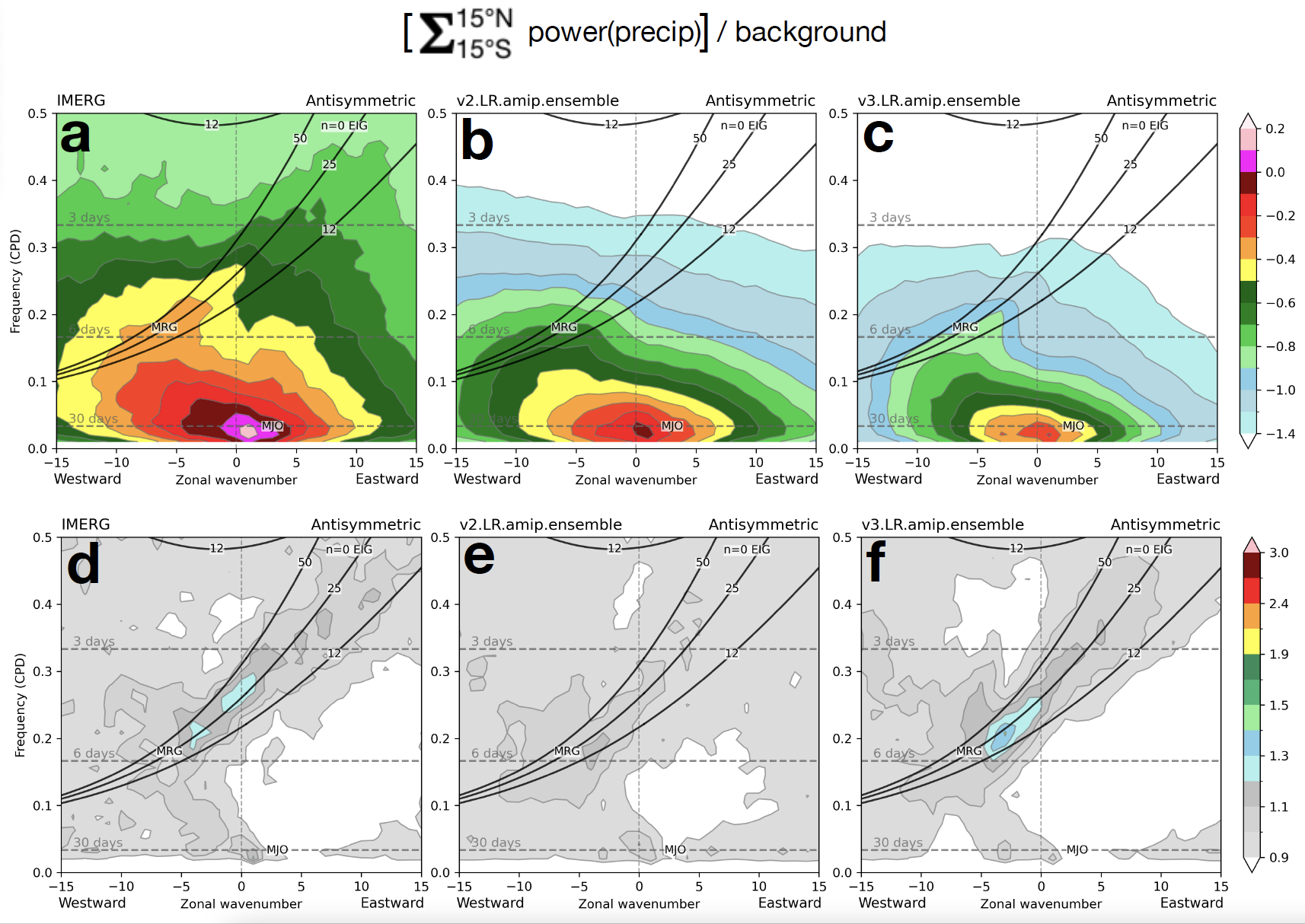
Figure 1. Power spectra in zonal wavenumber-frequency space of the component of precipitation that is symmetric about the Equator. Non-normalized power values are shown on the top row, with power values normalized by a smoothed background spectra on the bottom row, for (a,d) IMERG observation-based precipitation estimates, (b,e) E3SMv2, and (c,f) E3SMv3. Listed disturbance types include: Kelvin waves (“Kelvin”), equatorial Rossby waves (“n=1 ER”), the Madden-Julian oscillation (“MJO”), and westward (n=1 “WIG”) and eastward (“n=1 EIG”) inertia-gravity waves, where n is the meridional mode number. Note the stronger signal of MJO and Kelvin waves in the EAMv3, compared with EAMv2.
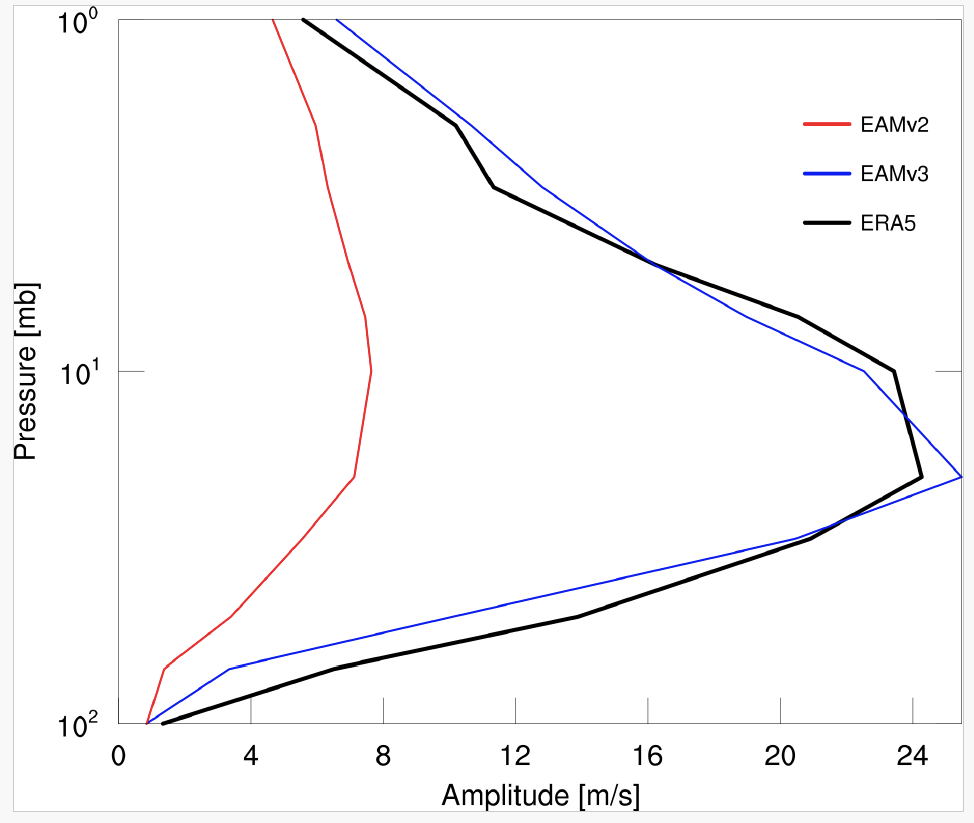
Figure 2. QBO amplitude profile derived from the power spectra of the equatorial mean (5°S-5°N) zonal wind calculated for periods between 20 and 40 months for ERA5 (black), EAMv2 (red), and EAMv3 (blue).
While previous versions of E3SM, particularly E3SMv2, showed good skill in capturing the mean-state atmosphere, one area that previous versions struggled was atmospheric variability. With the combination of the new microphysics scheme and convection enhancements, EAMv3 improves on a number of those modes of variability, including the diurnal cycle of precipitation, the Madden Julian Oscillation, and other modes of variability (e.g., Kelvin waves) (Terai et al., 2025) (Fig. 1f compared with Fig. 1e). Furthermore, by refining the vertical resolution around the lower stratosphere and retuning the convectively-generated gravity wave drag parameterization, EAMv3 now has a much-improved representation of the Quasi-Biennial Oscillation (QBO) (Yu et al., 2025) (Fig. 2).
Broader Impacts and Future Direction
EAMv3 represents a major update to the atmosphere component of E3SM, expanding the science applications and reducing long-standing biases. It will be exciting to see how the enhanced capabilities of EAMv3 can be used to answer new science questions and to help with Earth system predictions.
With work ongoing to finalize the ~0.25 degree, high-resolution configuration of EAMv3 and work started for the next version of the atmosphere model, which will be based on the atmosphere model written in C++ (EAMxx) with a target horizontal resolution of 13-km, the 100-km version of EAMv3 sets a high bar for future versions of the model to improve upon.
Paper Reference
- Xie, S., Terai, C. R., Wang, H., Tang, Q., Fan, J., Burrows, S., et al. (2025). The Energy Exascale Earth System Model version 3: 1. Overview of the atmospheric component. Journal of Advances in Modeling Earth Systems, 17, e2025MS005120. https://doi.org/10.1029/2025MS005120.
