

Bringing It All Together: Finalizing the E3SMv3 High-Resolution Coupled Configuration
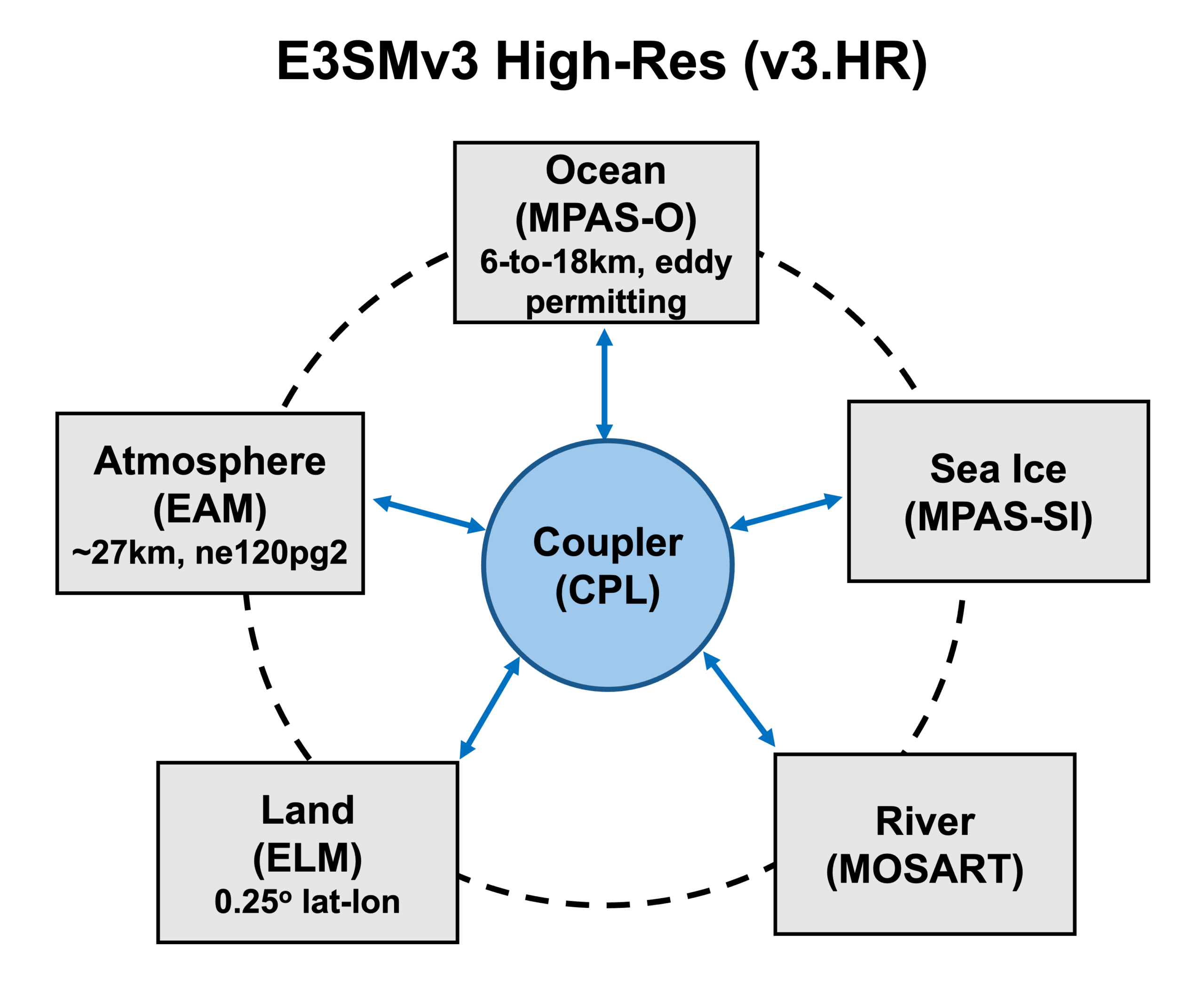
Figure 1. Schematic diagram of the v3.HR components
E3SM’s high-resolution coupled configuration (v3.HR) has been finalized, marking a major milestone toward achieving more realistic simulations of the coupled Earth system. Pending satisfactory spin-up simulation, the current model configuration will be the v3.HR release. Building on the low-resolution baseline (v3.LR), v3.HR sharpens the model’s view of key processes — from equatorial waves to western boundary currents — while improving numerical coupling and conservation (Fig. 1). The result is a configuration better equipped to capture extremes and regional patterns that influence impacts and risk.
Why High Resolution Matters
Higher resolution brings two key advantages. First, it better resolves extreme events — such as atmospheric rivers, mesoscale convective systems, and tropical cyclones—leading to more realistic intensity and spatial patterns. Second, it enhances ocean–(sea ice)–atmosphere coupling, improving sea-surface temperature (SST) patterns and variability that strongly influence regional extremes.
What Changed from v3.LR
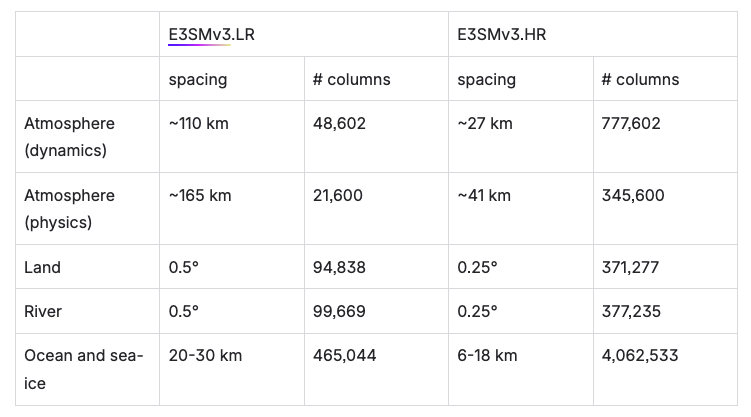
Model resolution was increased across all components (Table below). The atmosphere resolution increases from ~110 km (ne30pg2) to ~27 km (ne120pg2), the ocean and sea-ice from 20-30 km to 6-18 km and the land and river from 0.5° to 0.25°.
Atmosphere (~27 km, ne120pg2). A new orographic wave-drag scheme, deactivated deep-convection mass-flux adjustment, and a dust-emission cap were introduced alongside targeted tunings to address resolution-driven instabilities.
Ocean & sea ice (6–18 km, eddy-permitting). The ocean now uses biharmonic instead of Laplacian viscosity, allowing sharper eddies and fronts. A tighter coupling method and shorter barotropic time step improve stability. A frozen runoff mapping file (with tropical spreading) and a new sea-ice congelation freezing method enhance mass budgets and ice formation.
Land & river (0.25°). Updates include hexagonal snow-grain shape and a 1-hour runoff coupling interval to reduce the model biases.
Coupler. Non-linear mapping is now enabled for atm→lnd and atm→ocn,ice, improving precipitable-water mass conservation—an important step toward tighter energy and water-budget closure at high resolution.
Early Results
- Mean climatology & circulation. v3.HR improves large-scale circulation compared to v3.LR due to the higher resolution. With additional tuning, v3.HR captures more realistic features such as the Quasi-Biennial Oscillation (QBO) and a more plausible global dust distribution compared with earlier E3SM HR versions.
- Atlantic biases & overturning. Long-standing North Atlantic biases are greatly reduced, as are SST biases in the California upwelling region and off West Africa. Eddy-resolving currents strengthen the Atlantic Meridional Overturning Circulation (AMOC), improving northward heat transport in both hemispheres.
- Sea-ice behavior. Sea-ice deformation is more realistic, though grid aliasing remains a challenge and motivates further algorithmic Elastic-Viscous-Plastic (EVP) improvements.
- Throughput. The configuration achieves about 2.1 simulated years per day (SYPD) using 225 nodes on Chrysalis, which is sufficient to enable the v3.HR simulation campaign.
Known Challenges
Not everything improves at higher resolution. The model still produces excess sea ice east of Greenland and maintains a summer warm bias over mid-latitude continents. Continued work on land–ocean–sea-ice coupling is needed to fully eliminate negative runoff and unrealistic sea-ice buildup.
Looking Ahead
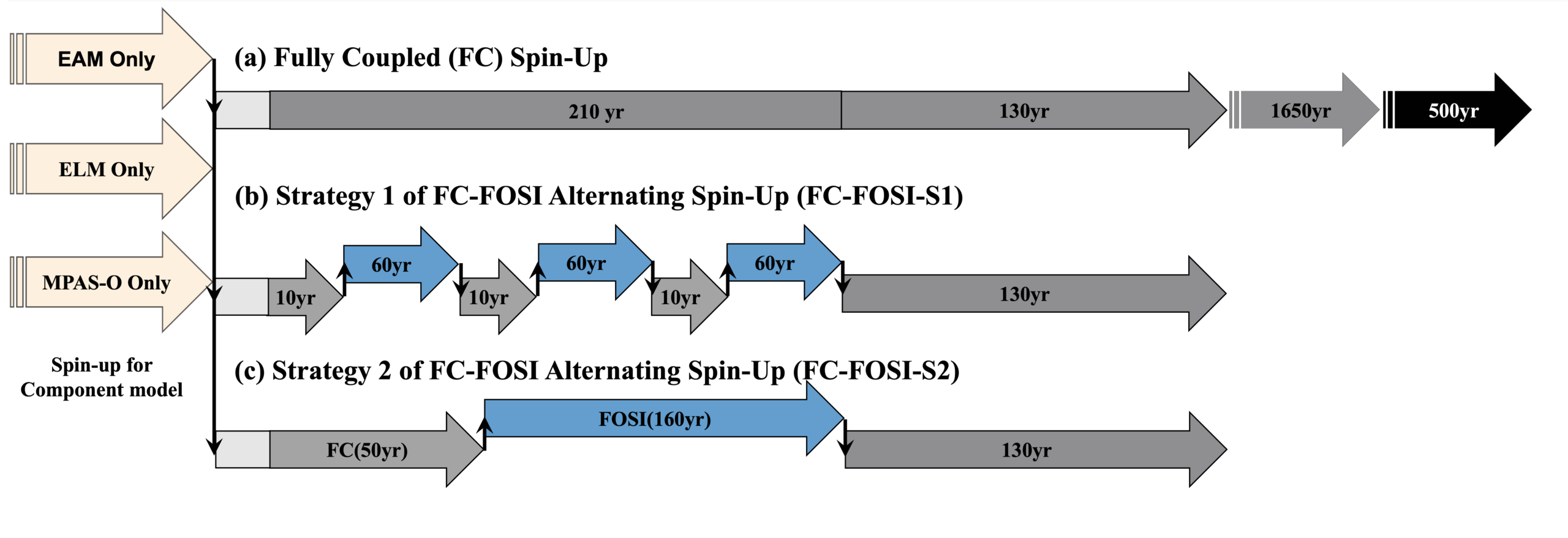
Figure 2. Schematic of spin-up approaches: (a) standard continuous fully coupled (FC) configuration, (b) v3.HR spin-up configuration alternating between FC segments (gray arrows) and forced ocean–sea ice (FOSI) segments with different simulation periods (Figure Courtesy of Shixuan Zhang).
With the finalization of v3.HR, E3SM is poised to deliver high-resolution coupled simulations that better capture extremes, SST structures, and large-scale circulation. The v3.HR coupled simulation campaign will include the pre-industrial control (piControl) simulation and historical simulations. To speed equilibration for the upcoming v3.HR coupled simulation campaign, the piControl spin-up will alternate between long, computationally efficient standalone-ocean segments and short, fully coupled segments (Fig. 2b-c). This hybrid approach accelerates oceanic adjustment while preserving coupled feedbacks. Building on the lessons learned, the team is well prepared for the upcoming simulation campaign and the development of the next-generation v4 high-resolution model.
