

v3 LR overview paper
Key Points
- E3SMv3.LR represents a significant scientific and technical advancement across atmosphere, ocean, sea ice, land, and river components, including a new tri-grid configuration, resulting in more accurate and reliable simulations.
- The E3SMv3.LR resolves critical historical biases by successfully addressing the bias in global surface air temperatures and accurately capturing observed positive trends in ocean heat content.
- E3SMv3.LR enhances capabilities for Earth system modeling and provides a more robust tool for Department of Energy (DOE) research and science applications.
Introduction
A manuscript describing the coupled system of the Energy Exascale Earth System Model version 3 at lower resolution (E3SMv3.LR) was submitted to the Journal of Advances in Modeling Earth Systems (JAMES) on June 19, 2025 (preprint available at https://doi.org/10.22541/essoar.175097464.44666291/v1). This is a part of a series of manuscripts describing various aspects of E3SMv3.LR in the fully coupled setting. Another manuscript focusing on the Atmosphere component was also previously submitted to JAMES in April (preprint available at https://doi.org/10.22541/essoar.174456922.21825772/v1).
E3SMv3.LR represents a major step forward in simulating the interactions between the atmosphere, oceans, sea ice, land, and river systems. This latest model version introduces significant scientific and technical advances, resulting in more accurate simulations and a more reliable model for predictions and projections.
Key Improvements in E3SMv3
E3SMv3 builds on the foundation of previous versions with substantial updates across all major components. The atmospheric model now features improved chemistry, aerosol-cloud interactions, convection, and microphysics, while the ocean component benefits from a higher-resolution mesh and improved time-stepping. The sea ice model incorporates advanced snow and ice physics, and the land model now simulates dynamic vegetation growth and better accounts for the effects of topography on solar radiation. Notably, E3SMv3 introduces a new tri-grid configuration, harmonizing the grids used by the land and river components for more precise process coupling.
These changes are not just technical upgrades—they enable the model to capture key processes with greater fidelity.
Resolving the “Pothole Cooling” Problem
One of the most significant achievements in E3SMv3 is the resolution of the long-standing “pothole cooling” bias. In previous versions, the model simulated an unrealistic cooling trend in global and especially northern hemisphere surface air temperatures during the mid-20th century, primarily due to an overestimation of aerosol-induced cooling. This problem limited the reliability of historical reconstructions and hindered confidence in future projections. Figure 1 demonstrates the dramatic improvement: E3SMv3’s simulation of global, northern, and southern hemisphere surface air temperature anomalies from 1850 to 2024 now closely matches the observational record (HadCRUT5). The previous versions (E3SMv1 and v2) exhibited a pronounced cold bias, especially from 1960 to 1990. By refining the treatment of aerosols and their radiative effects, E3SMv3 has largely eliminated this discrepancy, bringing the model into much closer agreement with observed historical trends.
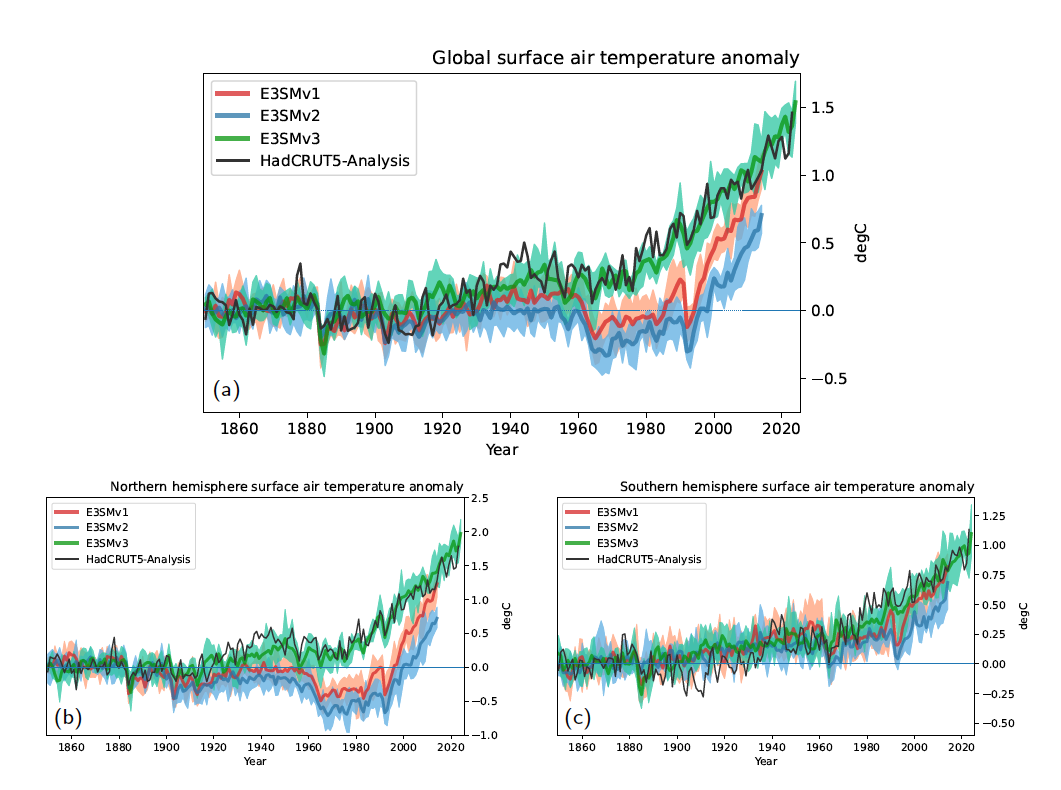
Figure 1: Annual surface air temperature anomalies for E3SMv1, v2, v3, and observations
Improved Ocean Heat Content Trends

Figure 2: Annual ocean heat content anomalies for E3SMv2, v3, and NOAA observations
The benefits of these improvements extend below the surface. Excessive aerosol cooling in earlier models also led to unrealistic trends in ocean heat content. As shown in Figure 2, E3SMv3 now accurately captures the observed positive trend in ocean heat content at both 0–700 m and 0–2000 m depths. In contrast, E3SMv2 showed flat or even negative trends during the historical period, diverging from National Oceanic and Atmospheric Administration (NOAA) observational data. The improved agreement in E3SMv3 demonstrates the model’s enhanced ability to represent the accumulation of heat in the world’s oceans—a critical factor in understanding sea level change, marine ecosystems, and long-term changes.
Broader Impacts and Future Directions
E3SMv3’s advances are the result of a comprehensive development and evaluation effort by a large team of scientists as evidenced by the 78 co-authors as well as significant investments in computational infrastructure as evidenced by the more than 5,000 years of simulation across pre-industrial, idealized, and historical scenarios.
The model’s improved fidelity in reproducing historical temperature and ocean heat content trends will benefit a wide range of Department of Energy (DOE) research and science applications. Additionally, E3SMv3’s new capabilities lay the groundwork for future research, including a 25-member large ensemble of historical and near future (to 2050) that will be the subject of a third overview manuscript. The project is also finalizing a higher-resolution configuration of E3SMv3.
Beyond E3SMv3, the project is preparing for a transition to a Exascale ready code base, ensuring that E3SM remains at the forefront of Earth system modeling as computing technology evolves. (See details for E3SM’s ongoing activities and future plan in previous edition of Floating Points).
Conclusion
E3SMv3 marks a major milestone for the E3SM project, offering a more robust and accurate tool for Earth system modeling in support of DOE’s mission to provide enhanced predictions for energy and national security. The project is excited to see what the broader E3SM community will use this model for and the exciting results.
