

E3SM v3.2 tag
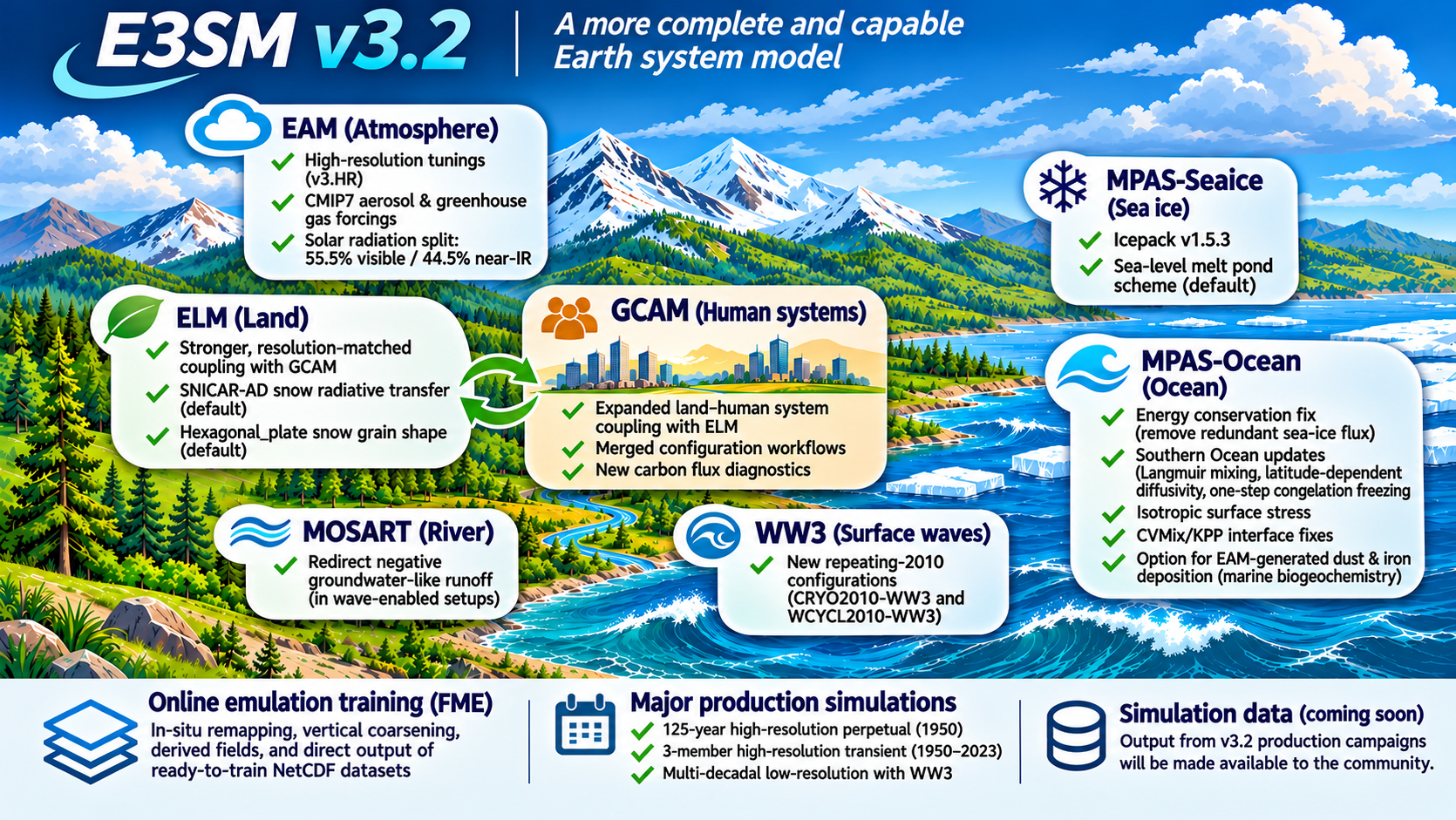
Generated with ChatGPT.
The E3SM Project has tagged E3SM version 3.2 of its source code. While technically an incremental release following v3.0 (and the intermediate v3.1), version 3.2 delivers substantial scientific and technical advances including finalized default configurations and tunings for the high-resolution coupled model (v3.HR), key answer-changing physical improvements in the ocean and sea-ice components, expanded coupling with human systems and ocean surface waves, and an innovative online processing pipeline for outputting training data for emulators.
Resolutions and grids
Version 3.2 provides the supported coupled high-resolution (HR) configuration of version 3 of E3SM, incorporating finalized atmosphere and ocean parameter tunings along with updated CMIP7-based HR aerosol and greenhouse gas forcings for both 1950 control and 1950–2023 transient simulations. The v3.HR configuration consists of:
- Atmosphere on
ne120pg2: A grid on the sphere is made by projecting the square grids of a cube’s six faces onto it (“cubed sphere”). There are 120 elements (ne120) along each cube edge – 30x more than in the low-resolution configuration (v3.LR). For dynamics, nodes (points) within each element are on average 25km apart – 4x closer than in v3.LR. The physics grid remains unchanged from v3.LR: each elements is divided into a 2×2 finite-volume grid (pg2). - Land and river on
r025: Regular 0.25° lat-lon grid. - Ocean and sea ice on
RRSwISC6to18E3r5: Rossby Radius Scaling (RRS) is used, meaning the mesh is finer toward the poles and coarser near the equator. Cell size ranges from about 6 km to about 18 km (6to18). This differs from v3.LR’s use of a subdivided icosahedron, giving a quasi-uniform Voronoi mesh with a nominal resolution of 30km. Unchanged from v3.LR: the E3SM v3 generation of the mesh (E3), revision 5 (r5) is used, and it includes the ocean under Antarctic ice shelves (wISC“with ice shelf cavities”).
Users interested in low resolution (ne30pg2) should continue to use v3.0 (from the maint-3.0 branch).
New features per component
The sea-ice model (MPAS-Seaice) received major updates that alter the simulation answers relative to v3.0. MPAS-Seaice now incorporates the Icepack v1.5.3 physics library and switches to the sea-level melt pond scheme by default.
The ocean model (MPAS-Ocean) includes an energy conservation fix: the removal of a redundant sea-ice enthalpy flux term that affected all configurations with active ocean and sea ice. Additionally, refined Southern Ocean grid configurations now feature Langmuir mixing, latitude-dependent background diffusivity, and one-step congelation freezing as defaults. Since v3.0, the ocean has added isotropic surface stress, fixes to the CVMix/KPP interface (the link between the ocean model and the community library, CVMix, that calculates how the upper ocean is stirred by wind and surface heating, using a method called K-Profile Parameterization), and the option to use E3SM Atmosphere Model (EAM)-generated dust and iron deposition in marine biogeochemistry runs.
In the atmosphere, EAM, the high-resolution tunings are available by default as well as updated CMIP7 forcings for HR. The split between visible and near-infrared solar radiation was changed from even to 55.5/44.5.
Version 3.2 of ELM significantly advances coupling with the human system model (GCAM), introducing resolution-matched configurations to the land grid, merged configuration workflows, and new carbon flux diagnostics. ELM also made SNICAR-AD the default snow radiative transfer scheme, with hexagonal_plate as the default snow grain shape. The river model, MOSART, includes targeted adjustments to redirect negative groundwater-like runoff in wave-enabled setups.
Coupled capabilities expanded further with the inclusion of new repeating-2010 configurations featuring the WAVEWATCH III (WW3) surface wave model (CRYO2010-WW3 and WCYCL2010-WW3, for cryosphere and water cycle configurations respectively). The performance of WW3 in v3.2 has been dramatically improved, running at twice the speed on one third the number of processors.
Output for Emulators
To support the rapid rise of machine learning (ML) in Earth system modeling, v3.2 introduces online processing for Full Model Emulation (FME) training. Several components (EAM, ELM, MOSART, MPAS-Ocean and MPAS-Seaice) can now perform horizontal lat-lon remapping, vertical coarsening, derived field calculation, and direct output of ready-to-train NetCDF datasets while the simulation runs on exascale hardware, eliminating significant post-processing bottlenecks.
Simulation campaigns
With v3.2 finalized, the project is launching several major production simulation campaigns:
- A high-resolution 125-year perpetual 1950 coupled simulation.
- A three-member high-resolution transient ensemble spanning 1950 to 2023.
- A 200-year low-resolution coupled simulation incorporating the WW3 wave model.
Simulation data will be made available to the wider scientific community via E3SM Data Docs.
The project has created a maintenance branch in the repository, maint-3.2, which will receive machine updates and critical bug fixes. E3SM users wishing to run v3.2 should check out this branch. There will be one more release in the v3 series (v3.3). v4.0 is planned for release in early 2028.
Related stories
Contact
- Robert Jacob, Argonne National Laboratory
This article is a part of the E3SM “Floating Points” Newsletter, to read the full Newsletter check:
- E3SM Floating Points, Nov ’26: New Emulators for Exploring Earth System Change
