

Understanding Biases in E3SMv3 Cloud Radiative Effects
Key Points:
- Excessive Shortwave Cloud Radiative Effect (SWCRE) is mainly due to overestimated optically intermediate low clouds over tropical and subtropical oceans, the Southern Ocean, and Northern Hemisphere storm tracks (Fig. 1).
- Excessive Longwave Cloud Radiative Effect (LWCRE) over tropical convection regions results from overestimated high clouds and its increase in bias relative to E3SMv2 is primarily associated with optically thin high clouds.
- The new P3 stratiform-cloud scheme accounts for most of the cloud changes, while the new double-moment microphysical scheme for convective clouds increased intermediate-thick low and optically thin tropical clouds relative to E3SMv2.
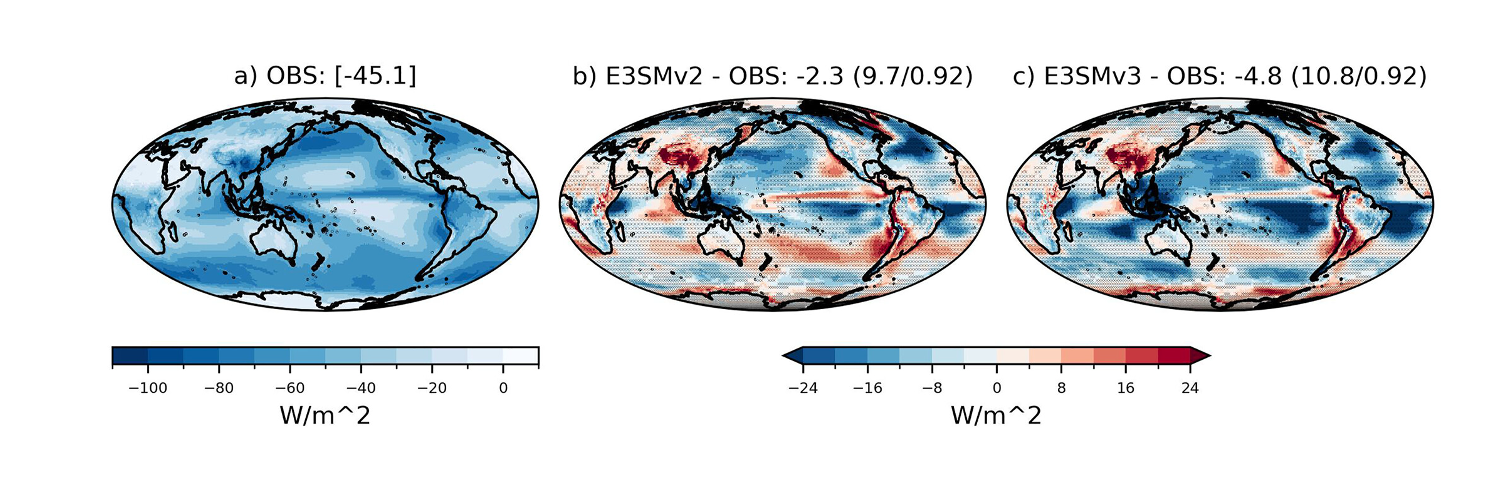
Figure 1. Maps of annual mean SWCRE for a) CERES, and differences b) between E3SMv2 and CERES, c) between E3SMv3 and CERES. In a), the global annual mean of SWCRE is reported in brackets. In b) and c), the global annual mean bias, followed by the RMSE and correlation coefficient in parentheses, is reported for the SWCRE difference between model and observation. The regions with cross marks denote the differences between E3SMv2 and v3 are statistically significant at the 95% confidence level. The observational data used is from 2000-2024 from CERES_EBAF_Ed4.2
Background
Clouds influence how much energy enters and leaves the Earth system. Incoming sunlight is in the form of shortwave (SW) radiation, some of which is reflected back to space by clouds, whereas energy emitted by the Earth’s surface and atmosphere is in the form of longwave (LW) radiation.
Scientists describe the energy impacts of clouds using cloud radiative forcing or effect (CRE), which measures the difference of net radiative flux (e.g., watts per square meter) between all-sky (with clouds) and clear-sky (without clouds) conditions. Measured at the top of the atmosphere (TOA), the Shortwave Cloud Radiative Effect (SWCRE) represents the change in reflected and absorbed solar energy associated with clouds and is typically negative, indicating a cooling effect. The Longwave Cloud Radiative Effect (LWCRE) represents the change in outgoing longwave energy associated with clouds and is typically positive, indicating a warming effect.
One factor affecting CRE is optical depth or thickness, often denoted by the Greek letter τ, which provides a means of measuring how difficult it is for radiation to pass through a cloud. Optically thin clouds (low τ) transmit most radiation, while optically thick clouds (high τ) reflect or absorb most of it.
Cloud altitude is another factor. Because temperature generally decreases with height in the troposphere, higher clouds are much colder than lower clouds. As a result, high clouds emit less LW energy to space than the warmer surface would emit, allowing them to trap more outgoing LW energy than low clouds do. Altitude has less influence on how much sunlight a cloud reflects, which depends mainly on its optical thickness. So, a high cloud and low cloud with similar optical thickness may reflect a similar amount of SW energy but the high cloud would trap more LW energy, and therefore has a more warming net effect than the low cloud.
Table 1 shows a summary of these two factors on CRE.
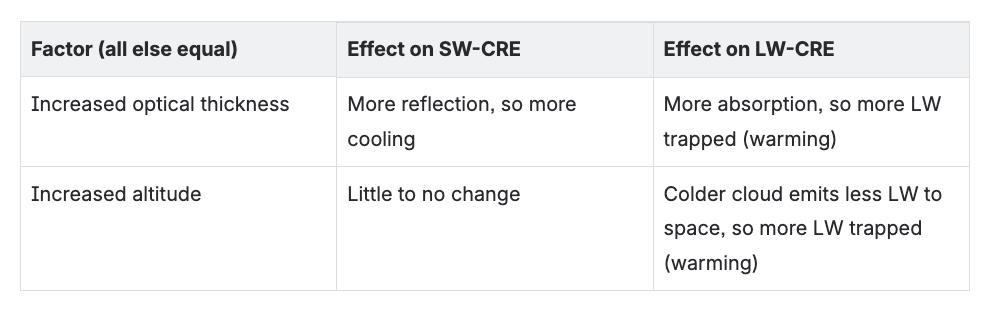
Table 1. Effect of factors on CRE.
Introduction
While E3SMv3 substantially improves simulations of tropical variability (such as ENSO and MJO) and historical global temperature trends (Terai et al. 2025, Xie et al. 2025, Golaz et al. 2026), its cloud and cloud-radiative-effect simulations show limited improvement relative to E3SMv2 and observations.
The model produces excessive SWCRE over tropical and subtropical oceans, the Southern Ocean, and Northern Hemisphere storm tracks, as can be seen in Figure 1, where these regions have lower negative (larger in absolute value) irradiances indicating too much SW energy is being reflected back. It also produces a larger positive LWCRE bias over the Maritime Continent and other tropical convective regions, indicating too much LW energy is being trapped.
The study examines the sources of these biases using observations from passive satellite sensors, including ISCCP, MODIS, and MISR, and the active sensor CALIPSO by utilizing the COSP satellite simulator package, which enables more accurate comparisons between model clouds and satellite data by simulating what a satellite would see if the model data were actually being observed. A cloud-radiative-kernel analysis (Zelinka, et al. 2012) is also used to further assess how cloud-property biases affect radiation.
What Causes the Excessively Strong Cloud Radiative Effects?
The excessive SWCRE in E3SMv3 is primarily caused by an overestimate of low clouds, particularly optically intermediate low clouds as indicated by MISR observations (Fig. 3). These clouds strongly reflect incoming SW radiation. Their spatial distribution closely matches the model’s negative SWCRE bias, indicating that they are a major contributor to the excessive effect.
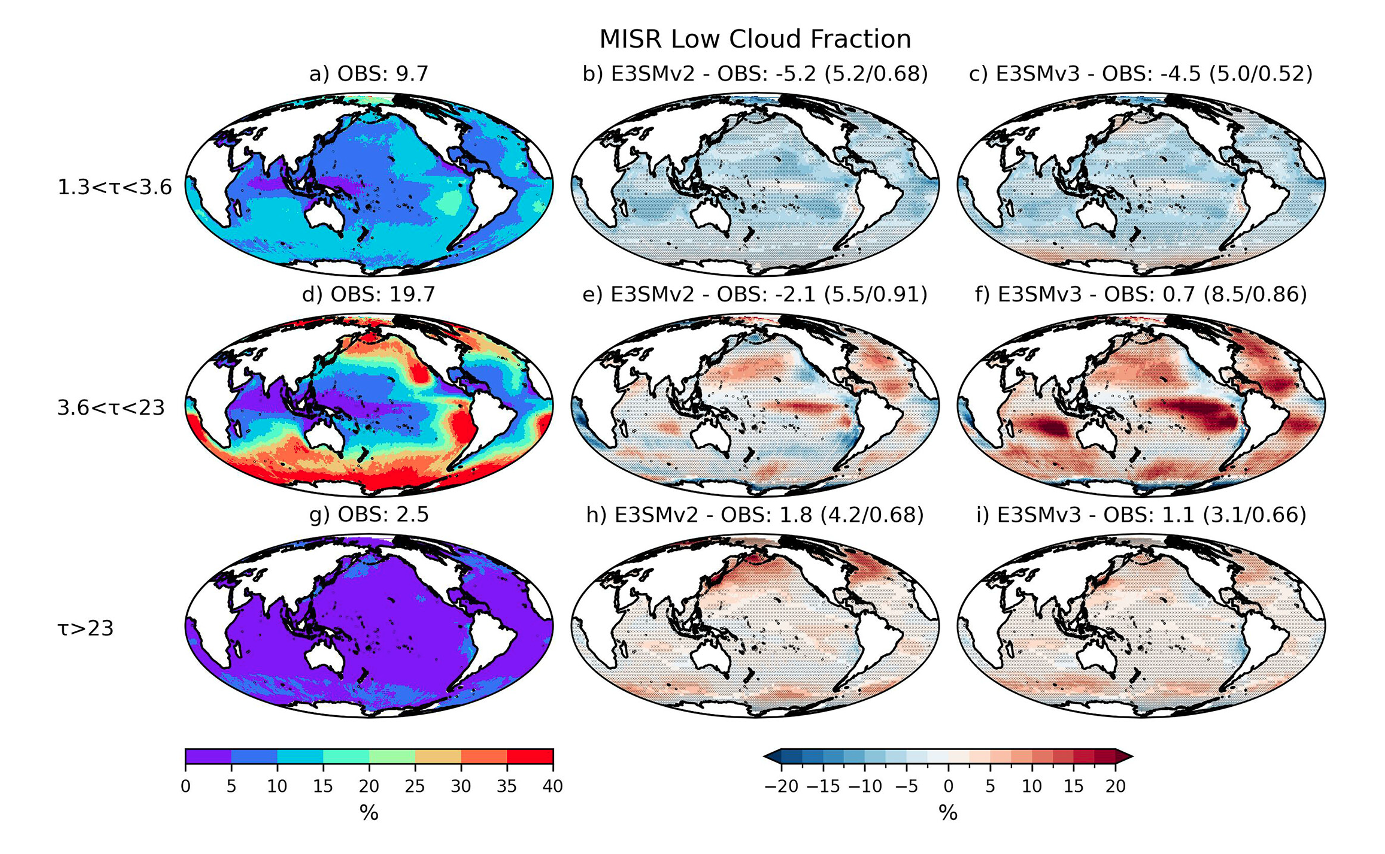
Figure 3. Maps of MISR low-topped optically thin (top row, 1.3< τ <3.6), intermediate thickness (middle row, 3.6< τ <23) clouds and thick (bottom row, τ > 23) clouds. In the left column, a), d), g), are MISR observations (OBS). In the middle column, b), e), h), are the differences between E3SMv2 and OBS. In the right column, c), f), i), are the differences between E3SMv3 and OBS. The number after each panel name is the global annual mean of cloud fraction for observations (left column) or the global annual mean bias along with the RMSE and correlation coefficient (in parentheses) for cloud fraction differences (middle and right columns). The regions with cross marks denote the differences between E3SMv2 and v3 are statistically significant at the 95% confidence level.
Excessive LWCRE over the Maritime Continent and other tropical convective regions is associated with an overestimate of high clouds, which trap LW radiation. Although E3SMv3 overestimates optically thick clouds compared with MODIS observations, its increase in bias relative to E3SMv2 is primarily associated with optically thin high clouds.
The analysis indicates that updates to stratiform and convective cloud microphysics contribute substantially to the changes in SWCRE and LWCRE. The new P3 stratiform-cloud scheme (Shan et al. 2024) substantially increased high-cloud cover and ice water content at low latitudes, which is the primary cause of the excessive LWCRE over the Maritime Continent and other tropical convective regions while the double-moment convective microphysical scheme (Song et al. 2025) increases intermediate-thick low and optically thin tropical clouds relative to E3SMv2.
Future Direction
Excessive SWCRE remains a persistent challenge across E3SM model versions. Continued improvements in cloud formation, microphysics, and convection are needed to better represent these processes in the model. Improving cloud microphysical properties could reduce biases in cloud optical thickness and radiative effects, while reducing the intensity and frequency of deep tropical convection may reduce excess high clouds and improve LWCRE. These improvements would support more realistic simulations of cloud distributions, radiation budgets, tropical variability, and Earth system response.
Paper Reference
- Zhang, Y., Xie, S., Terai, C. R., Lin, W., Golaz, J.-C., Chao, L.-W., et al. (2026). Understanding biases in simulated Cloud radiative effects in E3SMv3. Earth and Space Science, 13, e2025EA004757. https://doi.org/10.1029/2025EA004757.
Contact
- Yuying Zhang, Lawrence Livermore National Laboratory
- Shaocheng Xie, Lawrence Livermore National Laboratory
This article is a part of the E3SM “Floating Points” Newsletter, to read the full Newsletter check:
