

New Aerosol Treatments Improve Earth System Modeling
E3SM version 3 expanded aerosol physics and chemistry capabilities, resulting in improved simulations of organic particles, dust, volcanic sulfate, nitrate, and ammonium.
The Science
Airborne particles affect how much sunlight Earth absorbs and how clouds form, but their many sources, chemical changes, and removal pathways make them difficult to represent in Earth system models. Earlier versions of the Energy Exascale Earth System Model (E3SM) simplified or omitted several important particle types and processes. For example, the Modal Aerosol Module (MAM) originally grouped aerosol species into four distinct modes (Aitken, Accumulation, Coarse, and Primary-carbon), with an optional simple treatment of volcanic sulfate aerosols by including them in the Coarse mode. Using this four-mode scheme, about six months after the 1991 Mount Pinatubo eruption, the modeled volcanic sulfate lifetime begins to decline faster than observations (Fig. 1).
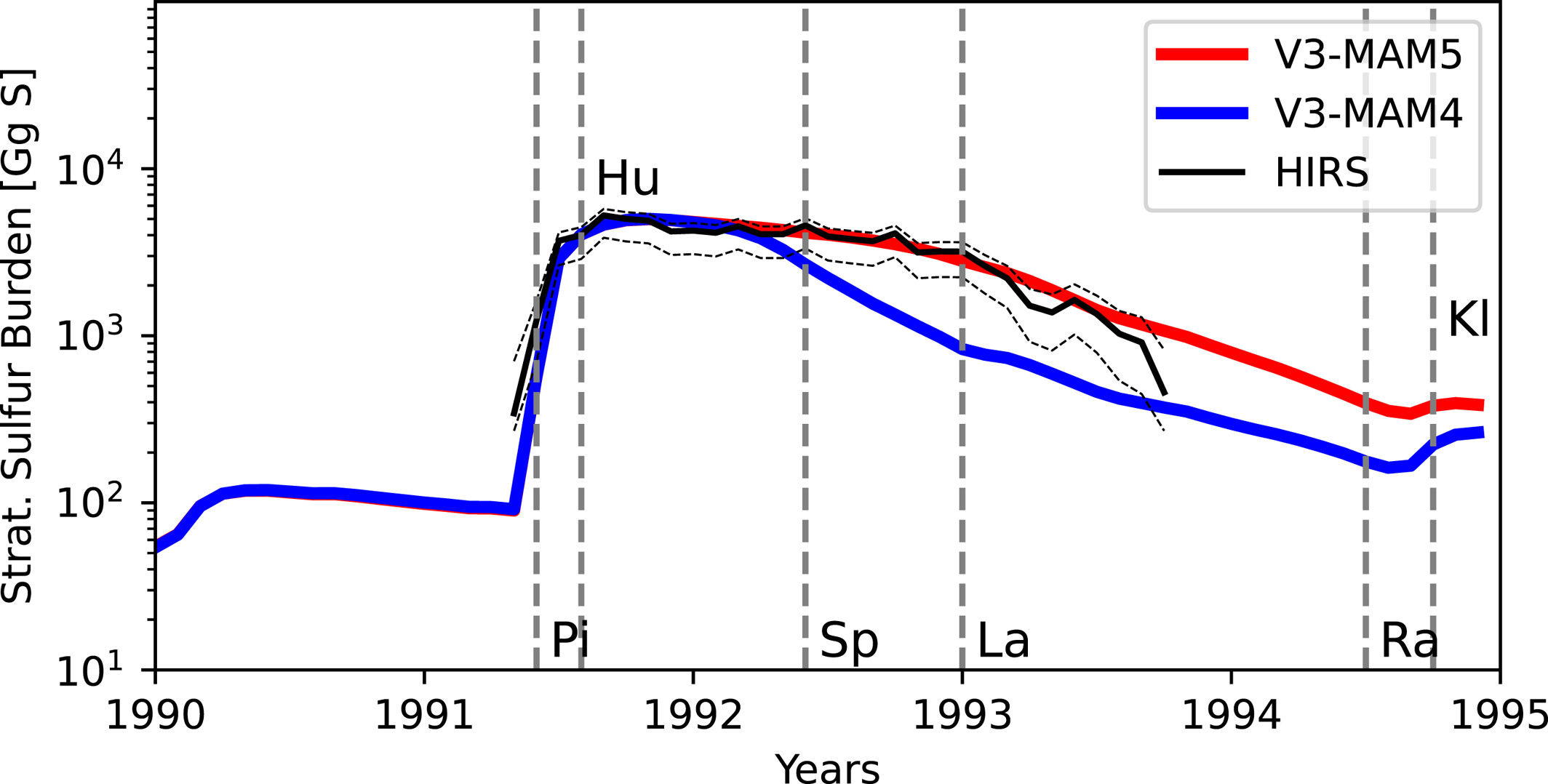
Figure 1. After the 1991 Mount Pinatubo eruption, the new five-mode treatment (red) kept simulated stratospheric sulfate closer to High-Resolution Infrared Sounder satellite observations (black). Sulfate in the earlier four-mode treatment (blue) declined too quickly. Figure reproduced from Wang et al. (2026). The article was published under a Creative Commons Attribution License.
The Impact
The advances in E3SM version 3 (E3SMv3) provide a more complete way to represent particles and their connections with atmospheric chemistry, clouds, and radiation in E3SM. The default configuration now predicts volcanic sulfate instead of prescribing its optical properties, and an optional gas and particle chemistry scheme explicitly represents nitrate and ammonium. Together with other physics improvements in E3SM version 3 (Xie et al., 2025), the aerosol developments helped the model reproduce historical temperature trends more accurately (Golaz et al., 2026) and positioned the model to better project near-future Earth system changes. The evaluation also identified interactions among aerosols, gases, clouds, and aqueous chemistry that require further improvement in future model versions.
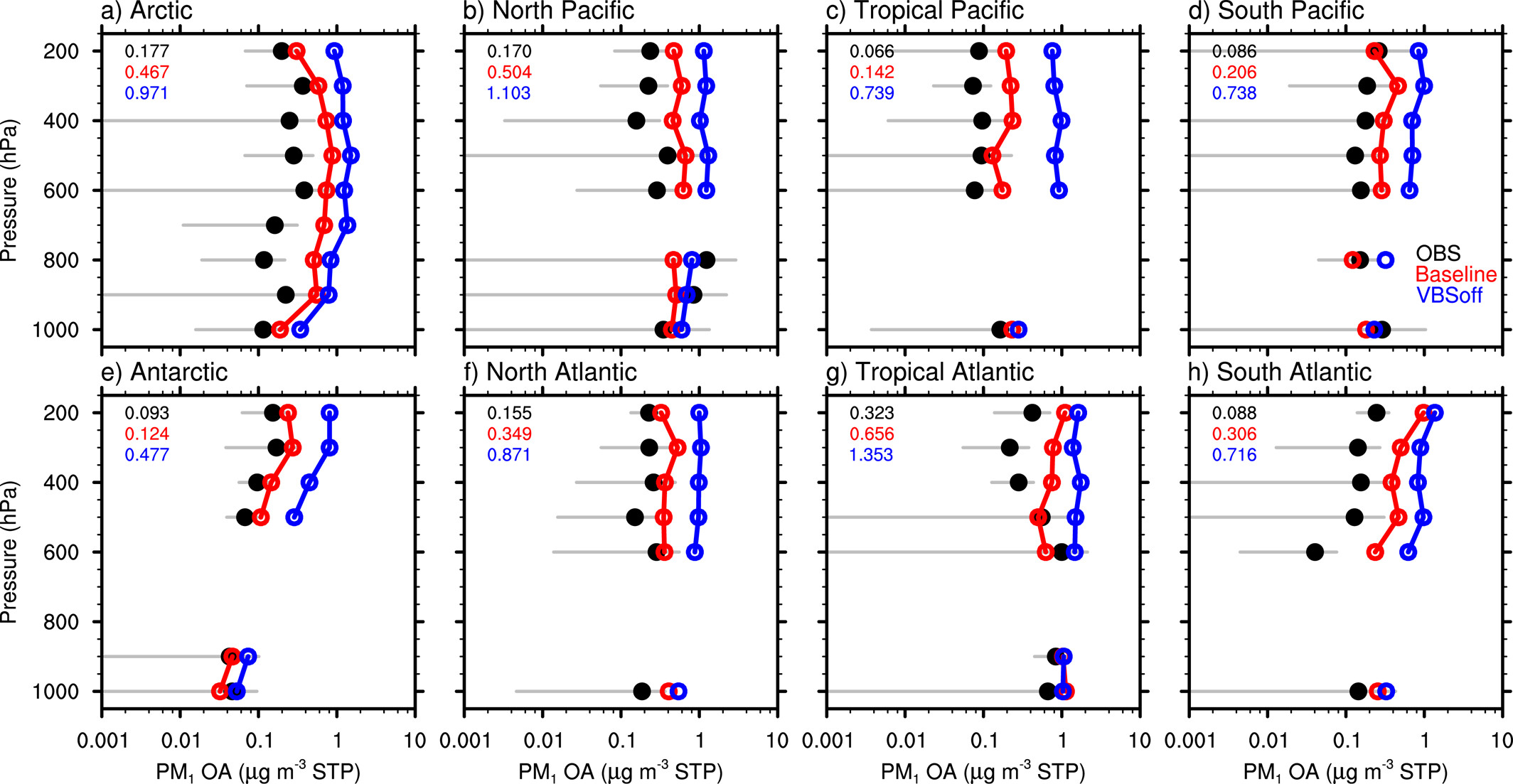
Figure 2. Vertical profiles (ranging from 1000 hPa to 200 hPa) of mean organic aerosol (OA) concentrations, in units of micrograms per cubic meter at standard temperature & pressure (STP). Observation (OBS, black dots with gray bars for mean ± one standard deviation) is compared with the baseline (red) and the new VBS SOA scheme turned off (blue). See the paper’s Figure 3 for more details.
Summary
The study documented the effects of five groups of aerosol developments in the atmospheric component of E3SMv3 (EAM), showing which treatments altered particle amounts, lifetimes, cloud-forming ability, and radiative forcing. The additions and their effects include:
- an optional gas and particle chemistry module (“MOSAIC”) that explicitly simulates nitrate and ammonium, predicting aerosol species from emissions. This produced strong spatial correlations for nitrate and ammonium but retained regional and upper-atmosphere biases.
- a volatility basis set (“VBS”) to represent the formation, aging, and loss of secondary organic aerosol (SOA). The new SOA treatment lowered the global SOA burden by 40% and shortened its modeled lifetime from 15.9 to 3.8 days, improving agreement with aircraft measurements in the middle and upper troposphere (Fig. 2).
- a fifth MAM mode for prognostic stratospheric aerosol (“PSA”) from explosive eruptions. After the 1991 Mount Pinatubo eruption, the new five-mode aerosol scheme increased the modeled volcanic sulfate lifetime, reproducing the observed persistence of particles, and more closely matched satellite retrievals than the earlier four-mode scheme (Fig. 1).
- revised coupling among emissions, dry deposition, and turbulent mixing
- a dust emission scheme (“DustEP”) linked to changing land-surface conditions. Revised dust emission and process coupling increased the dust burden and lifetime and improved its geographic distribution relative to satellite observations, although total dust remained high.
The team compared a baseline simulation containing the new default treatments with sensitivity experiments that turned individual features off or added the optional gas and particle chemistry. They evaluated particle burdens, lifetimes, geographic and vertical distributions, cloud condensation nuclei, cloud droplet numbers, and radiative forcing against aircraft, surface, and satellite observations and published model benchmarks. Collectively, the upgrades changed aerosol-cloud and aerosol-radiation effects and contributed to an improved representation of historical temperature trends in E3SM version 3 (Xie et al., 2025, Golaz et al., 2026). Simulations and data processing used resources at the NERSC user facility.
Publication
- Wang, H., Wu, M., Ke, Z., Feng, Y., Shrivastava, M., Tang, Q., Wan, H., Liu, X., Easter, R. C., Lin, W., Singh, B., Terai, C. R., Burrows, S. M., Fan, J., Ma, P.-L., Mahfouz, N., Mülmenstädt, J., Qian, Y., Shan, Y., Zhang, K., Zhang, Y., Leung, L. R., Rasch, P. J. & Xie, S. Overview of aerosols in the E3SM version 3: new model features and their impacts. J. Adv. Model. Earth Syst. 18, e2025MS005733 (2026). https://doi.org/10.1029/2025MS005733
Funding
- This research was supported primarily by the U.S. Department of Energy (DOE), Office of Science, Biological and Environmental Research (BER), Earth System Model Development program area as part of the Energy Exascale Earth System Model project. Additional support came from the Desert Research Institute for new faculty; the DOE BER Atmospheric System Research program; the Scientific Discovery through Advanced Computing program, a partnership between BER and Advanced Scientific Computing Research; and the BER Regional and Global Model Analysis program area. Simulations and tests used computing resources supported by BER’s Earth System Model Development program and the DOE Office of Science’s National Energy Research Scientific Computing Center.
Contact
- Hailong Wang, Pacific Northwest National Laboratory
This article is a part of the E3SM “Floating Points” Newsletter, to read the full Newsletter check:
- E3SM Floating Points, Nov ’26: New Emulators for Exploring Earth System Change
