

E3SM Data Docs expands access to emulator training datasets
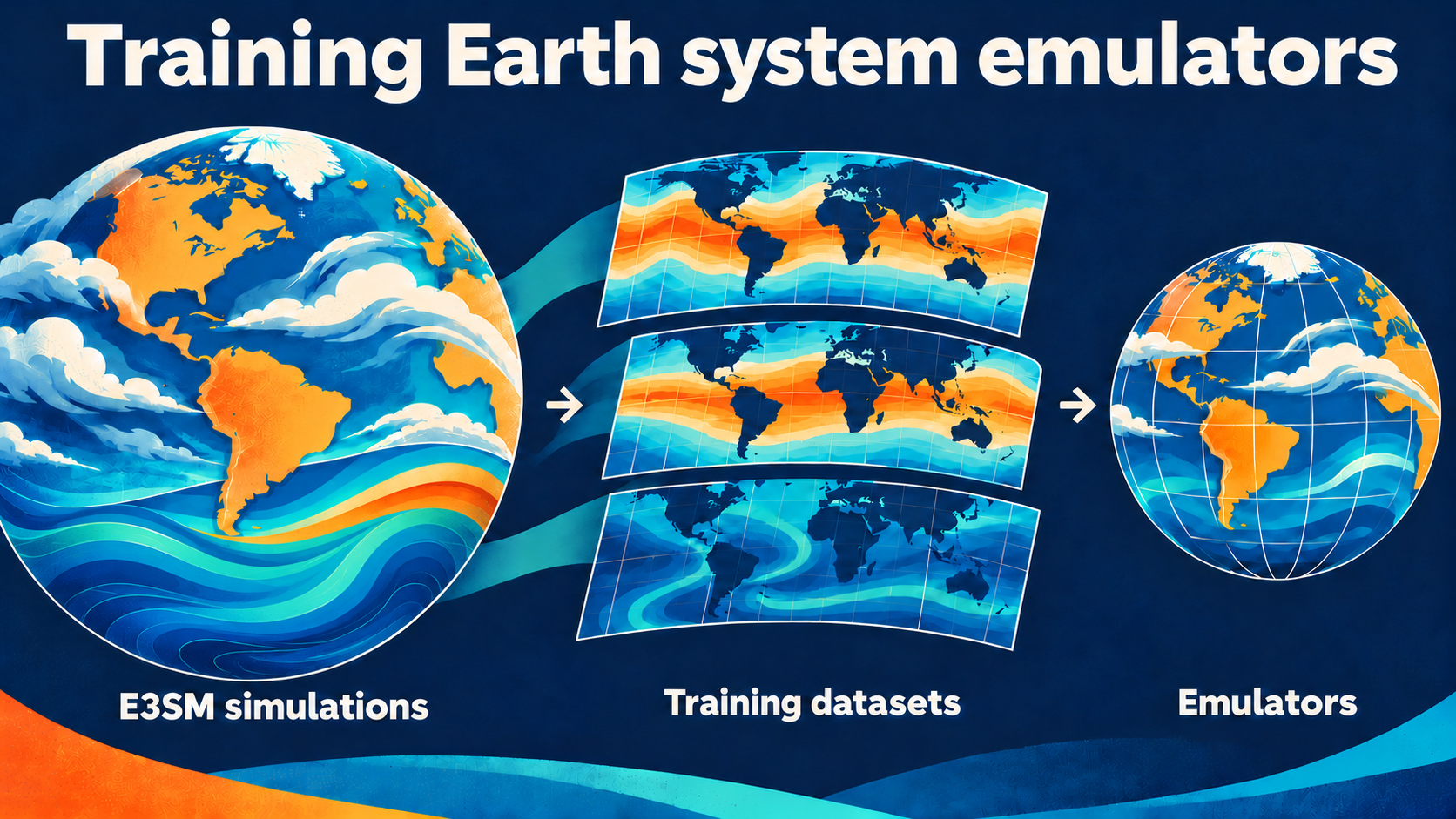
Generated with ChatGPT.
E3SM has expanded the public collection of training data for machine-learning applications, with datasets spanning atmosphere-only, coupled Earth system, and storm-resolving simulations. The updated E3SM Data Docs provides descriptions and access instructions.
These releases complement the trained emulators described in the Introduction to E3SM Emulators. By making the underlying simulations available, the project invites researchers to train their own models, explore different approaches, and investigate which aspects of E3SM’s behavior those models can reproduce.
Available now
- EAMv3 atmosphere-only dataset covers 51 years, from 1970–2020, with observed sea-surface temperatures and other forcing conditions held at 2010 levels. Used to train ACE2-EAMv3, these simulations support experiments examining atmospheric responses to ocean-surface conditions.
- E3SMv3 coupled preindustrial dataset contains 105 years of atmosphere, ocean, and sea-ice output. Used to train SamudrACE-E3SMv3 and supports research on emulating coupled earth system variability.
- SCREAM storm-resolving dataset provides global atmospheric output at approximately 4.9-km resolution and ten-minute intervals. Used to develop the first autoregressive AI emulator for global storm-resolving atmospheric dynamics, STRATA. These simulations open opportunities to develop emulators that capture storm-scale atmospheric evolution. STRATA is described in detail in another article in this edition of Floating Points.
The EAMv3 and coupled E3SMv3 datasets are available through the Data Docs page. SCREAM data are available through the NERSC portal and NVIDIA’s Hugging Face repositories: sdecadal, sdy1, and sdy2. Each resource provides details about the data and how to use them.
Looking ahead
Planned additions include E3SMv3 historical ensemble members, extending the collection to simulations with evolving historical forcing. The project also plans to expand the available training data alongside emulator development for E3SMv3’s high-resolution configuration and E3SMv4.
The team encourages researchers to try these datasets, build on the existing emulators, and share what they learn. They are interested in new scientific applications, alternative modeling approaches, and feedback that helps make future releases more useful.
Please cite the relevant datasets and publications and follow the E3SM data policies when publishing results.
Contact
- Naser Mahfouz, Pacific Northwest National Laboratory
This article is a part of the E3SM “Floating Points” Newsletter, to read the full Newsletter check:
- E3SM Floating Points, Nov ’26: New Emulators for Exploring Earth System Change
