

E3SM Data Docs adds newly available v3 RRM and large-ensemble datasets
Generated with ChatGPT.
The E3SM Data Docs website had added new datasets and a how-to guide to accessing the data.
New v3 data
The v3 documentation page has been updated to include data from E3SMv3 regionally refined model (RRM) simulations and the 25-member E3SM v3 low resolution (v3.LR) historical large ensemble.
Datasets from the v3 RRM simulation campaign is now available. The campaign ran Atmospheric Model Intercomparison Project (AMIP) simulations for years 1985-2014 on multiple meshes, including two new RRM meshes introduced in this v3 RRM release: the Amazon RRM (AMZRRM) and the East Asia RRM (EARRM) (Fig. 1). There are two North America RRM (NARRM) simulations. Both use atmosphere grids with resolution ranging from 25 km to 110 km, but they differ in their land/river grids: 0.25o in the v3 RRM release and 0.125o in the sensitivity experiment. A 25-member NARRM ensemble was also performed using the prescribed sea surface temperature and sea ice concentration from the 25-member v3.LR ensemble. Lastly, a low-resolution ensemble rounds out the campaign. These datasets are available through NERSC High Performance Storage System (HPSS), with archive paths and direct web links provided in the documentation. More information on the campaign will be shared in an upcoming manuscript.
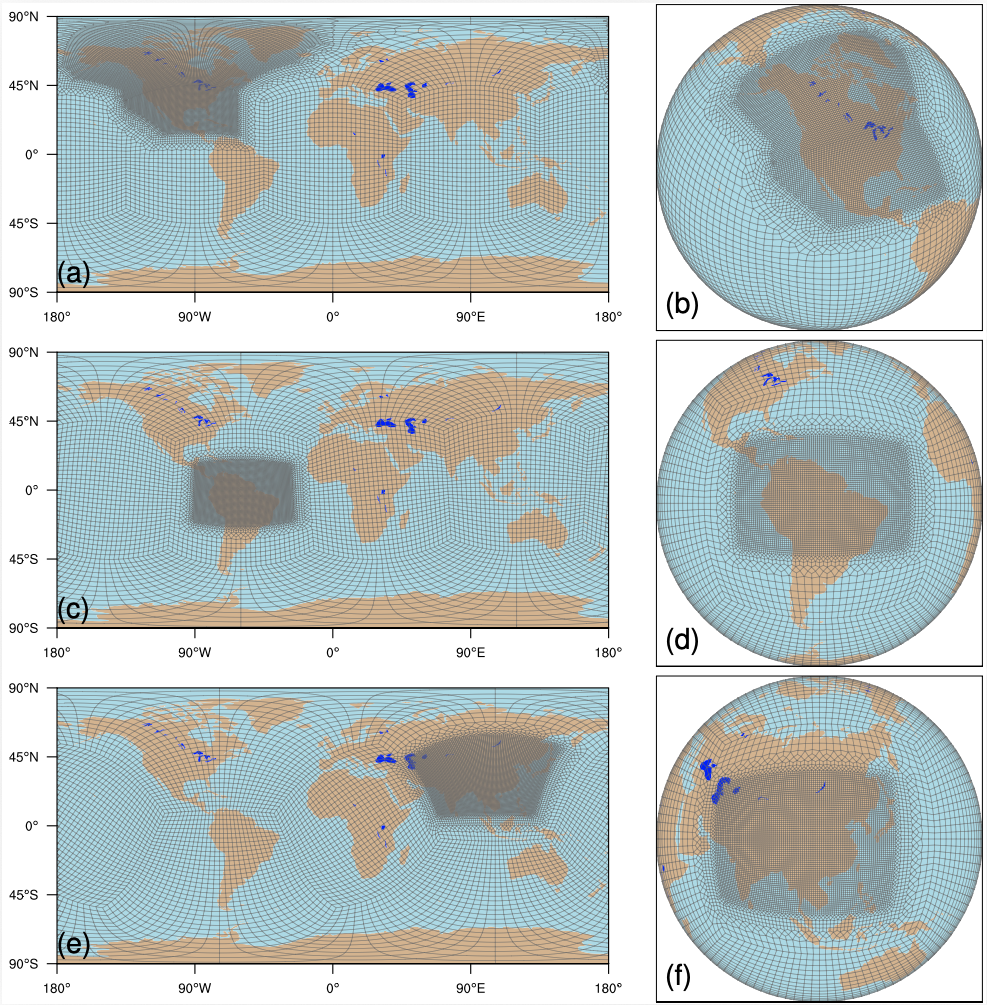
Figure 1. Atmosphere dynamical core grids used for the v3 RRM simulation campaign. (a–b) North American RRM (NARRM), (c–d) Amazon RRM (AMZRRM), and (e–f) East Asia RRM (EARRM) grids are shown in (left) a cylindrical equidistant projection and (right) an orthographic projection. Panels (a–b) are replotted from Fig. 1 of Tang et al. (2023). This figure appears in: Tang, Q., J.-C. Golaz,W. Lin, J. D.Wolfe, et al. (2026), Overview of the Energy Exascale Earth System Model Version 3: The Regionally Refined Model Configuration, J. Adv. Model Earth Sy., under review.
The new v3.LR historical large ensemble includes 25 members, providing a broader sample of internally generated earth system variability for historical analysis. The data are available in CMIP format through the Earth System Grid Federation (ESGF), with native model output archived through NERSC HPSS.
Accessing the data
A new Accessing E3SM Data page explains retrieval through NERSC HPSS, ESGF, and Globus. HPSS is the authoritative long-term archive. ESGF provides CMIP-formatted data, while Globus supports selected high-use datasets.
Users should review E3SM publication policies and acknowledge E3SM and the U.S. Department of Energy, Office of Biological and Environmental Research using the instructions on this page.
Related stories
Contact
- Tony Bartoletti, Lawrence Livermore National Laboratory
- Jill Zhang, Lawrence Livermore National Laboratory
- Ryan Forsyth, Lawrence Livermore National Laboratory
This article is a part of the E3SM “Floating Points” Newsletter, to read the full Newsletter check:
- E3SM Floating Points, Nov ’26: New Emulators for Exploring Earth System Change
