

An Introduction to E3SM Emulators
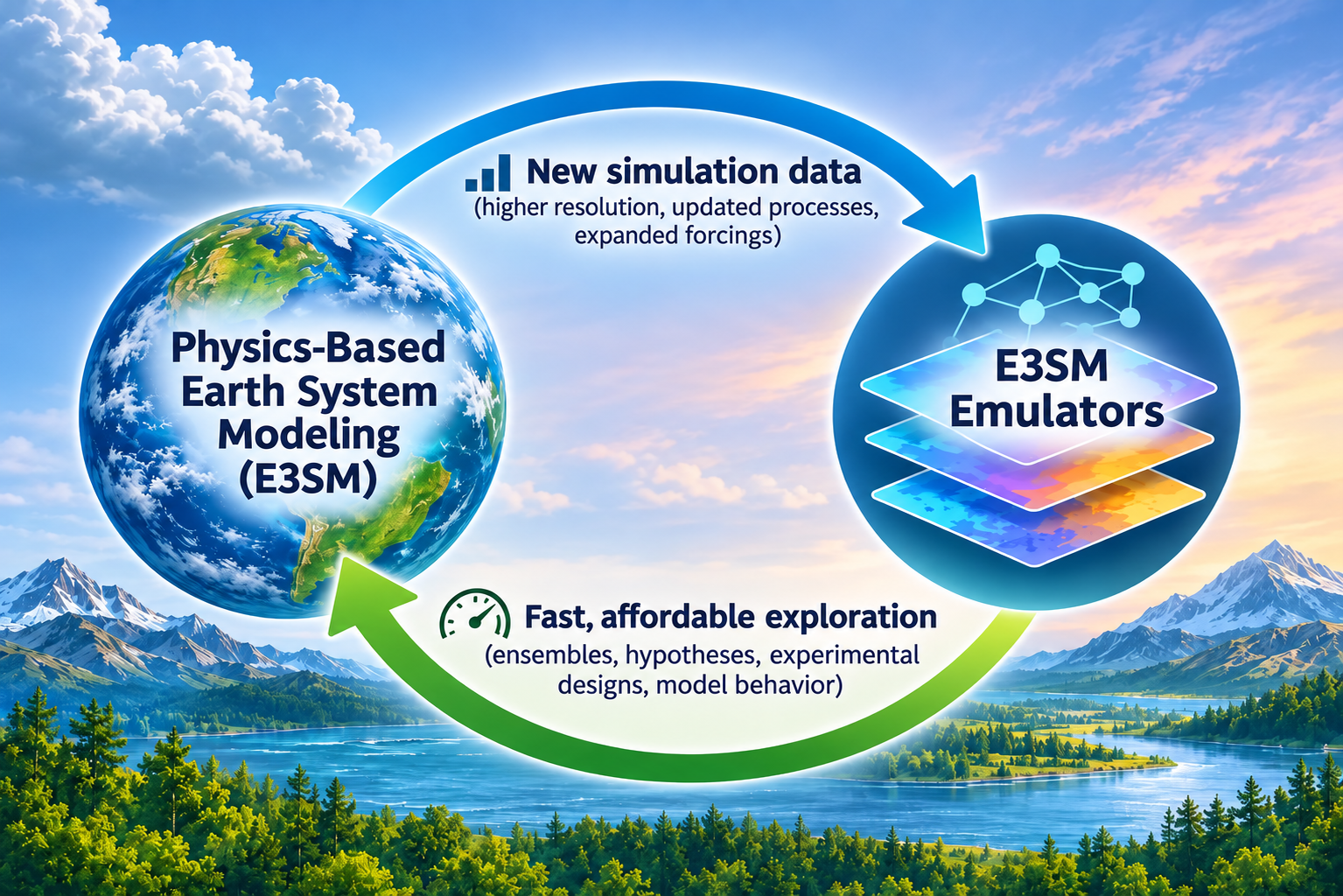
Figure 1. Physics-based simulations and emulators improve each other. Generated with ChatGPT.
Running an Earth system model is computationally expensive. That cost shapes the questions researchers can ask: how long a simulation can run, how many ensemble members are practical, and how many experiments can be explored. At a fraction of the cost, E3SM AI emulators offer another way to investigate the behavior of the modeled system, potentially with novel experimental designs.
E3SM’s emulators learn from simulations produced by the physical E3SM model. During training, a neural network is shown how fields such as temperature, winds, and moisture evolve together. It learns to advance a representation of the model state from one time to the next. Once trained, it can repeatedly apply that learned update to generate a new simulation. This method is known as autoregressive emulation.
This makes an emulator a working model in its own right. Researchers supply initial conditions and the boundary conditions and external forcing appropriate to the experiment, then run it forward and analyze the resulting evolution of the Earth system. The substantial investment in generating training data and training the network supports many subsequent experiments with the released emulator.
E3SM is committed to releasing emulators for every major version of the model. The aim is to make emulation a regular part of the E3SM ecosystem, with publicly available trained models, supporting data, documentation, and evaluation. As E3SM develops, researchers will have access to both its physics models and fast emulators trained to reproduce aspects of their behavior. As E3SM focuses on increasingly higher-resolution experiments, the team believes emulators will offer an economical and accessible way for E3SM users to explore some of their scientific questions.
A different way to represent the model
Traditional E3SM components advance the atmosphere, ocean, land, and ice using numerical solvers and physical parameterizations. An emulator learns an approximation to their evolution from the output those components produce. Depending on its scope, it can represent an individual process, an entire component, or interactions among coupled components.
This changes both how a model is distributed and how it develops. Alongside the software, users download a checkpoint: the trained network and associated information needed to run it. Its scientific identity includes the E3SM configuration that generated its training data, the conditions represented in those simulations, and the architecture and training procedure used to learn from them.
Emulators can therefore evolve along two connected paths (Fig. 1). New E3SM simulations provide opportunities to represent updated physics, finer resolution, and additional forcing conditions in the emulators. Advances in learning methods can improve how well an emulator represents the same underlying simulation, including its variability, extremes, and long-term behavior. Each release brings its own evaluation of those capabilities.
Emulators available now
Two E3SMv3 emulators developed in collaboration with the Allen Institute for AI (Ai2) currently have public checkpoints:
- ACE2-EAMv3 emulates E3SMv3’s atmosphere model. It was trained on EAMv3 simulations using observed sea-surface temperatures from 1970–2020, but with other forcing conditions—radiative gases, aerosols, land use, and land fraction—representative of conditions around 2010. It advances the atmosphere in six-hour steps on a 1° grid, with sea-surface temperatures supplied as boundary conditions. ACE2-EAMv3 supports experiments examining how the atmosphere responds to ocean-surface conditions (the emulator was trained on data from 1970 to 2020).
- SamudrACE-E3SMv3 couples an ACE atmosphere emulator with the Samudra ocean emulator. Trained on 105 years of E3SMv3 preindustrial control output, it generates coupled atmosphere–ocean variability under preindustrial forcing. The atmosphere advances in six-hour steps, exchanging information with the ocean every five days. Its stochastic formulation allows ensemble members to develop different realizations of Earth system variability, resulting in a generally improved representation of variability.
These releases illustrate the progression from emulating one component with prescribed boundary conditions to allowing learned components to interact. They also support different scientific experiments: atmosphere-only runs can isolate responses to supplied ocean conditions, while coupled runs allow atmosphere–ocean variability to develop interactively.
Additionally, a SCREAM emulator developed in collaboration with NVIDIA currently has a public checkpoint:
- STRATA emulates global storm-scale atmospheric evolution using SCREAM output at 4.9-km resolution. Trained on 17 days of simulation data, it learns ten-minute updates from local spatial tiles and combines overlapping tiles to advance the atmosphere globally. STRATA produces stable 24-hour simulations with realistic storm-scale structures and achieves roughly 50 times the energy efficiency of SCREAM, opening a path toward more accessible experiments with global storm-resolving models. The team is currently developing ways to allow STRATA to run for longer than a day or so.
Getting started
The new Emulators documentation page, provides a starting point for running these models. It walks through setting up the Python environment, downloading a checkpoint, preparing a configuration file, launching a simulation, and reading the output. Users run the released checkpoints directly for inference and prediction with predetermined weights (training the underlying neural networks is a separate workflow). Depending on the emulator and configuration, the computational requirements make experimentation accessible on much smaller allocations than the original simulations, including personal laptops.
Where the effort is heading
The release roadmap includes emulators for E3SMv3 historical simulations, the E3SMv3 high-resolution configuration, upcoming E3SMv4, and targeted high-resolution emulators. These directions expand the conditions and scales represented by the emulator collection, including changing historical forcing and the behavior of newer model configurations. Storm-resolving emulation, like STRATA, extends the effort toward the much finer scales represented by SCREAM.
Another direction is running emulators within E3SM itself. Integrating learned components with the model’s coupling infrastructure would allow researchers to combine emulated and numerical components in the same experiment and investigate how their interactions affect the resulting simulation.
The broader goal is to give the community more ways to work with E3SM: generate ensembles, explore hypotheses, test experimental designs, and study model behavior with shorter turnaround times before performing computationally expensive physics-based simulations. Public releases and practical documentation make those capabilities available for researchers to use, evaluate, and build upon.
Contact
- Naser Mahfouz, Pacific Northwest National Laboratory
This article is a part of the E3SM “Floating Points” Newsletter, to read the full Newsletter check:
- E3SM Floating Points, Nov ’26: New Emulators for Exploring Earth System Change
