

Improved Representation of Surface Emissivity Effects on Longwave Radiation
A new surface emissivity method improves E3SM simulations of longwave radiation and atmospheric heating
The Science
Surface emissivity modulates upwelling longwave (LW) radiation, which impacts atmospheric heating rates. To reduce computational complexity and expense, Earth System Models (ESMs) often use simplified physics. A prevalent example is the broadband surface emissivity assumption, which approximates constant emission over all wavelengths. In reality, surface emissivity varies with wavelength and surface type. The broadband approximation therefore misrepresents the amount of upwelling longwave radiation in the atmosphere. The broadband blackbody (BB) approximation assumes that no energy is reflected. Many ESMs, including E3SM, approximate surface emissivity ε as either blackbody (ε=1) or greybody (ε<1), which biases upwelling longwave surface flux and heating rates. Blackbody emissivity is the crudest approximation and overestimates surface emission yet maintains consistency between surface and atmosphere components. The commonly used greybody method (Effective Greybody, “EG”) accounts for the reflected component, yet introduces an effective temperature bias (Fig. 1).
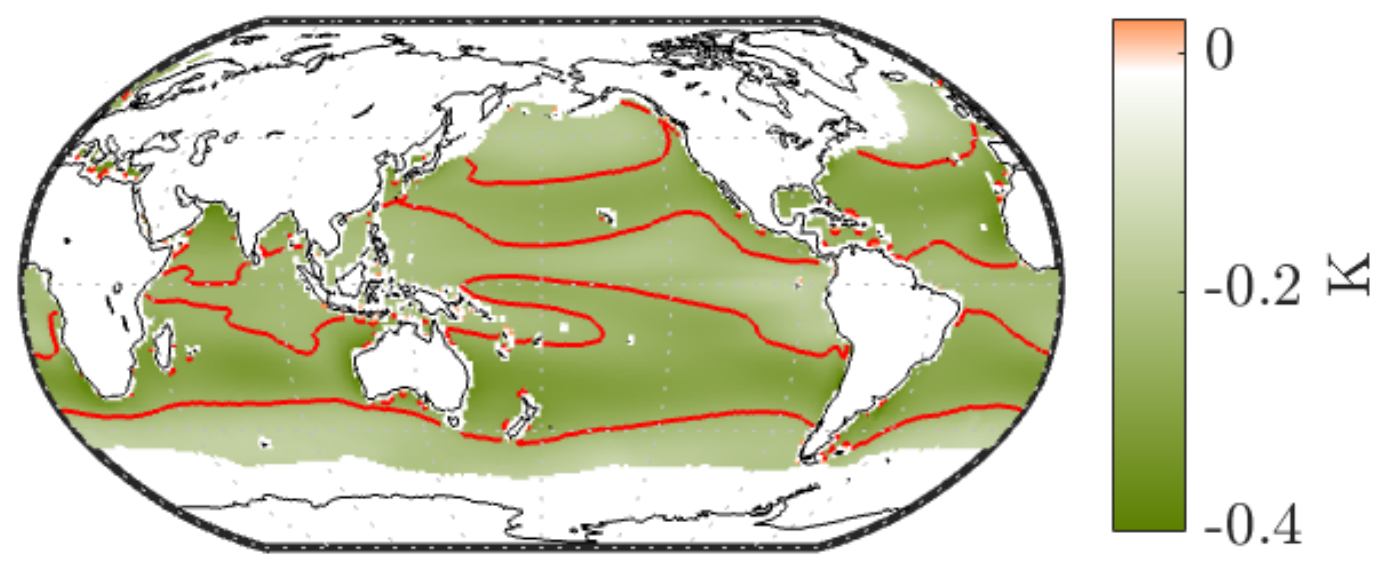
Figure 1. Mean bias in effective temperature (-0.24 K, red contours) from the current greybody method (“EG”) over the ocean surface.
The Impact
The team’s new method of representing surface emissivity is more physically realistic than the blackbody approximation, and avoids an inconsistency in effective temperature from the greybody approximation currently used in E3SM. This method can reduce bias in atmospheric warming rates, which in turn impact the global energy budget. They conclude that their novel greybody method, “Full Greybody” (FG), is a simple and more physically realistic alternative to current broadband implementations.
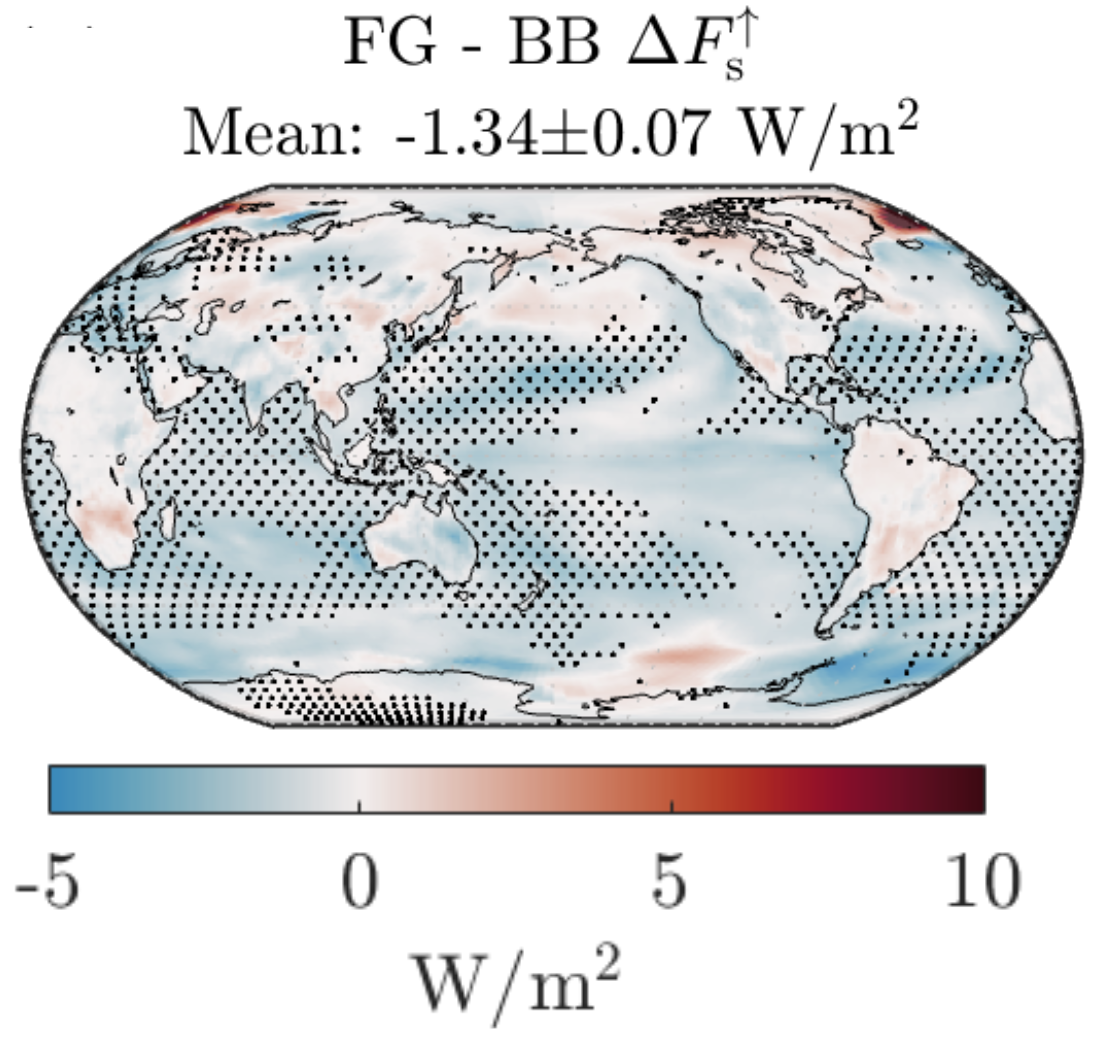
Figure 2. Mean change in upwelling longwave surface flux from the new FG method relative to blackbody (BB). Stippling indicates regions with 95% statistical compatibility over the 30-year period. Note: Emissivity was only modified over the ocean surface, so the direct forcing is only nonzero over the ocean. This figure is showing the mean change in LW flux when the forcing is applied to the coupled model, so even though nothing over land is being directly changed, feedbacks propagate the change in flux over the whole globe, though most of the statistically significant changes are over the ocean.
Summary
E3SM Researchers quantified the effective temperature bias from the EG method (-0.24 K) and the radiative forcing bias from the BB method (1.38±0.05 W/m2) over the ocean surface. The team also developed an improved method of representing surface emissivity that is more computationally efficient than the alternative spectrally resolved solution. They implemented the FG method, which modifies ocean flux from blackbody to greybody with ε =0.9735 and modifies the equations for both effective temperature and spectral LW flux. Using the FG method over the ocean surface in the fully coupled E3SM (Fig. 2), they found that FG emissivity is more realistic than blackbody and eliminates the effective temperature bias from the current EG method. A full implementation across land, ocean, and sea ice is not planned until E3SM v5 because it requires substantial changes to the land, sea-ice, and coupler components. In the medium term, the team plans to develop methods for applying FG to multiple surface types and to transition the current implementation to E3SM’s v4 framework once Omega stabilizes. Merging the ocean and sea-ice grids may also facilitate future implementation across those surfaces.
Publication
- L. Manzo, C. Zender, A. Roberts, E. Thomas, “Improved representation of surface emissivity effects on longwave radiation in a coupled Earth System Model.”
Funding
- This work was supported by the Earth System Model Development program area of the Department of Energy, Office of Science, Biological and Environmental Research program.
- This research was supported as part of the Energy Exascale Earth System Model (E3SM) project, funded by the United States Department of Energy (DOE), Office of Biological and Environmental Research (DE‐SC0019278). E3SM simulations were performed using the DOE-supported National Energy Research Scientific Computing Center (NERSC) under Contract No. DE-SC0022117. L. Manzo gratefully acknowledges the support of the UCI-LANL-SocalHub fellowship and the United States Department of Education’s Graduate Assistance in Areas of National Need (GAANN) Fellowship (P200A240042)
Contact
- Lili Manzo, University of California, Los Angeles
This article is a part of the E3SM “Floating Points” Newsletter, to read the full Newsletter check:
- E3SM Floating Points, Nov ’26: New Emulators for Exploring Earth System Change
