

A Fully Coupled AI Emulator of E3SMv3 Reproduces Its Statistics
Over the past few years, machine-learning emulators have learned to reproduce individual pieces of the Earth system (like the atmosphere, land, ocean, and sea ice) each one running orders of magnitude faster than the physics-based models it imitates. The obvious next frontier is harder: stitch those pieces back together so they exchange information the way a fully coupled model like E3SM does.
Researchers from Ai2 (the Allen Institute for AI) and E3SM have now taken that step with SamudrACE-E3SMv3, training a fully coupled atmosphere–ocean emulator that reproduces E3SMv3’s pre-industrial control simulation. The payoff is several orders of magnitude in speedup: where the reference E3SM simulation advances about 28 simulated years per day (SYPD) across 105 compute nodes on Chrysalis, the emulator produces roughly 1,100 SYPD on a single H100 GPU — fast enough to make century-scale experiments routine for scientists as opposed to time-consuming simulation campaigns.
In order to achieve this milestone, the team re-ran the E3SMv3 pre-industrial control simulation for 105 years to output the variables from the necessary time intervals for the emulator to learn from: six-hourly for the atmosphere and five-day means for the ocean and sea ice. Crucially, much of the preprocessing was done while E3SM was still running. The raw output was coarsened in the vertical coordinate (8 levels for atmosphere, 19 levels for ocean) and remapped onto a shared one-degree grid during E3SM runtime.
The coupling itself follows a deliberately staged recipe, shown in Figure 1. The atmosphere and ocean emulators are first pre-trained separately, where each sees reference boundary conditions taken straight from E3SM data rather than from the emulators, so each learns its own task before being asked to cooperate. Only then are the two joined and fine-tuned together, in a single coupled stage. At the interface, the atmosphere emulator sends the ocean emulator its five-day mean surface fluxes, precipitation, and wind stress; the ocean emulator hands back sea-surface temperature and sea-ice fraction.
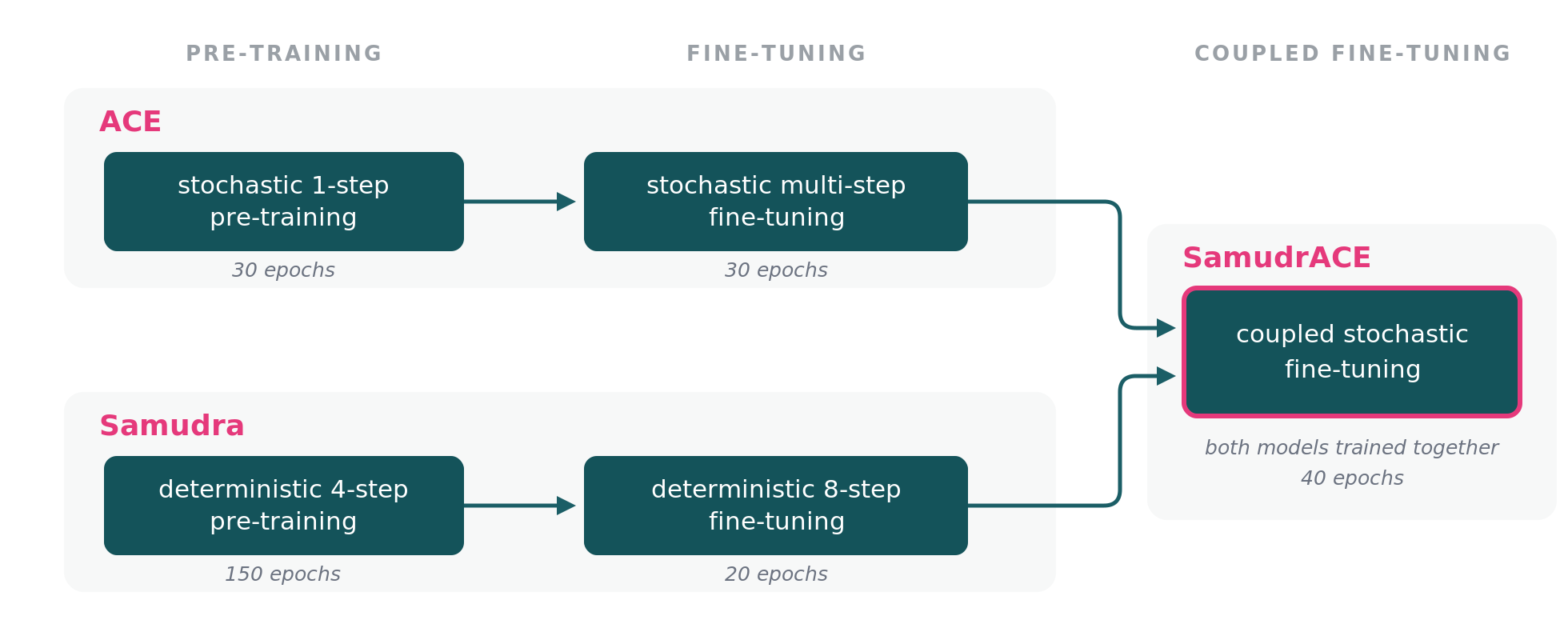
Figure 1. The SamudrACE-E3SMv3 training recipe. The atmosphere (ACE) and ocean (Samudra) emulators are pre-trained separately with “perfect” boundary conditions, then joined and fine-tuned together in a single coupled, stochastic stage.
The most consequential design choice was to make the atmosphere probabilistic. In place of the original deterministic ACE2, SamudrACE-E3SMv3 uses ACE2S, which produces an ensemble of equally plausible atmospheric states and is trained with a probabilistic objective. That randomness becomes the coupled system’s source of internal variability. When the researchers checked the emulator’s long-term state against 400 independent years of data, the mean state came out faithful to E3SM. The surface-temperature and precipitation biases between SamudrACE and E3SM are smaller than the gap between E3SM and observations.
The stochastic design significantly enables the emulator to reproduce the variability of the reference model. The emulator sustains a realistic El Niño–Southern Oscillation (ENSO) across the full 400-year rollout (Fig. 2a), with no drift or collapse, and its Niño 3.4 power spectrum sits comfortably inside the spread of E3SM’s own 40-year windows (Fig. 2b), including the stubborn low-frequency tail beyond four years that deterministic emulators tend to flatten. It also reproduces E3SM’s ENSO teleconnections (Fig. 2c), placing Pacific rainfall and sea-surface-temperature anomalies where they belong.
A similar pattern is seen in the eddy-rich Gulf Stream and along the wandering sea-ice edge: a deterministic version of the emulator, trained to minimize mean-squared error, regresses toward the average and smooths those fluctuations out, while the stochastic version keeps them alive at close to the right amplitude. The emulator faithfully captures daily rainfall up to the 99.9th percentile, but underestimates the very rarest tropical downpours, capping their intensity below E3SM‘s most extreme events — a reminder that learning the shape of a distribution is not the same as reaching its far tail.
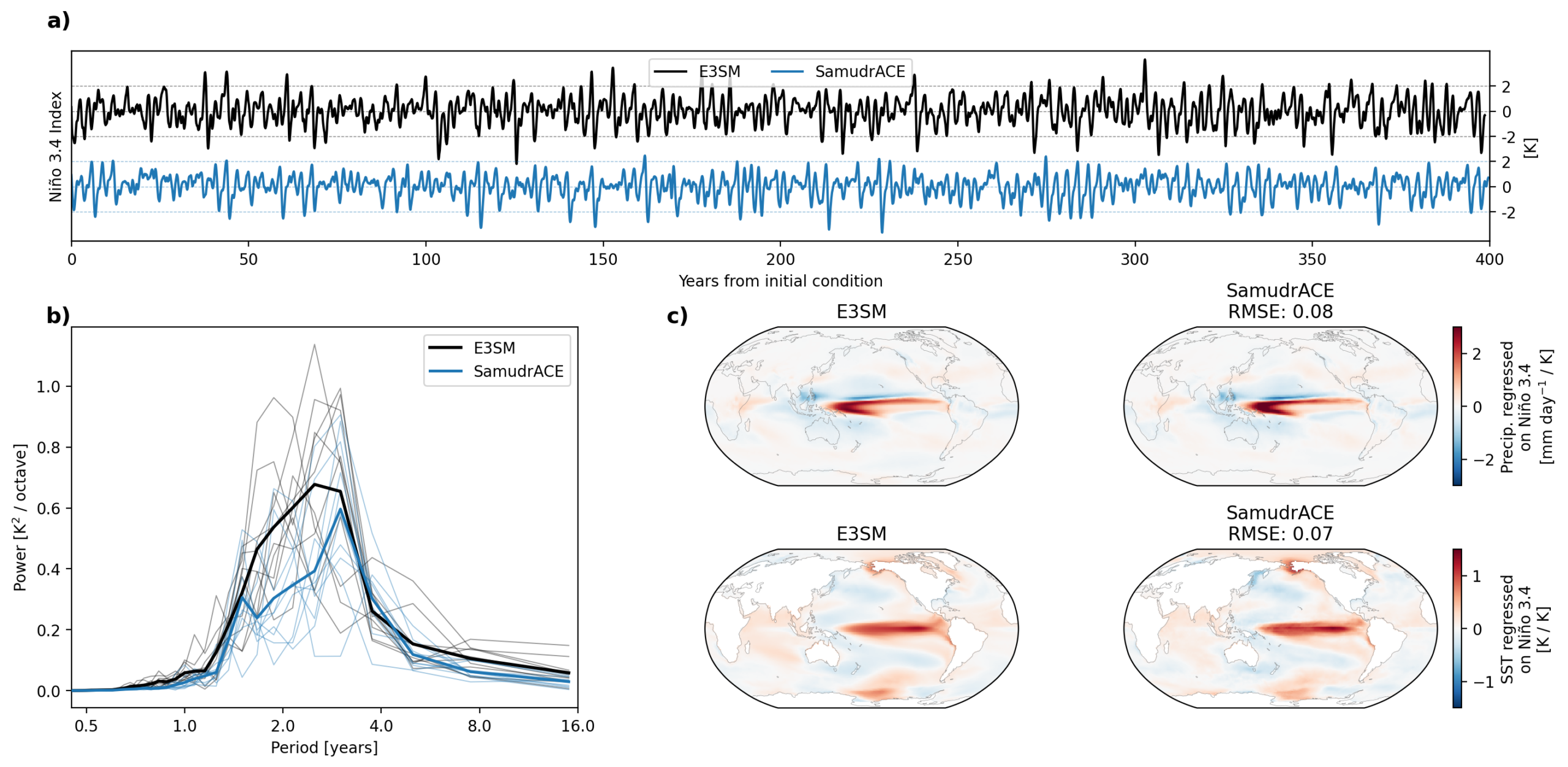
Figure 2. El Niño in the emulator. (a) The Niño 3.4 index stays stable and realistic across the full 400-year rollout; (b) the emulator’s ENSO power spectrum falls within the spread of E3SM’s own 40-year windows; and (c) SamudrACE reproduces E3SM’s precipitation and sea-surface-temperature teleconnection patterns, with low error relative to E3SM.
For E3SM, an emulator reproducing the mean and variability of the reference physics model opens avenues for scientific usefulness rather than mere speed. This emulator enables large ensembles that sample internal variability cheaply, rapid screening of ideas before they are committed to the physics-based simulations, and quick exploration of statistics that would otherwise be cost-prohibitive. The team’s next steps point straight at those goals: extending the emulator beyond a fixed pre-industrial control to historical runs with changing system forcing and probing why stochastic training recovers variability better than the deterministic counterpart.
Publication
Wu, E., Duncan, J. P. C., Arcomano, T., McGibbon, J., Watt-Meyer, O., Bretherton, C. S., Mahfouz, N., Tebaldi, C., Van Roekel, L., Roberts, A., Lin, W., Rebassoo, F., Golaz, J.-C., and Caldwell, P. M.: Stochastic emulation of a fully coupled preindustrial E3SMv3 simulation, manuscript submitted to JGR: Machine Learning and Computation, https://doi.org/10.48550/arXiv.2608.10277 , 2026.
Contact
- Elynn Wu, Allen Institute for Artificial Intelligence
- Naser Mahfouz, Pacific Northwest National Laboratory
This article is a part of the E3SM “Floating Points” Newsletter, to read the full Newsletter check:
- E3SM Floating Points, Aug ’26: Title TBD
