

Applying Corrective Machine Learning in the E3SM Atmosphere Model in C++ (EAMxx)
New software links Python-based AI tools with a high-performance C++ atmosphere model.
The Science
Global storm-resolving models (GSRMs) provide greater accuracy, but at greater computational cost. Traditionally, coarse-resolution can be “nudged” to a more accurate state, usually using observed data or existing high-resolution simulations. Researchers wanted to know whether machine learning (ML) could help a lower-resolution version of the E3SM Atmosphere Model (EAMxx) reproduce key behavior from a much more expensive cloud-resolving simulation. This would also necessitate connecting Python-based ML tools with the performance-portable C++ version of E3SM on CPU and GPU supercomputers.
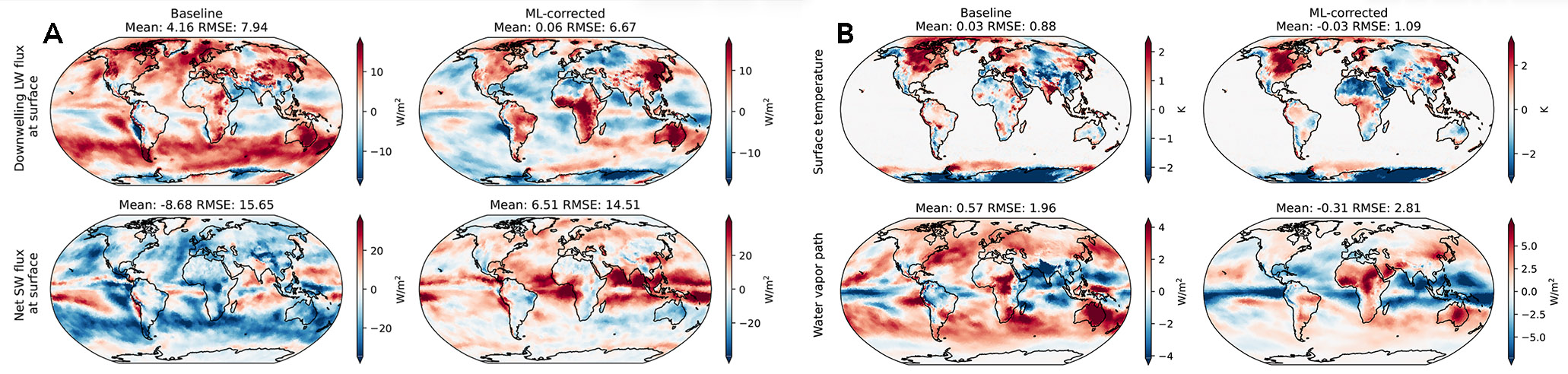
Figure 1. Comparison of biases for baseline “coarse” resolution (“Baseline” columns) and ML-Corrected coarse simulation (“ML-corrected” columns). ML-Corrected shows improvement for some metrics, such as Downwelling longwave flux at surface and Net shortwave flux at surface in (A), and higher bias for others, such as Surface temperature and Water vapor path in (B).
The Impact
This work advances hybrid Artificial Intelligence (AI)-physics in earth system modeling by showing what is required to integrate ML into production scientific software at scale. While the correction method produced mixed improvements, the study nevertheless delivered important infrastructure and revealed why ML methods may not transfer easily between different models. This finding highlighted limits of corrective ML, motivating interest in full-model emulation for earth system modeling. The results provide a valuable benchmark for the earth system modeling community and establish new capabilities for future ML enabled E3SM development.
Summary
The team applied a corrective ML strategy to SCREAM, the storm-resolving configuration of EAMxx, with the goal of making a coarse-resolution simulation better match a 3-kilometer global reference simulation. Neural networks were trained on correction tendencies derived from a nudged coarse simulation and then embedded directly into EAMxx. To do this, the researchers developed a Python/C++ coupling approach using pybind11 that worked efficiently on both CPUs and GPUs without expensive memory copies. In scientific tests, the ML correction improved some outputs, particularly surface downwelling longwave radiation, and modestly improved a few others such as net surface shortwave flux and precipitation (Fig. 1a). The added ML workflow increased runtime by only about 10% on CPUs and 6% on GPUs. However, it worsened errors in surface temperature and total water vapor path (Fig. 1b), showing that this approach was less effective in EAMxx than in prior studies with the GFDL-FV3 model.
Publication
- Donahue, A. S., Wu, E., Perkins, W. A., Caldwell, P. M., Bretherton, C. S., Rebassoo, F., and Golaz, J.-C.: Applying corrective machine learning in the E3SM atmosphere model in C+ + (EAMxx), Geosci. Model Dev., 19, 4763–4774, https://doi.org/10.5194/gmd-19-4763-2026 , 2026.
Funding
- This work was supported by the Earth System Model Development program area of the Department of Energy, Office of Science, Biological and Environmental Research program.
- Lawrence Livermore National Laboratory – LDRD (22-ERD-052)
Contact
- Peter Caldwell, Lawrence Livermore National Laboratory
- Aaron Donahue, Lawrence Livermore National Laboratory
This article is a part of the E3SM “Floating Points” Newsletter, to read the full Newsletter check:
- E3SM Floating Points, Aug ’26: Title TBD
