

Accelerating Earth System Modeling: AI-based land model spinup
Background
The development of the Energy Exascale Earth System Model (E3SM) and its E3SM Land Model (ELM) is crucial for understanding Earth system interactions. ELM enhances the ability to model essential processes such as energy and water exchange, nutrient cycling, and the effects of human activities. These processes are vital for ensuring infrastructure resilience and energy security. Presently, research focuses on advancing ELM to run high spatial resolutions – targeting grids at 1 kilometer horizontal spacing, leveraging high-resolution data to enhance simulation accuracy. Computational demands and data management pose significant challenges at these resolutions.
Ultra High-Resolution ELM (uELM) has been developed for graphics processing unit (GPU)-accelerated supercomputers as a strategic approach to enhance model performance. Current developments in uELM on GPUs—particularly through the ultrahigh-resolution ELM development (uELM) (Wang, et al., 2022) utilizing a dedicated Software Package for ELM development (SPEL) (Schwartz, et al. 2022) with OpenACC—demonstrate promising progress. However, the 3-5 times speedup of the GPU-based ELM simulation remains inadequate to fully address the computational challenges inherent in km-scale simulations. As a result, researchers are investigating Artificial Intelligence (AI) emulation methods as an innovative solution to further alleviate these issues.
Model spinup is one of the most computationally demanding aspects of ELM when running in its biogeochemistry-enabled mode, which is now the standard mode for all E3SM coupled simulation campaigns. Spinup entails finding dynamic steady-state conditions for all the model pools and processes for pre-industrial conditions. This can take hundreds to thousands of simulation years (Thornton, et al., 2005), and needs to be carried out independently for each model gridcell and subgrid component. This essential step resolves deep soil and carbon pools, removes artificial drift, and establishes equilibrium, ensuring accurate initial conditions for subsequent transient simulations. At very high spatial resolutions this spinup step can limit the scope of coupled simulation due to the time requirements.
To solve this problem, the E3SM project launched an exploration of AI-based methods to accelerate the land model spinup. The objective of this effort is to reduce the number of simulation years required for each spinup to tens of years, rather than hundreds or thousands. The E3SM land group defined the requirements for a solution, and then engaged the AI capabilities and expertise of other projects to find a practical solution. To that end, the Artificial Intelligence for BioGeoChemistry (AI4BGC) project at Oak Ridge National Laboratory (ORNL), funded by the ORNL AI initiative and recognized as an E3SM ecosystem project, used transformer-based AI models to accelerate the spinup process.
Methodology
The AI4BGC effort adopts a quantitative definition of model equilibrium, where the global net ecosystem exchange of carbon (NEE) between the atmosphere and terrestrial ecosystems approaches zero over predefined time periods. The approach begins with the development of AI models to emulate “slow” carbon, nitrogen, and phosphorus processes, trained on data obtained from standard spinup simulations that are run over thousands of simulation years. It subsequently utilizes a short-term ELM restart simulation to invoke other “faster” processes, such as water and temperature states, to reach their own steady states. It is important to note that a successful ELM restart simulation, with a AI-model generated restart file, enforces physical constraints (such as energy, water, and nutrient balance checking at every individual landscape grid cell and its subgrid components) and can be regarded as a significant measure that ensures the trustworthiness of the underlying AI model.
Technically, the effort employs a “one-shot prediction” method, leveraging the current E3SM restart capabilities. This involves initiating ELM simulations for a brief period to establish initial conditions, such as a restart file generated after 20 years of simulation. Subsequently, the AI model predicts the final or near-final states of these “slow” Carbon, Nitrogen, and Phosphorous (CNP) pools, where the NEE exchange aligns closely with equilibrium conditions. The AI-generated CNP pool data is then combined with the initial restart file creating a new restart state for subsequent transient simulations.
Implementation
The researchers have developed a modular deep‑learning framework to solve the spinup problem (Gao, et al., 2025). The solution combines data‑type–aware encoders for heterogeneous inputs with multi‑level physics‑based constraints that promote consistency from local dynamics to global system behavior.
Its architecture (Fig. 1) is designed to accommodate diverse data types of ELM, integrating complex and unaligned multi-modal simulation data into a cohesive training framework.
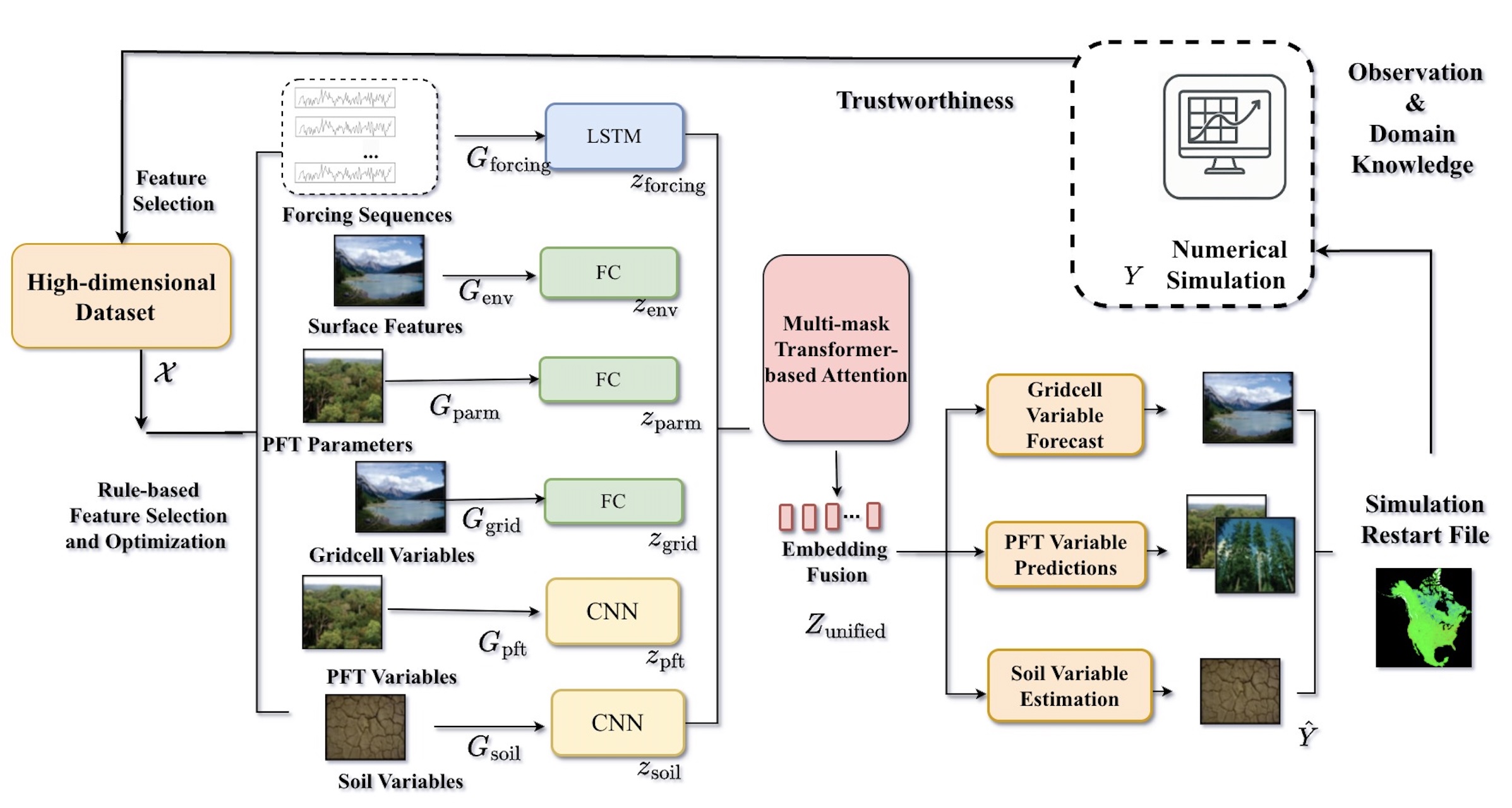
Figure 1: The physics-integrated and heterogeneity-aware architecture of AI-based land model spinup.
At the core of the AI-based spinup approach is a modular structure that harmonizes multi-level physics with data-type-aware encoders, enabling the incorporation of both hard and soft physics-based constraints. These constraints promote physical plausibility throughout the model, ensuring that the resultant simulations not only reflect local dynamics but also align with global system behavior. The integration of foundational domain knowledge is a pivotal aspect of the architecture, grounding the framework in established scientific principles from the outset. This systematic incorporation of domain knowledge enhances the model’s ability to yield high-fidelity results in complex applications, such as the land model spinup problem.
Results
Researchers have constructed a unified training dataset derived from global ELM simulations, encompassing 20,975 land grid cells at a 1 degree resolution. The main challenge encountered was the integration of heterogeneous data sourced from various files, including history, restart, and forcing files. This was addressed through the implementation of a custom data pipeline, which facilitated the creation of a cohesive, grid-cell-centered dataset. By leveraging domain-specific knowledge, input features were categorized into five major groups to align with the modular AI architecture: (1) Dynamic Atmospheric Forcing Features, (2) Static Land Surface Features, (3) Plant Functional Type (PFT) Trait Features, (4) PFT-Level State Pools, and (5) Layered Soil State Pools.
Initially six key variables that are highly representative of an ecosystem’s slow-turnover equilibrium state were investigated. These variables include three dead organic matter pools: Deadcrootc (Dead Coarse Root Carbon), Deadstemc (Dead Stem Carbon), and CWDC (Coarse Woody Debris Carbon); two soil carbon pools: Soil3c and Soil4c; and a vegetation state indicator: TLAI (Total Leaf Area Index).
The AI-based spinup approach has achieved the high coefficients of determination (R^2) across nearly all variables and produces stable restart conditions.
Figure 2 illustrates the spatial and PFT-dimensional agreement between predictions and ELM simulations, revealing only minor and spatially sparse deviations, along with strong consistency across PFTs. These results indicate that AI-based spinup effectively preserves both spatial patterns and PFT-dependent distributions of soil carbon with high fidelity.
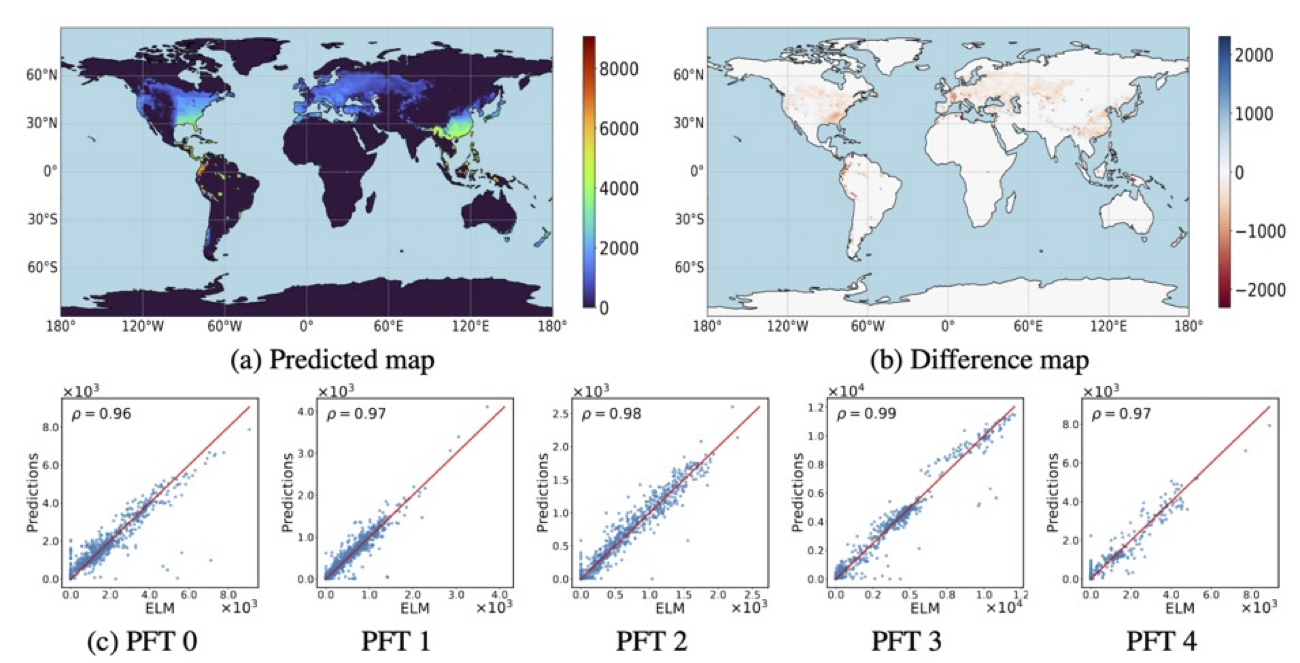
Figure 2: Analysis of Deadcrootc predictions. (a-b) Spatial comparison for the representative PFT 1. (c) Scatter plots across the first five Plant Functional Types (PFTs 1-5).
The framework’s generalization capability were further evaluated by transferring from a 1 degree to a 0.5 degree dataset using three experimental settings: Zero-shot, Few-shot, and Full-train. Results indicated that while Zero-shot performance was low, Few-shot fine-tuning significantly improved accuracy, highlighting the model’s ability to adapt to higher resolutions with limited data by effectively capturing resolution-invariant ecological and physical patterns.
Conclusion
A transformer-based AI framework employing a comprehensive data pipeline, specialized encoders, and multi-level physics constraints, yielded high-fidelity results for the acceleration of ELM spinup. Workflows have been developing for the creation of large-scale training datasets. The AI framework is currently being evaluated by several E3SM ecosystem projects to generate kilometer-scale simulations across North America. The successful AI-based spinup approach also provides a potential path for future development of full-model emulation across long time scales.
Acknowledgement
In addition to foundational investments from the E3SM project, this work has also been supported by the ORNL AI initiative, with substantial contributions stemming from collaborations with the University of North Texas and Saint Louis University.
