

Vegetation demography plays a crucial role in the effects of wood harvesting on the land surface properties
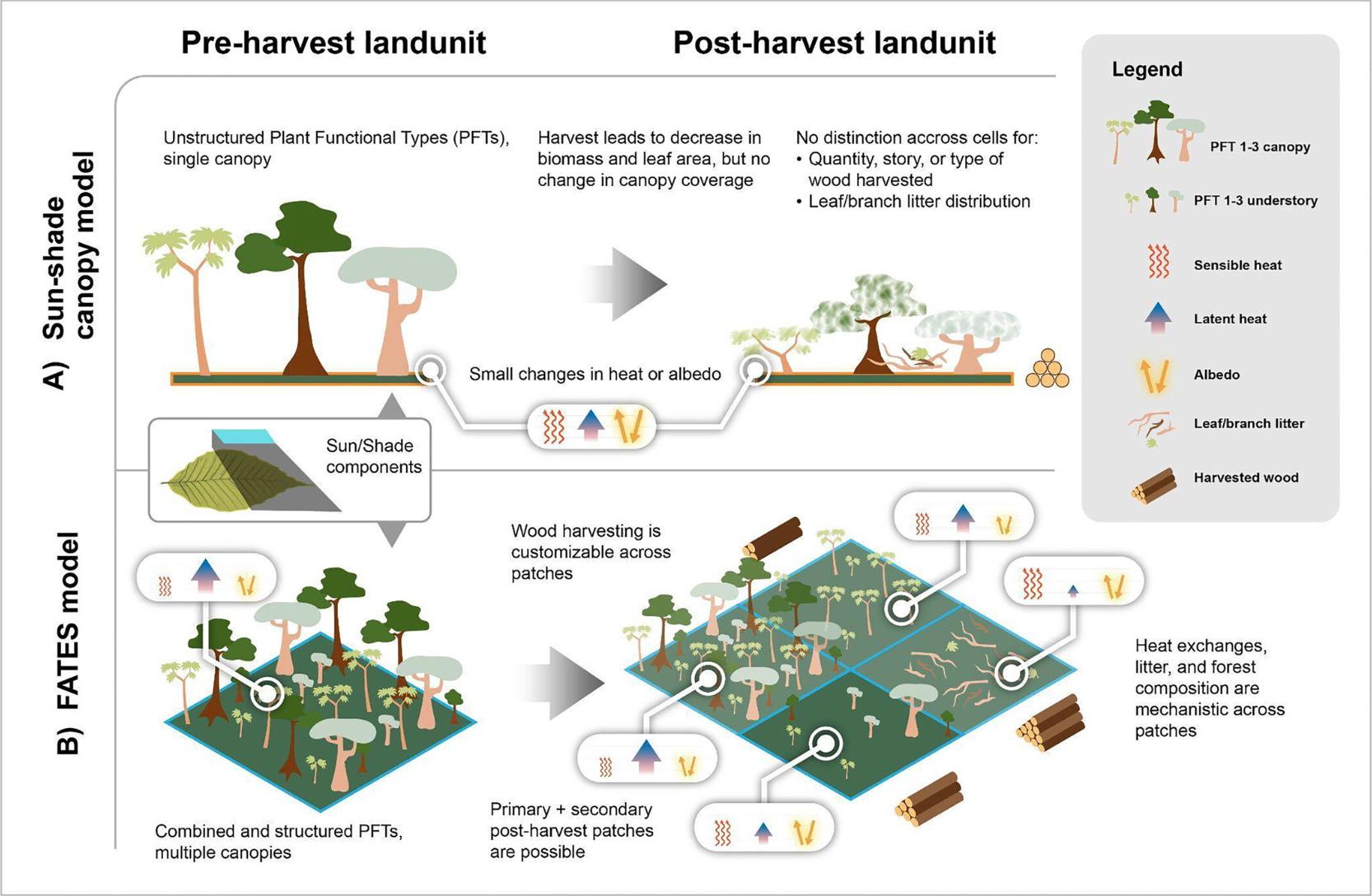
Fig. 1. Schematic showing major differences of wood harvest between (a) sun-shade canopy land surface model (e.g., ELM) and (b) Functionally Assembled Terrestrial Ecosystem Simulator (FATES). Image courtesy of Jeremy Snyder, LBNL.
Enhanced vegetation demography reveals greater wood harvesting impacts on global albedo, surface roughness, and land surface fluxes.
The Science
Wood harvesting is a significant land use activity that affects the environment, but its impact on the Earth’s biogeophysical systems is not well understood. The removal of trees through harvesting methods disrupts the land surface, altering physical properties like albedo, canopy coverage, and surface roughness (Fig. 1). This, in turn, influences local and regional weather patterns, but the magnitude and extent of these effects are unclear.
The Impact
This research provides new insights into the biogeophysical impacts of wood harvesting, highlighting the need to consider both the direct effects of logging and the legacy effects of regrowth from secondary forests. Global simulations with the updated demography model and harmonized data were a better match to observations of multiple land surface biogeophysical properties, showing that the importance of wood harvesting has been underestimated in E3SM. The findings have significant implications depending on the model structural approach of how forest management is modeled. By improving understanding of the complex relationships between wood harvesting, land surface properties, and atmosphere, this study can inform strategies to promote ecosystem sustainability and the role of forest management to enhance carbon storage. Overall, the study highlights the importance of considering the long-term effects of wood harvesting on the environment, and the potential benefits of sustainable forest management practices. In addition, the inclusion of vegetation demography will be useful for future studies on wildfire impacts because FATES represents varying canopy layers, size and age of trees, secondary forest succession and recovery, tree specific wood harvesting management (i.e., forest thinning) all capturing more realistic wildfire responses for human-societal needs.
Summary
Scientists used E3SM’s land model, ELM, which is coupled with a vegetation demography model, Functionally Assembled Terrestrial Ecosystem Simulator (FATES), to conduct global logging experiments. To have more accurate harvesting representation, the spatial pattern of global harvest rate supplied from the Land Use Harmonization 2 (LUH2) dataset was harmonized to ELM-FATES calculated forest inventory. By strengthening the biogeophysical impact of wood harvest via incorporating vegetation demography (i.e., dynamic plant growth, recruitment, mortality leading to variations in age and size-structure), this study found that from 1850 to 2015 accumulated canopy coverage loss reached 5-10%, causing a 0.5-1% increase in albedo over the harvested regions of the globe, up to 30% larger differences compared to a single canopy, sun-shade leaf version of the model. Wood harvesting leads to changes in the amount of tree cover, with some areas experiencing stronger regrowth and others experiencing more loss. Although the ELM-only model overestimated cumulative harvested carbon, compared to the harmonized FATES and driving dataset, its corresponding biogeophysical responses (e.g. changes in surface albedo, energy flux partitioning) were weaker. The team found that by considering variations in plant demography and the effects of regrowing new trees after harvesting, the modeled impacts of wood harvesting have a significant impact on land biogeophysical properties, warranting inclusion of both features in future models.
Publication
- Shu, S., et al, “Investigating the Global Biogeophysical Impact of Area and Mass Based Wood Harvest in a Vegetation Demography Mode.” Journal of Advances in Modeling Earth Systems, (2025). [DOI: https://doi.org/10.1029/ 2024MS004747]
Funding
- This work was supported by the Earth System Model Development program area of the Department of Energy, Office of Science, Biological and Environmental Research program. This research also used resources of the National Energy Research Scientific Computing Center (NERSC), a U.S. Department of Energy Office of Science User Facility located at LBNL which is managed and operated by the Regents of the University of California under prime contract number DE-AC02-05CH11231.
Contact
- Jennifer Holm, Lawrence Berkeley National Laboratory
- Shijie Shu, University of Maryland Center for Environmental Science
