

Using AI to enable improved physics in an Ocean Wave model
Background
Why care about ocean surface waves? Ocean waves play a vital role at the interface between the ocean, atmosphere, and ice. They influence key processes such as sediment transport, coastal flooding, sea-ice fracture, and air-sea exchanges of gas and heat [1]. Extreme wave events can cause significant damage to coastal communities and offshore infrastructure, including disruptions to oil rigs, and maritime operations. Accurate wave simulation is vital for reliable forecasting, risk mitigation, and coastal management.By updating model assumptions to align with field observations, scientists reduced bias in simulated forest dynamics.
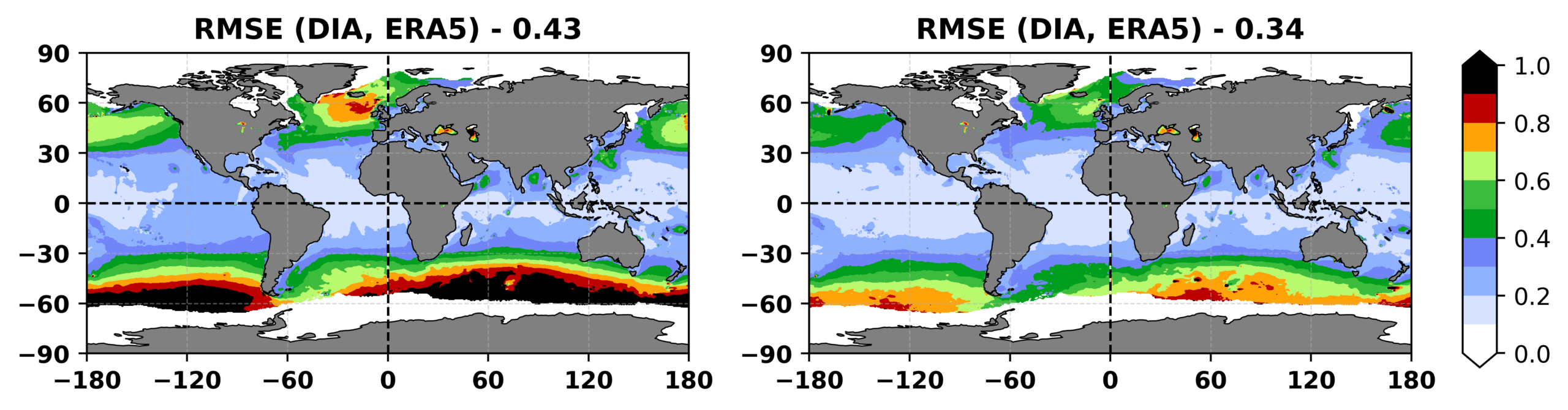
Figure 1. 2020 Global Root Mean Square Error (RMSE) pattern of significant wave height (HS) in (a) Discrete Interaction Approximation (DIA) relative to ERA5, and (b) Webb-Resio-Tracy (WRT) relative to ERA5. Lower numbers (bluer colors) are better.
Currently forecast accuracy comes at a high cost – One of the most important processes in ocean wave modeling is nonlinear wave interactions (NL), a process that redistributes energy across the spectrum and shapes the overall wave field. While exact methods, like Webb-Resio-Tracy (WRT), for modeling these interactions exist, they are computationally expensive for operational forecasting [2]. Instead, an approximated method, Discrete Interaction Approximation (DIA), which sacrifices accuracy for speed has been widely used in operational forecasting for decades [3]. Unlike WRT, which resolves all possible resonant interactions, DIA evaluates a fixed wavenumber configuration at specific angles. Figure 1 shows the annual RMSE of globally simulated significant wave height (HS) using DIA and WRT, relative to ERA5 reanalysis. DIA clearly overestimates HS, particularly in higher latitudes and regions with intense wave activity. The current use of the DIA degrades model prediction skill. Numerous efforts have aimed to improve DIA, and while more accurate, they often become computationally expensive. Early machine learning (ML) approaches [4] showed promise but used shallow neural networks and limited training data. This led to poor generalization, online instability, and expensive runtimes. As a result, they were not suitable for operational use.
Methodology
Enabling accuracy and speed through machine learning: With rapid advancements in ML and computing power, the team revisited the challenge of modeling the nonlinear wave interactions with high accuracy and low computational cost by developing a deep, computational fast and stable ML emulator trained on wave spectra from a global simulation. In this study, they used WAVEWATCH III (WW3), a third-generation spectral wave model developed by the National Oceanic and Atmospheric Administration National Centers for Environmental Prediction (NOAA/NCEP), which is widely used for simulating ocean wave evolution. The ocean is filled with a spectrum of surface waves and resolving the individual waves requires very high resolution. Given resolution requirements, WW3 predicts the evolution of the wave spectra and not individual waves at each geographic point. WW3 thus has a large number of degrees of freedom at every grid point, making emulators more complex. To train and validate the ML emulator, they performed two year-long global simulations, with high resolution near the coast, using both the exact (WRT) and approximate (DIA) NL schemes for 2010 and 2020, producing over 4 million data points across diverse sea states and seasons. To emulate the WRT nonlinear wave interaction parameterization, a deep neural network (NLML) was developed. To capture the structure in the wave spectra and interface with the rest of the WW3 code, an input layer consisting of the full spectra, group velocity and bottom depth was necessary. The inclusion of additional inputs help capture key physical relationships not evident from the spectrum alone. Instead of using the entire globe they chose a sub sample to represent different diverse dynamical regimes. Also, NL spans a wide range of magnitudes (10−25 – 10-2), so sensitivity tests were performed to determine a minimum cutoff below which simulated wave properties are unchanged. This prevents the ML model from being trained on large numbers of near-zero values. NL with maximum values below 10−7 were excluded from the data. 70% of the 2010 simulation data were selected for training, 30% for testing and 2020 for online validation. A brief hyperparameter search led the team to select a model with 4 hidden layers and 3,072 neurons per layer, balancing performance and efficiency. This deep architecture enables the model to learn complex physical interactions and achieve online stability, unlike earlier shallow models. A customized L1 loss function, weighted by output variance, was used to prioritize in high-variance regions of the spectrum.
Results
NLML – The first stable hybrid ML ocean wave model with accuracy & speed: These carefully designed ML choices, informed by physical understanding of ocean waves dynamics, enabled the development of the first stable hybrid ML emulator for nonlinear wave interactions that generalizes across ocean basins, bathymetric depths, and hemispheres. Figure 2 shows the 2020 annual mean significant wave height (HS) simulated by WRT, the RMSE of DIA relative to WRT, and the RMSE of NLML relative to WRT. As shown, NLML significantly reduces the large errors introduced by DIA, achieving up to 7× higher accuracy in some regions. Similar improvements are observed in other mean wave parameters.

Figure 2. (a) The 2020 annual mean significant wave height (HS) for WRT. (b) Global RMSE pattern of HS in DIA relative to WRT. (c) Global RMSE pattern of HS in NLML relative to WRT. For (a), the number in the white box indicate the global mean, whereas for (b) and (c), it indicates the global RMSE. Additionally, for (b) and (c), lower numbers (bluer colors) are better.
Given the goal of developing an emulator for the nonlinear wave interactions that combines the accuracy of WRT with the speed of DIA, evaluating the computational performance of NLML is critical. This assessment determines whether NLML can meet the efficiency demands of operational wave models while preserving high accuracy. By leveraging advanced graphics processing units (GPU) computing with half precision (FP16) capabilities, the team achieved substantial speedups, up to 136x faster than the WRT and only a modest 1.04x slowdown relative to DIA.
Conclusion
Given the substantial improvement in accuracy of global wave spectral energy and mean parameters relative to DIA, the minor computational overhead of NLML remains a reasonable trade-off for its improved representation of NL. With ongoing advancements in hardware acceleration, mixed precision computing, and ML optimization techniques, the efficiency of NLML can be further refined, making it a promising approach for future high resolution and real time wave modeling applications. In summary, the new ML parameterization of NL (NLML) bridges the gap between accuracy and efficiency, offering a promising alternative for improving wave modeling in operational settings and research purposes.
[1] Cavaleri, L., Fox-Kemper, B., & Hemer, M. (2012). https://doi.org/10.1175/BAMS-D-11-00170.1
[2] van Vledder, G. P. (2006). The WRT method for the computation of non-linear four-wave interactions in discrete spectral wave models. Coastal Engineering, 53(2–3), 223–242. https://doi.org/10.1016/j.coastaleng.2005.10.011
[3] Hasselmann, K. (1963). On the non-linear energy transfer in a gravity-wave spectrum: Part 2. Conservation theorems; wave–particle analogy; irreversibility. Journal of Fluid Mechanics, 15(2), 273–281. On the non-linear energy transfer in a gravity wave spectrum Part 2. Conservation theorems; wave-particle analogy; irrevesibility
[4] Tolman, H. L. (2009). Practical nonlinear interaction algorithms. In Proceedings of the 11th international workshop on wave hindcasting and forecasting & coastal hazards symposium. Nova Scotia. Retrieved from https://www.waveworkshop.org/11thWaves/Presentations/J2_Tolman.pdf
Publication
- Ikuyajolu, O. J., Van Roekel, L., Brus, S. R., & Thomas, E. E. (2026). NLML: A deep neural network emulator for the exact nonlinear interactions in a wind wave model. Journal of Geophysical Research: Machine Learning and Computation, 3, e2025JH000699. https://doi.org/10.1029/2025JH000699
Funding
- This research was supported as part of the Energy Exascale Earth System Model (E3SM) project, funded by the U.S. Department of Energy, Office of Science, Office of Biological and Environmental Research. This work was supported by the U.S. Department of Energy through the Los Alamos National Laboratory. Los Alamos National Laboratory is operated by Triad National Security, LLC, for the National Nuclear Security Administration of the U.S. Department of Energy (Contract No. 89233218CNA000001). Argonne National Laboratory is operated under the Department of Energy Office of Science contract number DE-AC02-06CH11357. This research used resources from the National Energy Research Scientific Computing Center (NERSC), a U.S. Department of Energy Office of Science User Facility located at Lawrence Berkeley National Laboratory, operated under Contract No. DE-AC02-05CH11231 using NERSC award BER-ERCAP-0027116 and BER-ERCAP-0032115.
Contact
- Olawale James Ikuyajolu, Los Alamos National Laboratory
- Luke van Roekel, Los Alamos National Laboratory
- Erin E. Thomas, Los Alamos National Laboratory
- Steven R. Brus, Argonne National Laboratory
