

Probabilistic Projections of Sea-Level Contribution from a Stable Antarctic Ice Sheet Sector
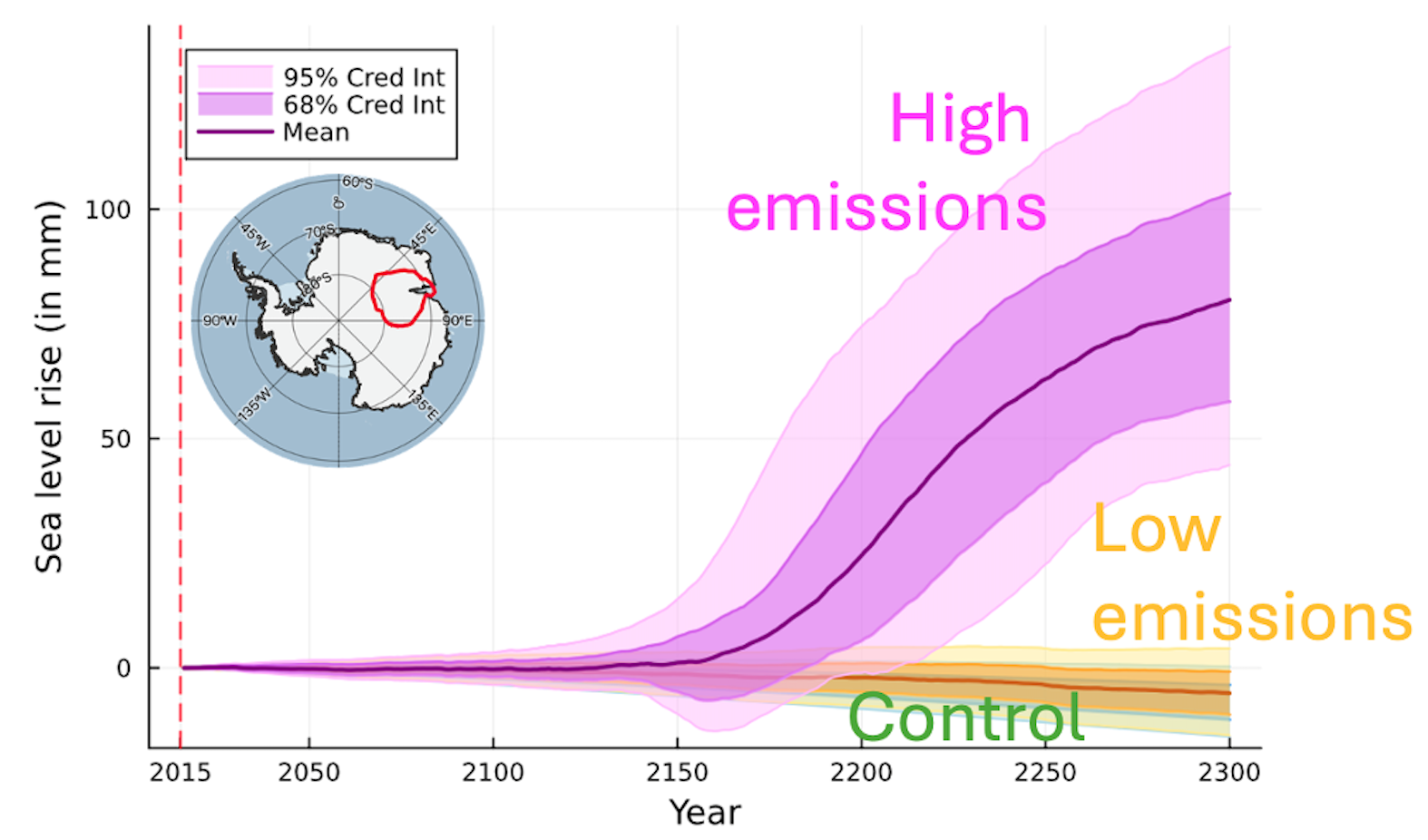
Figure 1. Probabilistic projections of sea-level contribution from the Amery Ice Shelf sector of Antarctica under low and high greenhouse gas emissions scenarios | Sanket Jantre, Brookhaven National Laboratory
Beyond 2100, high greenhouse gas emissions are likely to lead to rapid retreat of the presently stable Amery Ice Shelf sector of the Antarctic Ice Sheet.
The Science
The sector of the Antarctic Ice Sheet flowing into the Amery Ice Shelf has remained remarkably stable over the period of historical observations, suggesting it is unlikely to make a significant contribution to future sea-level change. Researchers used large ensembles of ice-sheet model simulations and statistical calibration techniques to quantify uncertainty in the future sea-level contribution from this region. They found that ocean-driven melting is potentially likely to increase future sea level from this region by 46 to 133 mm at 2300 (Fig. 1), which is up to 5 times larger than in previous estimates.
The Impact
Their results show that while more stable than other regions of Antarctica, the Amery Ice Shelf sector is susceptible to ocean-driven melting and rapid retreat. This result is robust accounting for uncertainty in key ice-sheet model parameters. The study demonstrates an efficient Bayesian calibration and uncertainty propagation workflow for ice-sheet model projections that can be extended to the entire ice sheet.
Summary
The Amery Ice Shelf drains 16% of the East Antarctic Ice Sheet and has been long considered stable to change due to its location in a narrow embayment and being surrounded by cold ocean water. However, recent global earth system model projections through 2300 indicate that extreme ocean warming in the region and subsequent ocean-melt-driven removal of the ice shelf is possible after 2100, casting the future stability of this region into doubt. At the same time, ice-sheet model projections are subject to uncertainty from poorly known model parameters, highlighting the need for uncertainty quantification. To address this, the team applied a regional configuration of the E3SM ice-sheet component, MALI (Fig. 2a), to generate an ensemble of 200 simulations with parameter values perturbed over their likely ranges (Fig. 2b). Using statistical emulation of the resulting ensemble (Fig. 2c), they performed Bayesian calibration on the uncertain model parameters (Fig. 2d), using observations of key glacier quantities from the historical period. By sampling from the posterior distribution of parameter values and utilizing statistical emulation of the model ensemble, they generated calibrated, probabilistic projections under different conditions. Accounting for the uncertainty in ice-sheet model parameters, they found that the difference between the two projections becomes statistically significant around 2130 and, the Amery sector could potentially contribute 46 to 133 mm to the global sea level.
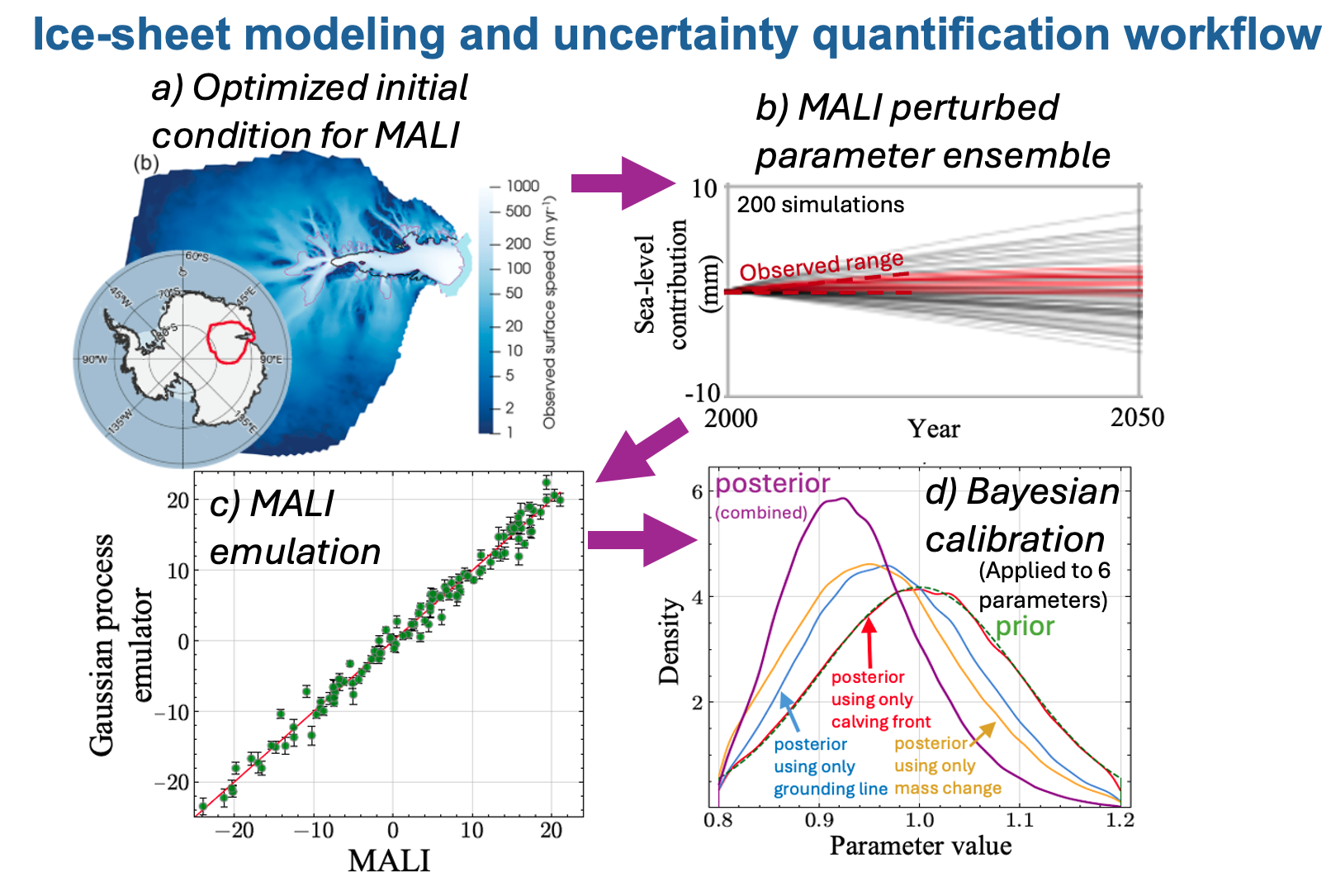
Figure 2. Workflow used by the researchers: a) optimized initial condition for MALI, b) MALI perturbed parameter ensemble, c) MALI emulation, d) Bayesian calibration.
Publication
- Jantre, Sanket, Matthew J. Hoffman, Nathan M. Urban, Trevor Hillebrand, Mauro Perego, Stephen Price, and John D. Jakeman. 2024. “Probabilistic Projections Of The Amery Ice Shelf Catchment, Antarctica, Under Conditions Of High Ice-Shelf Basal Melt”. The Cryosphere 18 (11). Copernicus GmbH: 5207-5238. doi:10.5194/tc-18-5207-2024.
Funding
- This work was supported by the Earth System Model Development program area of the Department of Energy, Office of Science, Biological and Environmental Research program.
Contact
- Matthew Hoffman, Los Alamos National Laboratory
This article is a part of the E3SM “Floating Points” Newsletter, to read the full Newsletter check:
-
….
