

Optimized Local Time-Stepping for the Ocean and Atmosphere
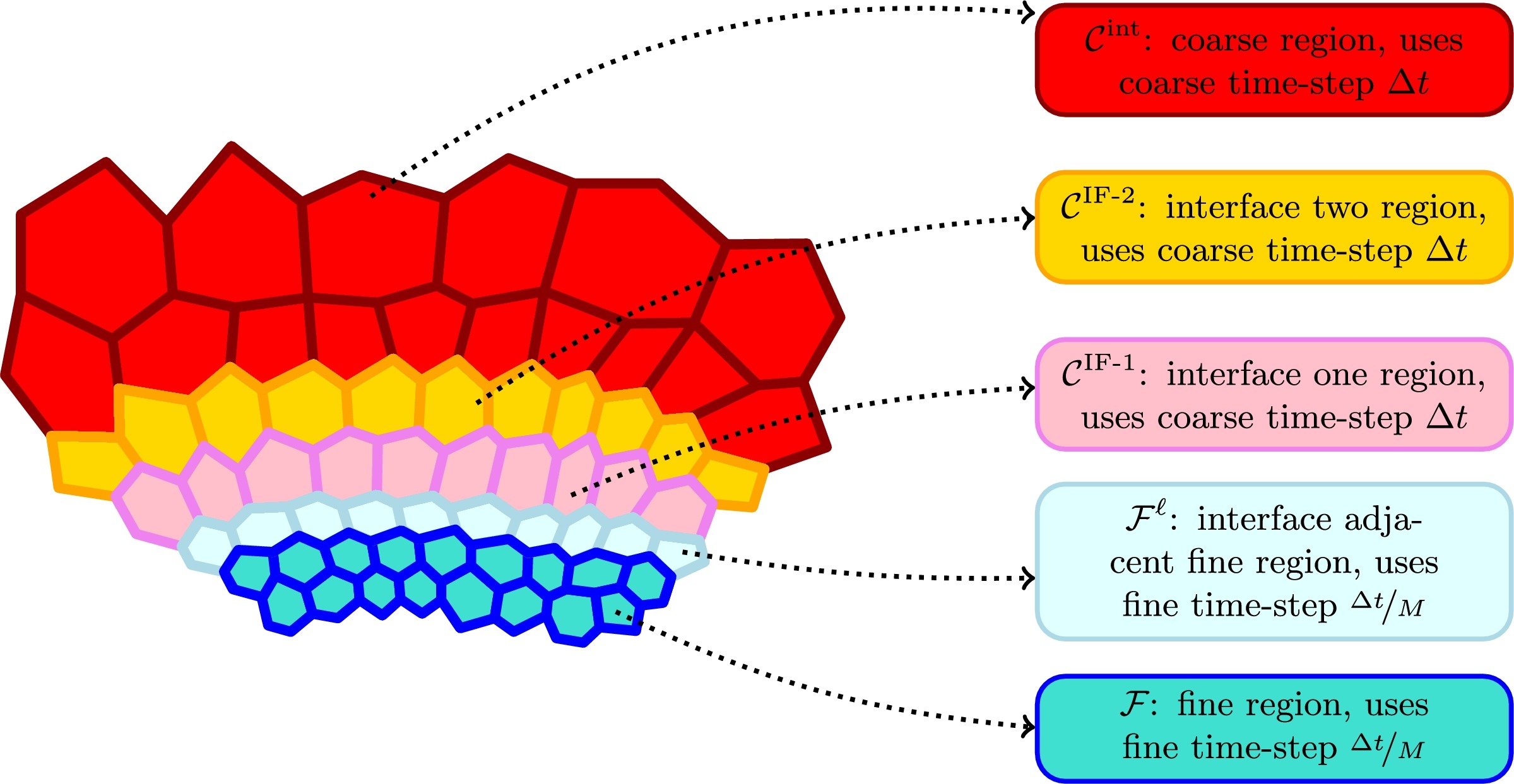
Figure 1. An example mesh with cells and edges labeled for local time stepping.
New local time-stepping scheme decreases runtime of higher resolution simulations.
The Science
Researchers developed and implemented a new local time-stepping (LTS) scheme, optimized for equations relevant to ocean and atmosphere modeling. This scheme, SplitFB-LTS, was shown to model storm surge caused by Hurricane Sandy, with a speedup of more than 10x in MPAS-Ocean.
The Impact
The DOE ocean model MPAS-Ocean uses unstructured grids of variable spatial resolution, allowing simulations to be run with only certain areas of the globe highly resolved. The computational efficiency obtained by SplitFB-LTS allows simulations on such meshes to run faster at higher resolutions.
Summary
The size of the time-step that can be used by explicit time-stepping schemes depends on the speed of the problem dynamics and the size of the spatial discretization. This means that the size of the admissible time-step can vary greatly over space (Fig. 1), especially when considering meshes of variable spatial resolution. Local time-stepping (LTS) schemes provide a solution to this problem by allowing time-steps of different sizes depending on local conditions.

Figure 2. The lower plot shows the sea-surface height solution at a given tidal gauge as produced by three different time-stepping methods; SplitFB-LTS produces a qualitatively equivalent solution to the other two methods (note that the orange and green curves are under the red curve) in one tenth the time. The upper figure shows a breakdown of the different sources of speedup within the SplitFB-LTS algorithm. | Image by Jeremy Lilly, LANL
Building on previous work, researchers developed a new LTS scheme called SplitFB-LTS, optimized specifically for the shallow water equations. They proved the scheme exactly conserves mass and vorticity. They then implemented it in MPAS-Ocean for single-layer configurations and used it to model the storm surge caused by Hurricane Sandy in Delaware Bay. Doing this, they showed that SplitFB-LTS is up to 10 times faster in terms of computational time than the previous MPAS-Ocean default (the fourth order Runge-Kutta scheme) while maintaining solution quality (Fig. 2).
Publication
- Lilly, Jeremy R., Giacomo Capodaglio, Darren Engwirda, Robert L. Higdon, and Mark R. Petersen. 2025. “Local Time-Stepping For The Shallow Water Equations Using Cfl Optimized Forward-Backward Runge-Kutta Schemes”. Journal Of Computational Physics 520. Elsevier BV: 113511. doi:10.1016/j.jcp.2024.113511.
Funding
- Part of this work was supported by the Earth System Model Development program area of the Department of Energy, Office of Science, Biological and Environmental Research program.
Contact
- Mark Petersen, Los Alamos National Laboratory
This article is a part of the E3SM “Floating Points” Newsletter, to read the full Newsletter check:
