

MAM4xx Report
In 2024, a development version of a prognostic aerosol scheme was incorporated into E3SM‘s next-generation atmosphere model, EAMxx. This MAM4xx Atmospheric Aerosol scheme (Modal Aerosol Model – 4 Modes, in C++[xx]) is a fully-validated C++ port of an earlier Fortran implementation of the same physics.
Since January 2025, a dedicated MAM4xx team, made up of researchers at Pacific Northwest National Laboratory and Sandia National Laboratory, has focused on completing the code integration, testing, and initial preliminary evaluation of MAM4xx’s behavior within EAMxx. In October 2025, the MAM4xx team achieved a major milestone by delivering a report to project leadership, outlining the key strengths and weaknesses of the initial MAM4xx implementation.
The team evaluated the MAM4xx module’s scientific and computational performance in year-long simulations at 12-km resolution with prescribed winds. They found that this early development version of MAM4xx simulates realistic geographic distributions of aerosol mass, and that the overall effect on the Earth’s radiative budget is within the observationally constrained range. However, several issues were also identified that the team will work to resolve during the upcoming year.
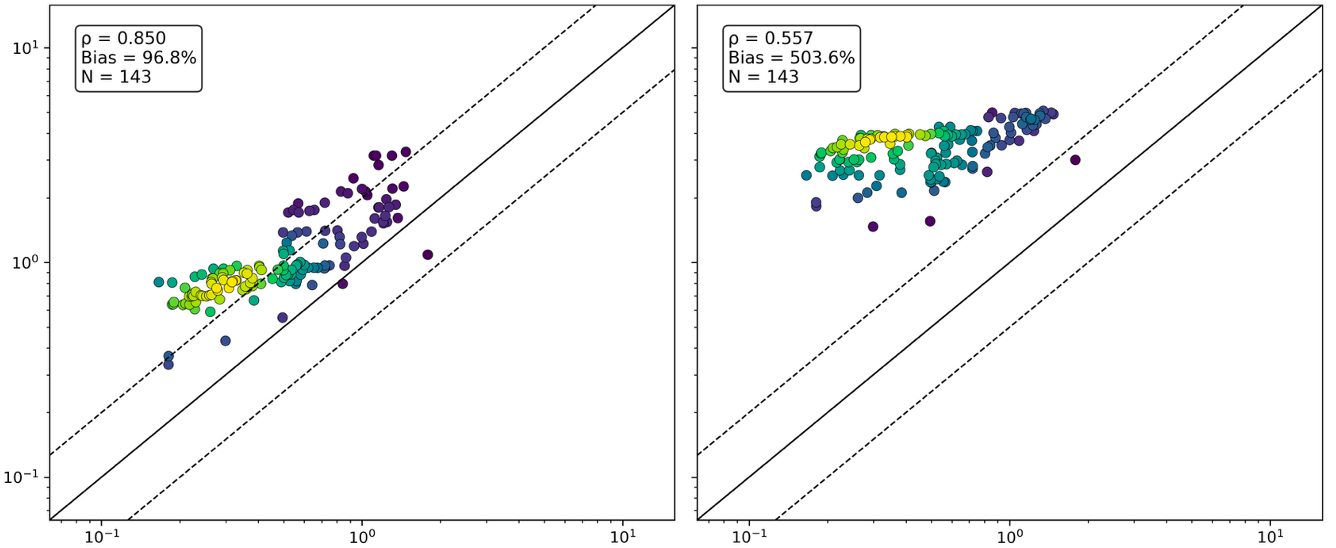
Figure 1. Preliminary evaluation of simulated sulfate aerosol mass concentrations in near-surface air over North America, compared with observations from the IMPROVE network. Left panel: EAMv2; Right panel: EAMxx-MAM4xx (development version). The EAMxx-MAM4xx simulation substantially overestimates aerosol concentrations, exhibiting a larger bias and lower correlation than the EAMv2 MAM4 aerosol module on which it is based. This high bias is caused by inefficient wet removal in this initial development version of MAM4xx.
For example, the team found that aerosols are not washed out of the atmosphere effectively by rain, resulting in a high bias in simulated concentrations (Fig. 1). This bias is partly attributable to the representation of aerosol wet removal (washout) by deep convective clouds. The traditional approach to parameterizing this process relies on the presence of a convection parameterization, which has not yet been implemented in EAMxx. Preliminary analysis suggests that the current biases will be significantly reduced by implementing the Zhang-McFarlane convection into EAMxx. This parameterization is currently under development and scheduled for completion in 2026. Additional bias reductions can be achieved through calibrations of the aerosol scheme similar to those described in Xie et al. (2025).
The computational cost of the aerosol module was also assessed. In this initial implementation, MAM4xx adds 40-60% to the computational cost of EAMxx.
Based on the results of this evaluation report, the project’s Executive Committee has decided to postpone the incorporation of MAM4xx as a default feature in the EAMxx model, allowing sufficient time for these issues to be robustly addressed. Initially slated for the E3SMv4.0 release, the prognostic aerosol scheme will now be added in a subsequent, incremental update (v4.X). Addressing the physics biases identified in the report and improving the computational performance will be the primary goals for the MAM4xx team in the upcoming year.
