

How Global Expansion of Irrigation Influences Moist-Heat Stress
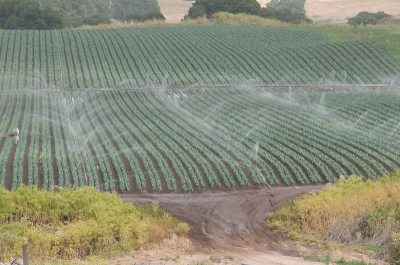
Photo by Lance Cheung (U.S. Department of Agriculture)
Irrigation expansion increases air humidity, which in turn can worsen moist-heat stress.
The Science
Irrigation, after a rapid expansion starting in the early nineteenth century, now accounts for more than 70 percent of total human freshwater use. This research addresses a knowledge gap regarding how irrigation affects air temperature and humidity, potentially worsening moist-heat stress, which refers to a combination of high humidity and high temperature that can cause adverse effects on human health. Two commonly used metrics of moist-heat stress are the Humidex (HU) and the wet-bulb temperature (Tw). The impact of irrigation on moist-heat stress is increasingly relevant in Earth system modeling due to growing water use during irrigation.
The Impact
Irrigated areas were found to be more prone to extreme wet-bulb temperatures especially in already-vulnerable regions like South Asia, Central North America, and East Asia. This research is the first to quantify this effect on a global scale using advanced Earth system models. The use of multiple moist-heat metrics allowed for a detailed understanding of how regions are affected differently, which can enable scientists to better predict the health impacts of irrigation. The results underscore the need for localized moist-heat monitoring and tailored responses to address the health risks associated with irrigation practices. The results also show that most Earth system models considerably underestimate the amount of irrigation water withdrawal – that is, the amount of water funneled from runoffs, rivers, reservoirs, etc. and into irrigation systems. This highlights the importance of accurate representation of irrigation in such models to improve predictions for water availability and management. Finally, the study’s framework can be applied to other fields, such as urban planning and public health.
Summary
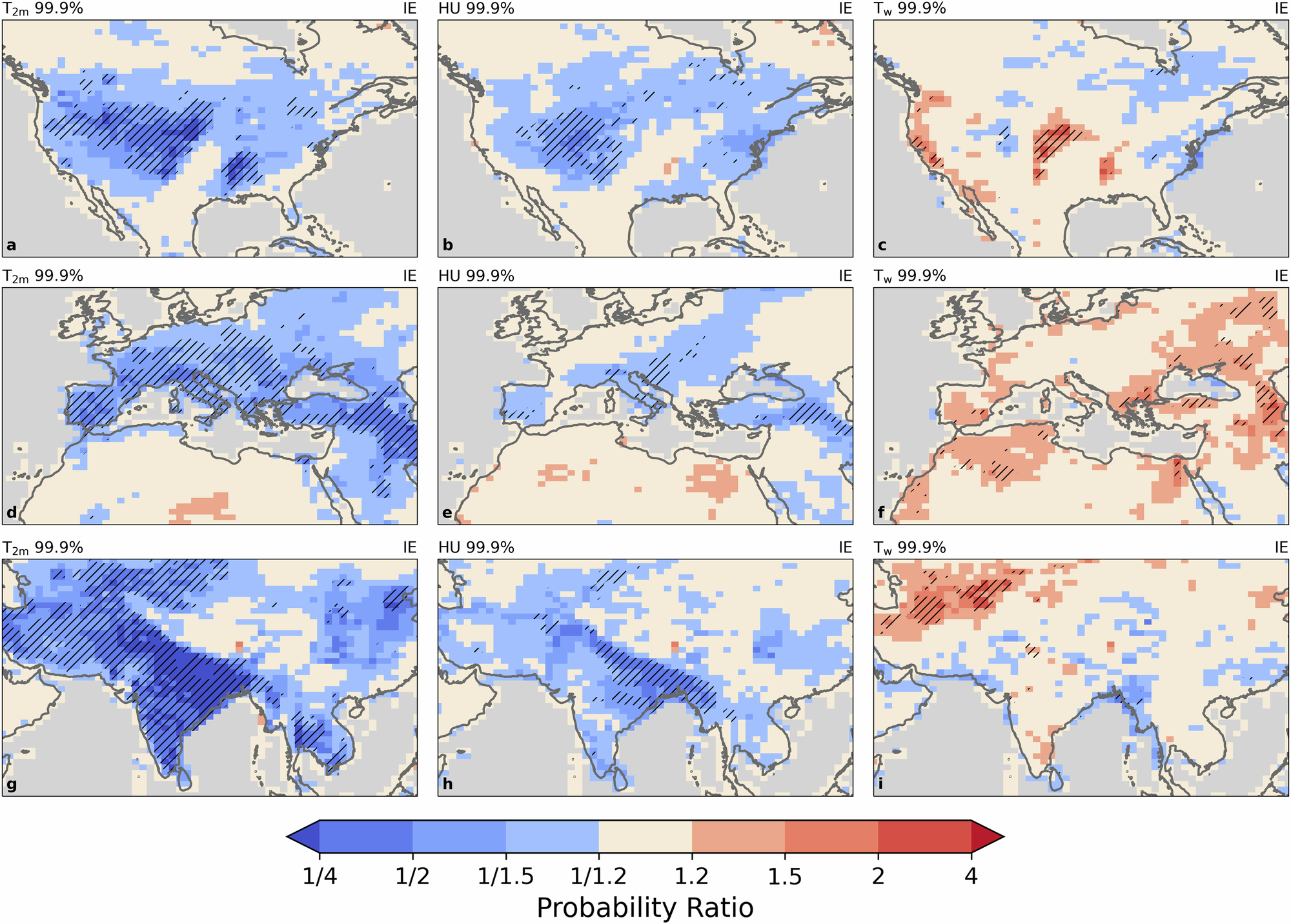
Figure 1. The impacts of irrigation expansion on the frequency of 99.9th percentile 2-meter air temperature (T2m), humidex (HU), and wet-bulb temperature (Tw). While irrigation expansion substantially reduces the frequency of T2m extremes (South Asia, West Central Asia, and Central North America), its impacts on HU and Tw are much less pronounced and inconsistent across models.
The impacts of historical irrigation expansion were quantified with six advanced Earth system models, including the Energy Exascale Earth System Model (E3SM). The research analyzed how irrigation influences wet-bulb temperatures. The E3SM was among the models used and was augmented with a sophisticated irrigation scheme to account for both surface water and groundwater withdrawal as part of the Irrigation Model Intercomparison Project (IRRMIP). While irrigation expansion led to a significant reduction in extreme 2-meter air temperature (T2m, see Fig. 1) events in heavily irrigated areas, the cooling effect on moist-heat stress was less pronounced, or even reversed, for some moist-heat stress metrics and regions. Irrigation expansion generally increased local humidity, thereby raising wet-bulb temperatures (Tw, see Fig. 1) and exacerbating moist-heat stress, especially in vulnerable regions like South Asia and East Asia.
Publication
- Yao, Y., Ducharne, A., Cook, B.I. et al. Impacts of irrigation expansion on moist-heat stress based on IRRMIP results. Nat Commun 16, 1045 (2025). https://doi.org/10.1038/s41467-025-56356-1
Funding
- The Department of Energy, Office of Science, Biological and Environmental Research program supported this research as part of the Regional and Global Model Analysis program area and the Earth System Model Development program area.
Contact
- L. Ruby Leung, Pacific Northwest National Laboratory
This article is a part of the E3SM “Floating Points” Newsletter, to read the full Newsletter check:
