

Heroic Bug Fixes – Snow Grain Size
Bugs are an inevitable part of any complex software project, and E3SM is no exception. A lot of time goes into finding and fixing bugs, the resulting impacts can rival major parameterization changes, but these efforts and their impacts frequently go unreported. Starting with this issue, Floating Points is proud to introduce Heroic Bug Fixes, a recurring column that celebrates the critical yet often overlooked work of debugging. We hope that by shining a well-deserved spotlight on this critical work we can inspire further debugging efforts across the community and provide the broader E3SM community with timely information about changes which could aid their own development and investigations.
Heroic Bug Fixes: Snow grain scattering improved by a team across the E3SM project, including Carolyn Begeman, Andrew Roberts, Charlie Zender, Shixuan Zhang, Darin Comeau, Wuyin Lin, Dalei Hao, Walter Hannah and Gautam Bisht.
Since the inception of E3SM, a large simulated surface air temperature bias has existed over the Antarctic and Greenland ice sheets. Even in control simulations, summer biases have exceeded +10˚C against 1980-2016 ERA and MERRA reanalyses, including in E3SM Version 3. This bias posed a problem for the BlueTip experiment (described below) being completed by the Polar Processes, Sea Level Change, and Coastal Impacts Group. Working intensively this year, the group has identified a key source of the bias.
BlueTip aims to quantify atmospheric forcing necessary for the onset and reversibility of rapid melt under Antarctic ice shelves as part of a broader investigation of critical thresholds in the crysophere. To achieve this, the bottom temperature of E3SM’s Southern Ocean must be close to present day. However, tests using a version 3 pilot of the Southern Ocean Regionally Refined Model (SORRM) revealed our austral ocean to be far too warm, precluding its use for BlueTip trace-gas ramping in E3SM Atmosphere Model (EAM). The polar team hypothesized that the core problem was not E3SM’s ocean, sea ice, nor marine atmosphere, but the surface temperature over the Antarctic continent itself. They surmised that high ice sheet temperatures were preventing frigid katabatics from modulating ocean heat content, and set out to diagnose the cause of E3SM’s ice sheet temperature bias, and fix it.
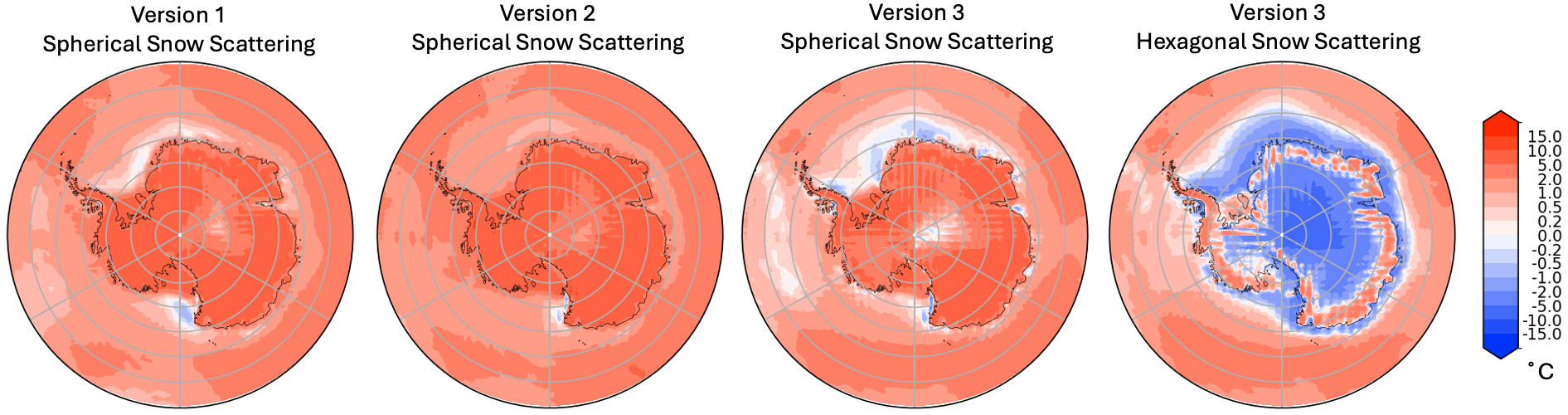
Figure 1. December to February standard-resolution mean 50-year fully coupled 1850 control surface temperature bias relative to 1980-2016 MERRA2 for each version of E3SM with standard spherical scattering in ELM SNICAR albedo calculations, and for E3SMv3 with hexagonal scattering. A negative bias, as seen in the last panel, is expected when comparing an 1850 control with 1980-2016 observations in agreement with a steady temperature increase registered across Antarctic meteorological stations beginning in 1903.
Their approach is lent from Sir Arthur Conan Doyle: “When you have eliminated the impossible, whatever remains, however improbable, must be the truth”. They eliminated model resolution, gravity wave drag, and EAM topographic smoothing as key sources of bias. Then a surface flux analysis matched summer Antarctic temperature bias to clear sky albedo; the cause of the bias lay in E3SM Land Model’s (ELM’s) radiative transfer model, SNICAR, or in land snow depth or morphology. Up to version 3, E3SM’s spherical snow grain scattering of shortwave radiation had been treated identically over land and sea ice – grains age from initially bright fresh snowfall to become rounded aged particles reflecting less light. Experimentation, as well as an encounter at the E3SM all-hands workshop in February, revealed the issue not to be snow aging, but scattering. The polar group determined that physically-appropriate hexagonal radiative scattering, rather than the default spherical scattering, reduced surface Antarctic temperature to become a mainly negative bias across the ice sheet, seen in the Figure 1. A simple namelist switch to hexagonal scattering had been omitted from E3SM’s code, and with a correction to it, colder temperatures commensurate with an 1850 control were achieved, including in the Southern Ocean.
This article is a part of the E3SM “Floating Points” Newsletter, to read the full Newsletter check:
