

Future Flood Extremes from Rain-on-Snow Events Face Change
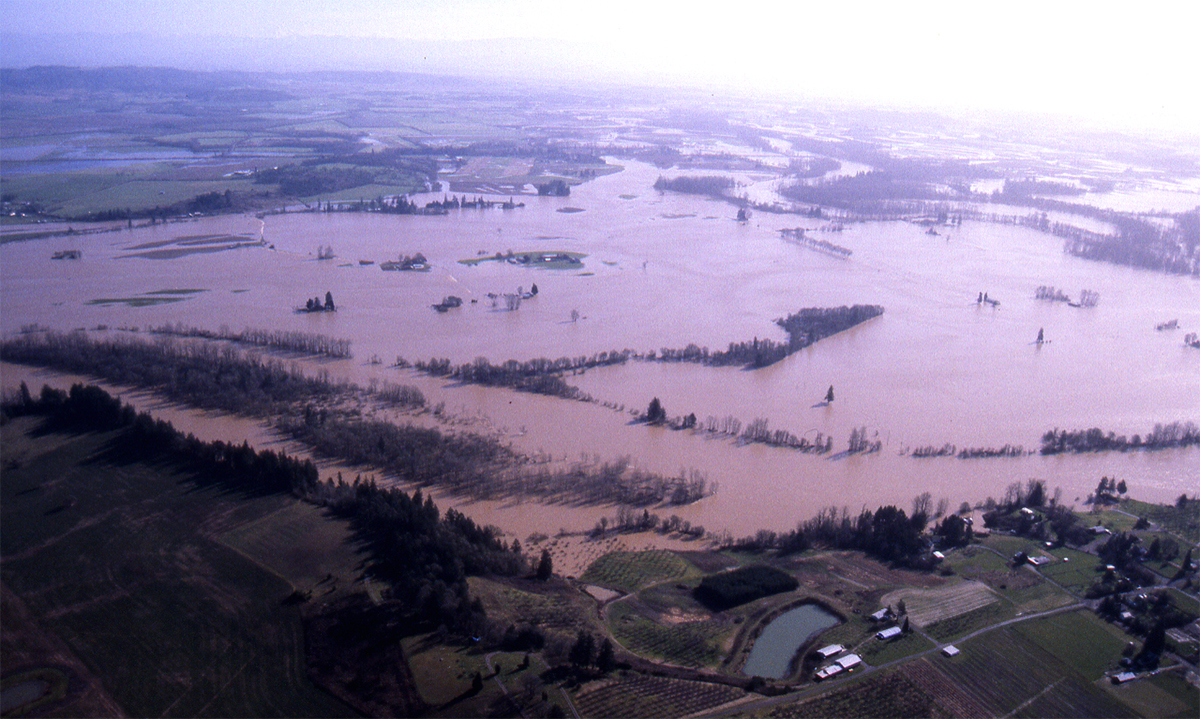
An extreme flooding event during a rain-on-snow (ROS) event in western Oregon in February 1996. Photo by Portland Corps | Accessed via Wikimedia Commons
Different historically impactful rain-on-snow extreme flood events show divergent responses to a changing world.
The Science
Rain-on-snow (ROS) events occur when rain falls on a preexisting and ripened snowpack. Earth system changes are altering the characteristics of ROS events (e.g., severity, frequency, distribution, timing, and duration) and their corresponding flood risks. However, there is a lack of consensus or comprehensive information about how ROS-induced extreme flood events with severe impacts would respond to Earth system changes.
The Impact
This research is the first to comprehensively examine how different future ROS extreme flood events could unfold and how key flood drivers may shift in a changing world. The results showed a range of ROS extreme flood events depending on different Earth system change scenarios. These divergent responses underscore the need for comprehensive flood control planning that quantifies region- and elevation-specific changes in ROS events. These findings are helpful in better projecting and managing extreme floods from ROS in a changing world.
Summary
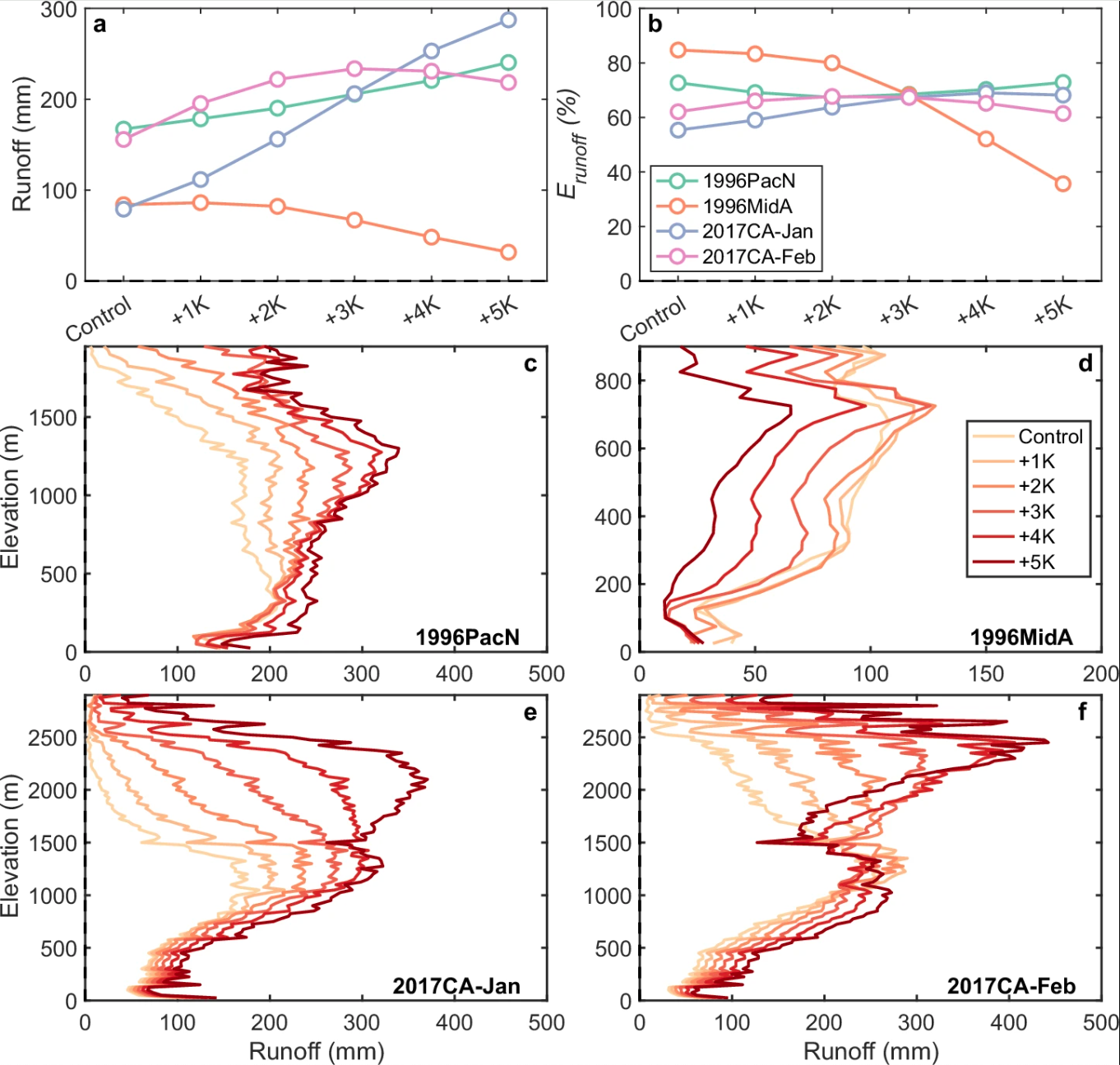
Figure 1. Different ROS-induced extreme flood events show divergent responses of the basin average (a-b) and elevation profiles (c-f) of cumulative runoff and runoff efficiency in a changing world with increasing air temperature and varying precipitation. 1996 Pacific Northwest floods (1996PacN; green lines in a-b), 1996 January Mid-Atlantic floods (1996MidA; orange lines in a-b), 2017 California floods (including two events in January and February: 2017CA-Jan and 2017CA-Feb; blue and pink lines in a-b, respectively).
This research explored four past ROS extreme flood events using a kilometer-scale land surface model, the E3SM land model (ELM). Compared to coarse-scale simulations, kilometer-scale simulations better capture fine-scale spatial details and elevation dependence. Using storyline analyses, the latter also revealed diverse responses of four historically impactful ROS-induced extreme flood events across the contiguous United States to Earth system changes resulting from alterations in their water budgets (Fig. 1). For the 2017 February California floods, runoff first increases and then decreases with air temperature, peaking under the +3 K scenario (Fig. 1a, pink line), whereas the runoff of the 2017 January California floods increases monotonically by ~53%/K (Fig. 1a, blue line). Contrastingly, runoff from the 1996-Jan Mid-Atlantic floods gradually decreases with air temperature (Fig. 1a, orange line). Despite these differences, Earth system changes generally shift flood-generating regimes along elevation profiles. High elevations may experience notably increased runoff, while low elevations may encounter a shift from runoff driven by ROS to rainfall-dominated runoff.
Publication
- Hao, D., G. Bisht, D. Xu, D. et al. 2025. Commun Earth Environ 6, 409. https://doi.org/10.1038/s43247-025-02354-6
Funding
- This work was supported by Scientific Discovery through Advanced Computing (SciDAC) Partnership Program, through the project “Capturing the Dynamics of Compound Flooding in E3SM”, funded by the U.S. Department of Energy, Office of Science, Biological and Environmental Research program, Earth System Model Development Program Area and the Office of Advanced Scientific Computing Research (ASCR). Pacific Northwest National Laboratory is operated by Battelle for the U.S. Department of Energy.
Contact
- Dalei Hao, Pacific Northwest National Laboratory
- Gautam Bisht, Pacific Northwest National Laboratory
