

Fully-Coupled E3SM Capability with Full Land/Ocean BGC
Key Points
- Development of a fully-coupled E3SM configuration integrating full land, ocean and sea ice biogeochemistry (BGC).
- Successful implementation and testing of new land features: crop, water management, and plant hydraulics.
- Substantial tuning of key biogeochemical parameters to improve the performance of land and marine processes.
Background
The fully-coupled biogeochemistry configuration of the Energy Exascale Earth System Model (E3SM) is one of its defining strengths, enabling dynamic feedbacks among atmosphere, land, ocean, and sea ice components. These interactions are critical to producing realistic projections of Earth system evolution, capturing exchanges of energy, water, and elemental cycling.
Biogeochemical cycles, particularly those governing carbon, nutrients, and ecosystem function, have historically been underrepresented due to process uncertainties, parameterization gaps, and/or computational limitations. Enhancing land and marine BGC is essential for simulating feedbacks between emissions and ecosystem responses with fidelity. In addition, a crucial test for any global model involves reproducing how the Earth system evolves in response to human emissions, as opposed to prescribing the concentrations of atmospheric constituents over time, but this is often difficult to achieve.
The Human-Earth System (HES) group has led a concerted effort to advance E3SM’s fully-coupled capability with active land and ocean biogeochemistry. Through extensive teamwork, they developed and tested an improved coupling framework, implemented key biogeochemical processes, and conducted pre-industrial simulations (Figure 1) to evaluate system equilibrium and performance.
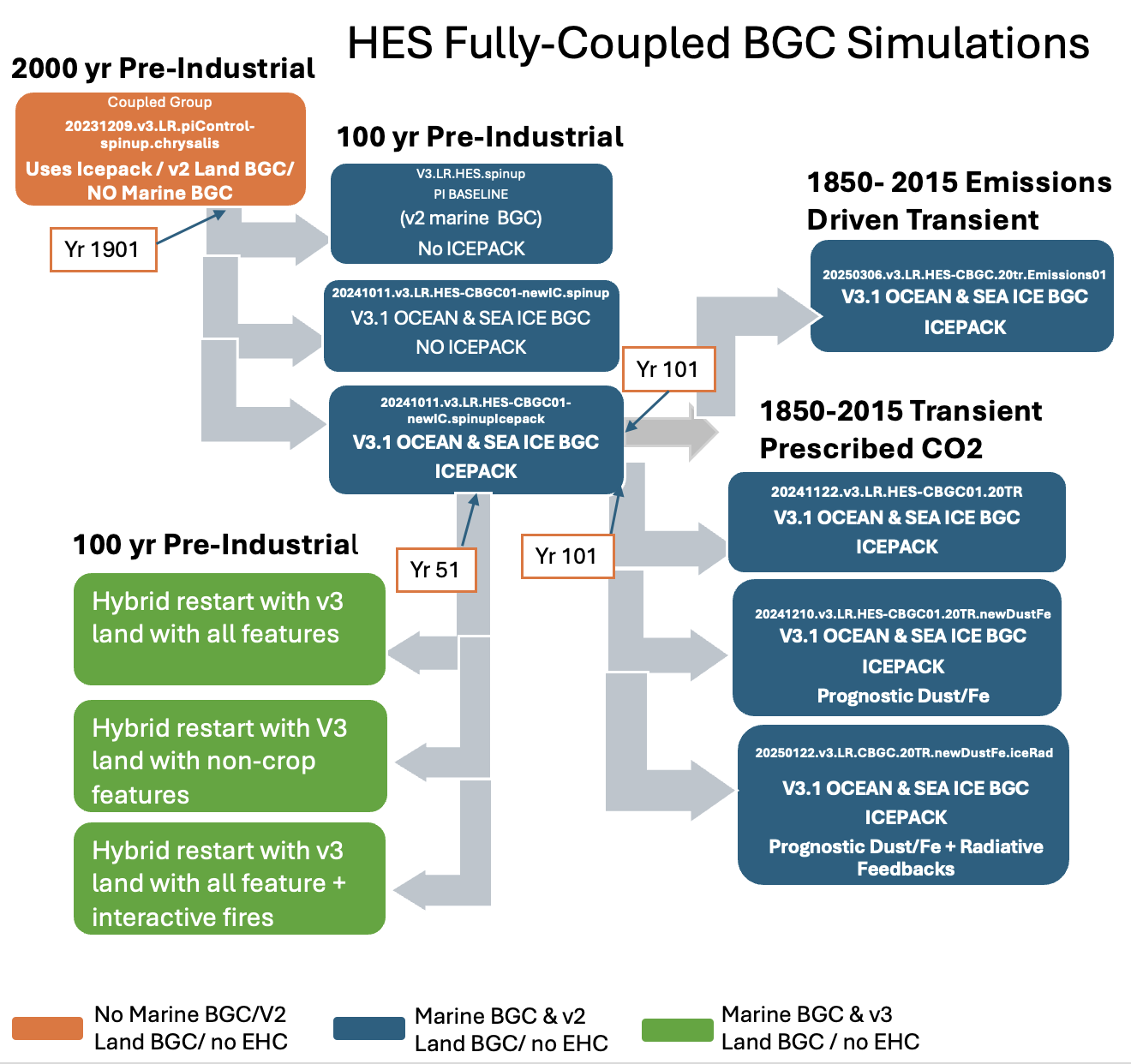
Figure 1. Roadmap of simulations needed for the fully coupled BGC simulation campaign. E3SM model versions (v) are indicated as v2, v3, and v3.1 (in progress). EHC represents the E3SM Human Component. Pre-Industrial initial conditions (Orange) are taken from the year 1901 of the v3 Coupled Group 2000 year spin-up. Simulations in blue test new marine BGC features in pre-industrial, prescribed CO2 historical and emissions-driven historical configurations. Simulations in green add new land features.
Key Achievements
Land Biogeochemistry Improvements
- Implementation of New Features: Introduced three critical land processes, including crop modules, water management, and plant hydraulics (Figure 2), into the coupled framework.
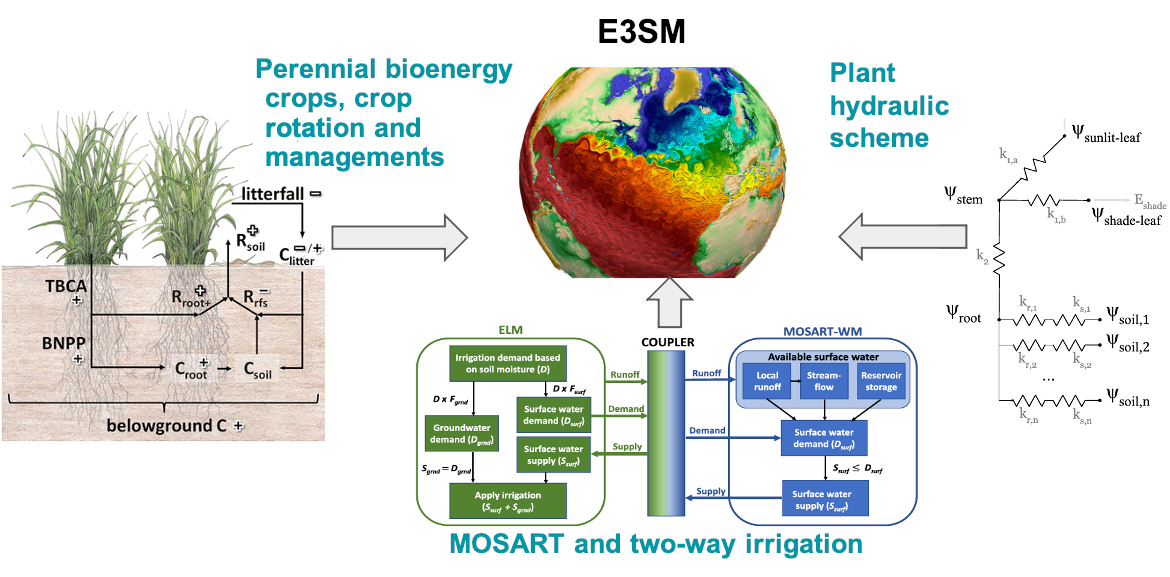
Figure 2. Summary of new land BGC features: improves how plant hydraulics are modeled to better capture vegetation responses to water stress; enhances crop simulations with detailed crop types and management practices; and adds explicit two-way irrigation processes. Altogether, these advancements reflect E3SM’s progress toward a well-calibrated, process-rich land model capable of representing complex interactions between human and natural systems.
- Parameter Optimization: Conducted targeted BGC tuning to improve the global performance of land variables, including gross primary productivity (GPP), biomass, evapotranspiration, and carbon stocks. Global performance has been fully evaluated with the International Land Model Benchmarking (ILAMB) system.
- Stability Assessment: Verified rapid equilibrium and stabilization of land carbon pools and fluxes during pre-industrial simulations (Figure 3).
Ocean and Sea-Ice BGC Improvements
- Improved representation of deep ocean frazil ice formation with impacts on stratification and marine BGC.
- Adds a flow-dependent river spreading algorithm for improved representation of river plumes in the ocean.
- Updates sea ice column physics and biogeochemistry to Community Ice CodE (CICE)-Consortium/Icepack.
- Adds dust and black carbon radiative feedbacks in sea ice.
- Parameter changes to improve biases in surface alkalinity, ocean CO2 uptake, surface nutrient biases, and primary production.
Coupling Framework Integration
- Robust coupling infrastructure for consistent exchange between the atmosphere, land, and ocean BGC systems.
- Consistent representation of iron in land dust emissions through the atmosphere, ocean, and sea ice exchanges.
- Ensured flux conservation and numerical stability across components.
200-Year Fully Coupled Simulation
- Completed a 200-year pre-industrial run with full BGC coupling (Figure 3).
- Demonstrated marked improvements in simulated land and ocean biogeochemical fields.
- Achieved equilibrium among model components, indicating readiness for transient historical simulations.
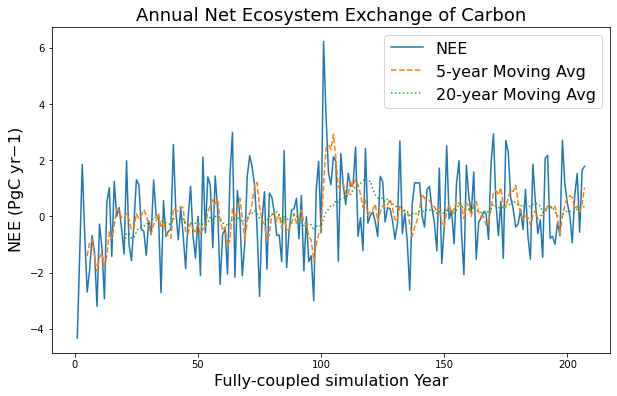
Figure 3. Year 0, new land BGC features were turned on; Year 100, calibrated land BGC parameters were updated. The time series showed that fast re-equilibrium of the coupled system led to a stable pre-industrial coupled simulation.
Broad impacts
This work establishes the most advanced E3SM capability to date for investigating Earth system dynamics and predictability. By fully integrating land and ocean biogeochemistry within a fully coupled framework, the model can now better capture complex interactions among environmental drivers, ecosystems, and human influences.
It provides a robust foundation for coupled Earth system research, enabling detailed examination of how land–ocean BGC processes regulate the water, energy, and elemental cycles. The fact that the fully coupled configuration produces reasonable behavior consistent with historical observations is a stringent test for the model. In addition, with improved representation of biogeochemical exchanges, the model supports a deeper understanding of environmental variability, carbon partitioning, and ecosystem resilience across spatial and temporal scales.
Ultimately, this capability directly supports Department of Energy (DOE) missions focused on energy and water security, as well as seasonal to decadal Earth system predictability. Enhancing confidence in projections, it offers a critical tool for informing sustainable decision-making and national energy strategy.
Next steps
The next stage will focus on conducting fully coupled historical simulations to evaluate the model’s fidelity against observed Earth system behavior throughout the 20th century. These historical runs will allow assessment of how well the enhanced E3SM captures past variability in land, ocean, and atmospheric processes, providing critical benchmarks for confidence in decadal projections.
The practical implications of representing biology within an Earth system model are far-reaching. Global food production, for example, is intimately linked with primary production, environmental conditions, land-use and irrigation. Future E3SM simulations will offer insights into potential shifts in food availability under a range of environmental conditions, including extremes.
Finally, the fully coupled capability will be leveraged to address high-impact scientific questions related to energy resilience, extreme events and disturbances, and ecosystem functionality. By enabling integrated analyses across components, this version of E3SM positions the community to explore emergent risks and inform strategies for future water and energy mitigation and adaptation.
Conclusions
In summary, the HES-led effort has delivered a major milestone in E3SM development, a fully-coupled system with full land–ocean biogeochemistry. With validated stability and improved performance, this capability is now positioned to drive next-generation Earth system science.
