

Earth System Changes Affect Future Agricultural Productivity in the Midwest
Photo by Highsmith, Carol M. (Library of Congress)
Combined temperature and precipitation changes in the U.S. Midwest reduce carbon storage and crop yields, causing significant agroecosystem vulnerability.
The Science
A major challenge in agriculture is understanding how Earth system changes affect food production and how these changes feed back to the Earth system. This research explores the effects of changes in both mean earth system conditions and variability for agroecosystems in the U.S. Midwest.
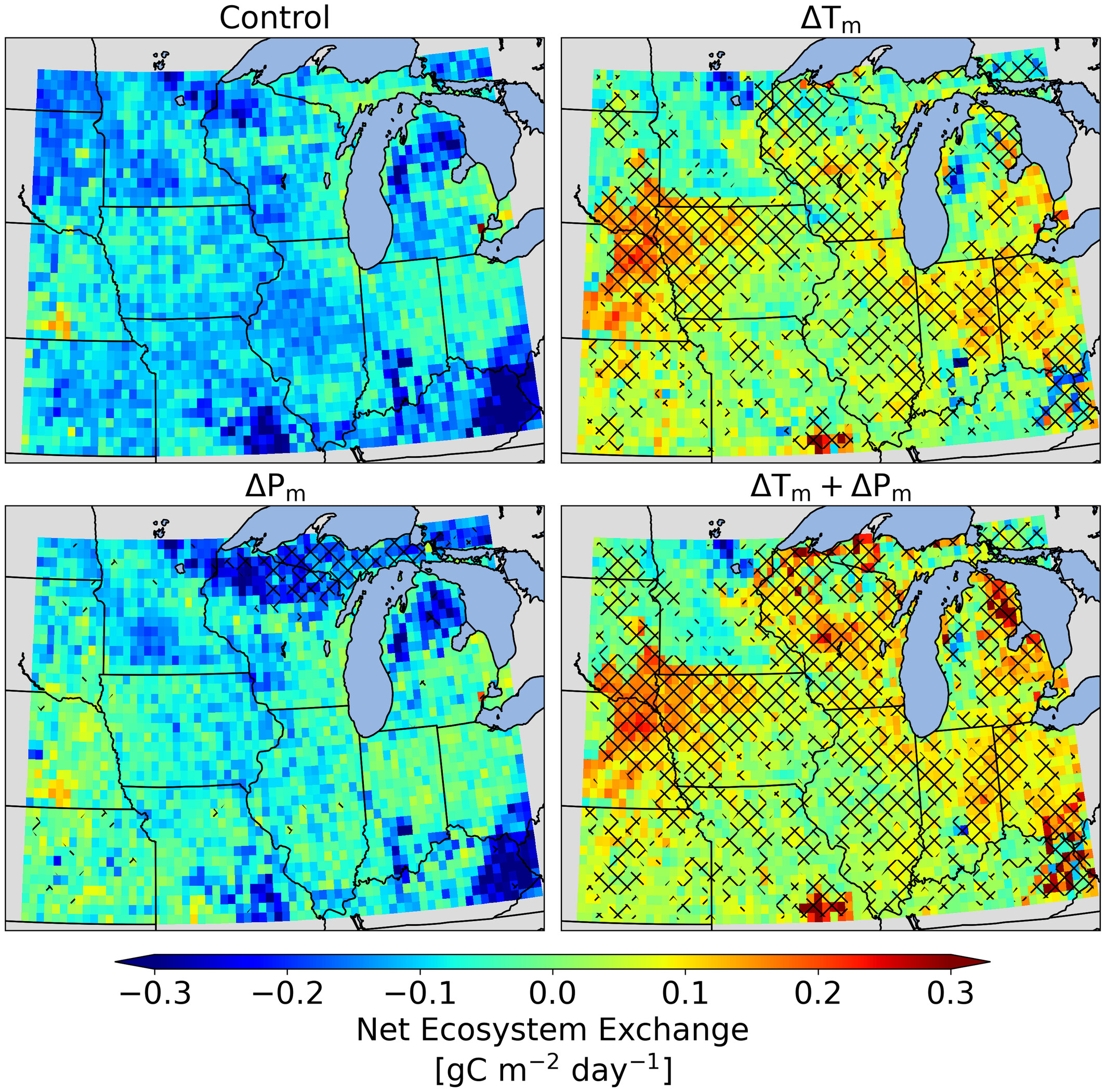
Figure 1. Potential effects of Earth system changes on carbon flux (Net Ecosystem Exchange) in the U.S. Midwest as a result of rising temperatures (top right), rising precipitation (bottom left), and both rising temperature and rising precipitation (bottom right). Rising temperatures (right column) can convert agricultural land from carbon absorbers (sinks; darker blue and green areas) into carbon emitters (sources; orange and red areas).
The Impact
This research explores how changes in mean temperature and rainfall, as well as strong anomalous weather events, may affect farming in the U.S. Midwest, a globally important region for food production. This study is the first to clearly separate average changes from changes such as very high temperatures and very dry conditions, finding that together, these variables harm crops more than each alone. This approach helps anticipate future farming challenges. These results highlight the necessity of considering both mean temperature and rainfall changes and variability to better predict and mitigate future agroecosystem vulnerability. Other scientists can build on this work to develop better strategies for managing future risks in agriculture and understand the possible outcomes for Earth system changes.
Summary
Using the Energy Exascale Earth System Model (E3SM) and an advanced weather generator, future Earth system scenarios were used to assess how average changes in temperature and rainfall, and their variability, may affect carbon fluxes, energy balances, and crop yields. An increase in mean temperature reduced stored carbon, plant productivity, and crop yield, potentially converting agroecosystems from carbon sinks (absorbers) to sources (emitters) due to hot conditions, shortening the crop growing cycle, and resulting in plants dying off much sooner. This transformation intensified when both temperature mean and variability rose, resulting in a nonlinear decline in carbon fluxes and pools. Gross primary production (GPP) decreased by 13% when both temperature mean and variability changed, compared to 9% and 1% for changes in mean temperature and variability alone, respectively. The combined effects of temperature and precipitation changes are more impactful than their individual effects. Scenarios involving changes in both temperature and precipitation means lead to the most significant reductions in carbon fluxes (16% decrease in GPP) and crop yields (median reductions of 33% for corn and 22% for soybean).
Publication
- Sinha, E., D. Xu, K.A. Morris, B.A. Drewniak, and B. Bond-Lamberty. 2025. Global Change Biology.. https://onlinelibrary.wiley.com/doi/10.1111/gcb.70064
Funding
- This work was supported by the Earth System Model Development program area of the Department of Energy, Office of Science, Biological and Environmental Research program.
Contact
- L. Ruby Leung, Pacific Northwest National Laboratory
- Eva Sinha, Pacific Northwest National Laboratory
This article is a part of the E3SM “Floating Points” Newsletter, to read the full Newsletter check:
