

DCMIP Summer School
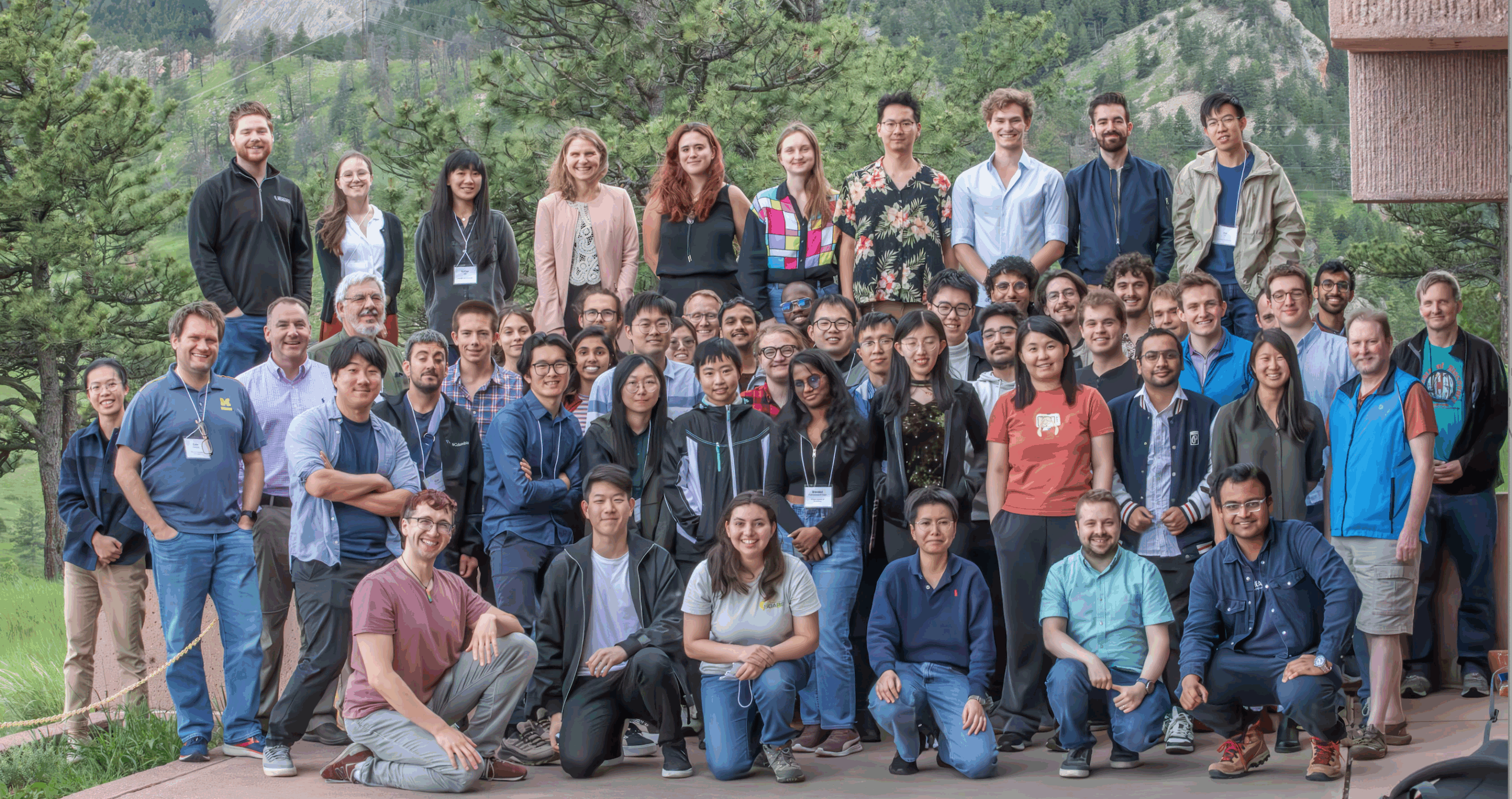
Group photo from the 2025 DCMIP Summer School.
The Dynamical Core Model Intercomparison Project (DCMIP) Summer School was held in June 2025. Lead organizer Christiane Jablownowski was joined by several co-organizers, including Department of Energy (DOE) E3SM and SciDAC researchers Peter Bosler, Oksana Guba and Mark Taylor. The summer school highlighted the newest modeling techniques for atmospheric General Circulation Models (GCMs), discussing both physical based models and new machine learning approaches. It was held at the National Center for Atmospheric Research (NCAR). The school hosted over 50 multi-disciplinary students and postdocs for one week. The students worked with three modern nonhydrostatic atmospheric “dynamical cores” from NCAR, National Oceanic and Atmospheric Administration (NOAA) and E3SM, all running within the Community Earth System Model (CESM). The students also worked with several machine learning (ML) emulators, including Google’s GraphCast and NVIDIA’s Spherical FourCastNet.
The summer school ran for 5 days, with morning lectures each day followed by hands-on modeling activities in the afternoon. The students used the models to simulate several types of atmospheric phenomena to understand how GCMs handle nonhydrostatic fluid dynamics and physics-dynamics coupling. The hands-on modeling aspect of the summer school was centered around three test cases. The first two were focused on topographically driven features, simulating vertically propagating gravity waves and mountain gap flow such as the narrow Juan de Fuca strait between the United States and Mexico. The third test included moist thermodynamics and phase change to simulate an idealized squall line. Squall lines are an important phenomena associated with convective activity in thunderstorms.
The summer school concluded with student lead presentations, describing experiments from all of the models and emulators. The results showcased the impacts of many aspects of model formulation such as horizontal and vertical resolution, dissipation mechanisms, timesteps and boundary conditions. The DCMIP-2025 school was supported by the National Science Foundation (NSF), NOAA, and NSF NCAR.
