

Omega, A Next-Generation Ocean Model for Exascale Computing
Ocean models are among the most computationally demanding tools in Earth system science, tasked with simulating processes that span vast ranges of space and time—from small-scale eddies to basin-wide circulation, and evolving over many years. Historically, these models have evolved alongside advances in computing, adapting from early vector supercomputers to modern parallel supercomputers. The field now faces another major transition: the rise of heterogeneous, GPU-dominated exascale computing systems. This shift is the primary motivation behind the development of Omega, the Ocean Model for E3SM Global Applications. Omega represents a fundamental redesign of ocean modeling infrastructure, built from the ground up to run efficiently on modern high-performance computing architectures. It is intended to eventually replace MPAS-Ocean, the current ocean component of the U.S. Department of Energy’s (DOE) Energy Exascale Earth System Model (E3SM).
The need for a new model arises from limitations in existing software approaches. Most current ocean models, including MPAS-Ocean, were developed in Fortran and optimized for CPU-based systems using MPI and OpenMP. While these approaches were successful for earlier generations of supercomputers, they are not well suited to modern systems where GPUs provide the overwhelming majority of computational power. Attempts to adapt older codes to GPUs—for example, by adding OpenACC directives—have had limited success. In practice, only portions of the code can be accelerated, and performance improvements were often minimal. On today’s leading DOE systems, such as Frontier and Aurora, more than 90% of peak performance resides in GPUs, making it essential for scientific models to be designed with these architectures in mind from the outset.
Omega addresses the evolving computing landscape through the concept of performance portability, which allows a single code base to run efficiently across a wide range of hardware platforms. This versatility is critical given the diversity of vendors and hardware across DOE leadership class computing systems. Performance portability eliminates the need for extensive rewrites in vendor-specific languages and reduces the importance of machine-specific optimization. To achieve this, Omega is written in C++ and uses the Kokkos library, which provides abstractions for parallel execution and data management that can be mapped to either CPUs or GPUs. This represents a significant departure from traditional ocean modeling practices, but it offers a path toward long-term sustainability as computing architectures continue to evolve.
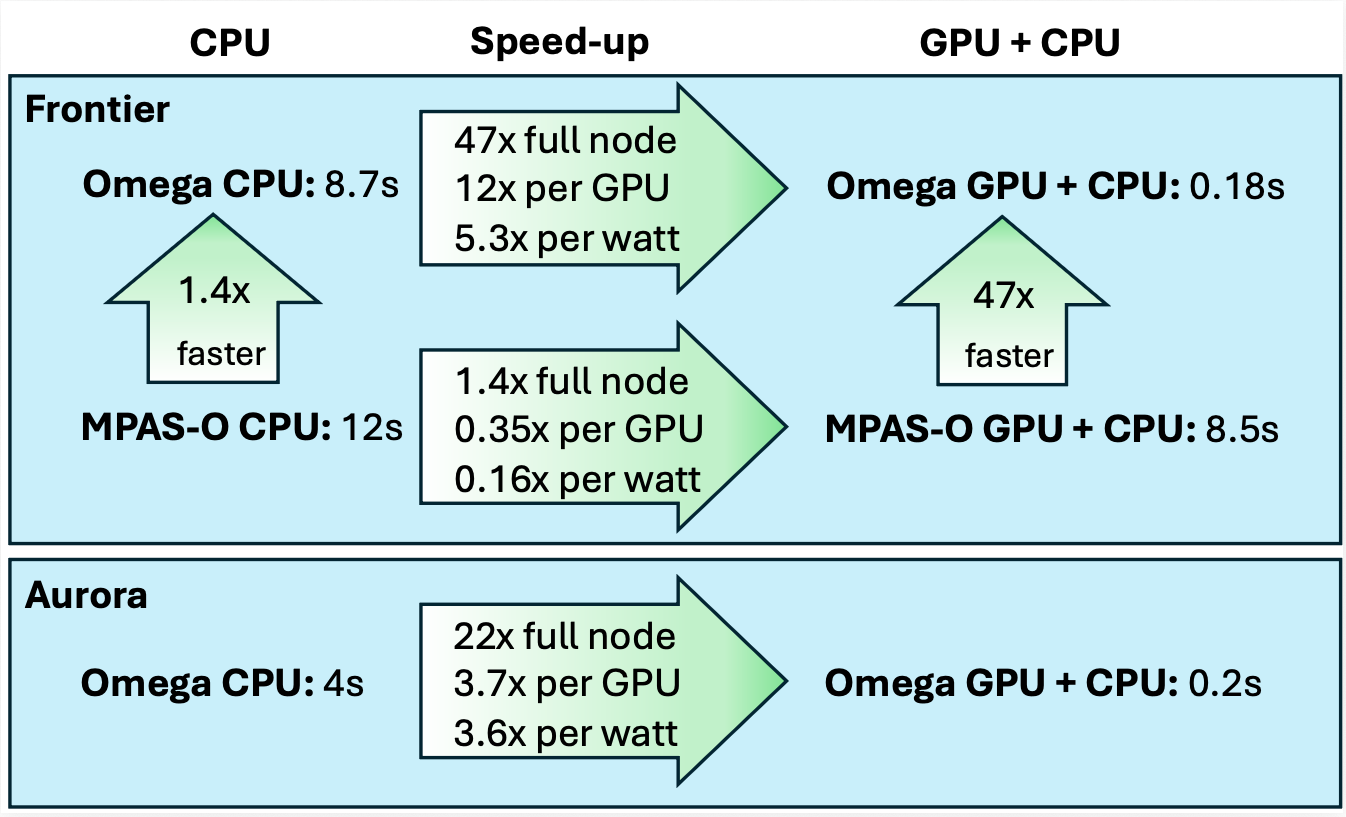
Figure 1. A diagram of the speed-up factors when including the GPUs on each machine, for Omega-V0 and MPAS-Ocean.
A recently accepted manuscript in Geoscientific Model Development introduces Omega Version 0 (Omega-V0), an initial implementation designed to test the model’s computational framework (see https://gmd.copernicus.org/articles/19/3569/2026/). Rather than simulating the full complexity of three-dimensional ocean dynamics, this version solves the shallow water equations, which describe the flow in a thin layer of constant density. The shallow water equations capture essential aspects of ocean dynamics such as wave propagation and large-scale circulation, without the complexity of vertical motion. In addition, the model includes passive tracers, which allow the transport of scalar quantities to be tracked without influencing the flow. These features provide a useful testbed for evaluating numerical methods and performance while laying the groundwork for more complex physics in future versions. Omega-V0 solves equations describing the conservation of momentum and mass in a rotating fluid. These equations include the effects of gravity, Earth’s rotation, and nonlinear advection, along with additional terms for diffusion, drag, and external forcing.
Omega uses the same unstructured, polygonal cell-based mesh as MPAS-Ocean. This design enables variable resolution that can be refined in regions of interest while remaining coarser elsewhere. This flexibility is needed to capture essential fine-scale ocean features in regions relevant to DOE mission needs without incurring the computational cost of constant global high resolution. From a computational perspective, Omega employs domain decomposition to distribute the mesh across multiple computing nodes, uses MPI for communication between nodes, and relies on Kokkos to manage parallel execution within each node on either CPUs or GPUs.
Extensive verification tests demonstrate that Omega-V0 correctly implements the intended numerical methods. These tests include comparisons with analytical solutions using manufactured solutions, tracer transport experiments in which a known distribution is advected around the globe, and idealized circulation scenarios such as the wind-driven barotropic gyre. In addition, more realistic global simulations incorporating coastlines, bathymetry, and wind forcing show that the model can reproduce large-scale circulation patterns similar to those produced by MPAS-Ocean. Together, these tests provide confidence that the new model framework is both accurate and robust.
One of the most significant results of the study is the improvement in computational performance. On CPU-based systems, Omega-V0 is 1.4 times faster than MPAS-Ocean for shallow water simulations. However, the benefits are much more pronounced on GPU-based systems, where the model achieves dramatic speedups. For example, simulations are 5.3 times more efficient per watt on Frontier GPUs when compared to CPUs (Fig. 1). These gains are the result of design choices that minimize data movement between CPUs and GPUs, use GPU-aware communication to reduce overhead, and structure computations to maximize parallel efficiency.
Omega also demonstrates excellent strong scaling, meaning it can efficiently utilize increasing numbers of processors as the problem size grows (Fig. 2). This capability is essential for future high-resolution simulations that will require tens of millions of grid cells and long integration times. By contrast, legacy models often encounter performance bottlenecks when scaling to large node counts, particularly on GPU-based systems.
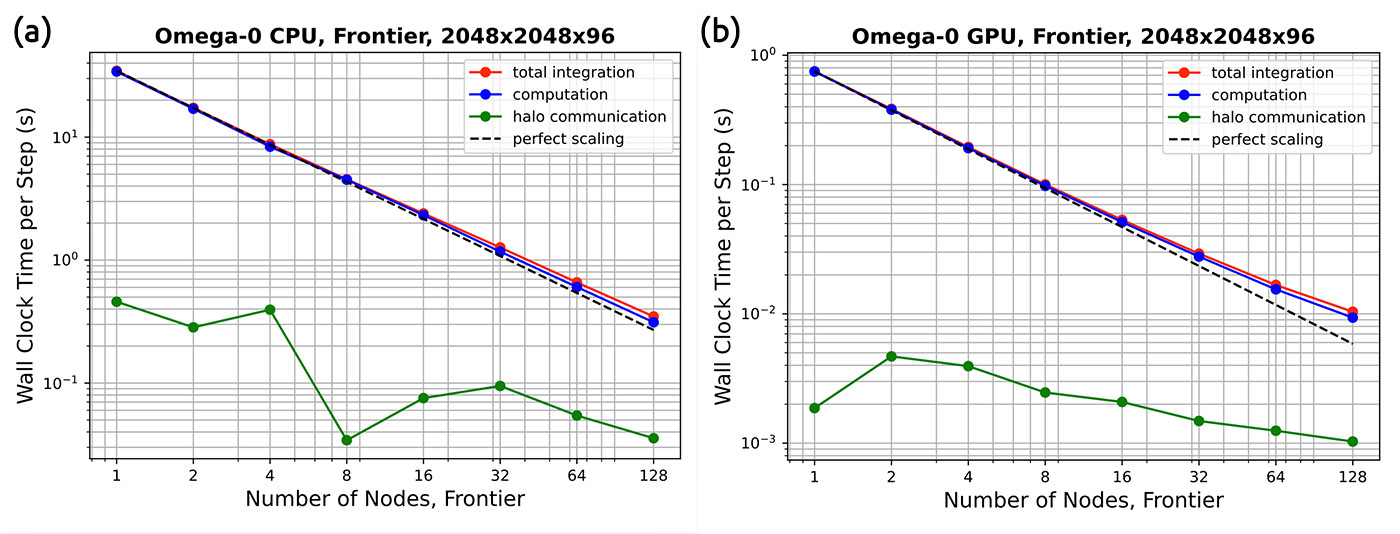
Figure 2. Strong scaling of Omega-V0 on Frontier showing CPU-only (left) and full-node GPU (right) on a high-resolution domain of 400 million grid cells. The colors separate the total (red) between the communication of data between compute nodes (inter-node halo communication) (green) and the on-node computation (blue). Start-up time and I/O are not included.
Looking ahead, Omega-V0 serves as a foundation for more advanced versions of the model. The E3SM ocean team is currently working on Omega Version 1, which will incorporate the full set of ocean physics, including vertical advection, vertical turbulent mixing, and surface fluxes. These additions will enable realistic simulations of global currents and overturning. Omega Version 2 will add coupling to E3SM, to include interactions with the atmosphere and sea ice. Later versions of Omega will add more sophisticated parameterizations of unresolved processes.
Omega development has been a true team effort, bringing together scientists from four DOE laboratories in a successful collaboration. The team includes experts in high performance computing, numerical methods, and ocean physics. Omega version 1 is nearing completion and will be coupled to E3SM in the summer 2026. After further testing and validation it will replace MPAS-Ocean as the default ocean model in E3SMv4. Due to its innovative, forward-looking design, Omega will be capable of supporting cutting-edge earth system research on the world’s most powerful supercomputers.
Publication
Petersen, M. R., Asay-Davis, X. S., Barthel, A. M., Begeman, C. B., Bishnu, S., Brus, S. R., Jones, P. W., Kang, H.-G., Kim, Y., Mametjanov, A., O’Neill, B. J., Overfelt, J. R., Ringel, K. K., Smith, K. M., Sreepathi, S., Van Roekel, L. P., and Waruszewski, M.: The ocean model for E3SM global applications: Omega version 0.1.0 – a new high-performance computing code for exascale architectures, Geosci. Model Dev., 19, 3569–3594, https://doi.org/10.5194/gmd-19-3569-2026, 2026.
Contact
- Mark Petersen, Los Alamos National Laboratory
- Luke Van Roekel, Los Alamos National Laboratory
- Steven Brus, Argonne National Laboratory
This article is a part of the E3SM “Floating Points” Newsletter, to read the full Newsletter check:
- E3SM Floating Points, May ’26: Looking Forward to the Summer All-Hands
