

Understanding and improving the quasi-biennial oscillation in E3SM
Key Points
- The QBO, the leading pattern of stratospheric variability, modulates stratospheric chemistry, polar and midlatitude weather extremes, and tropical convection, yet accurately simulating the QBO has been a challenge for most Earth system models, including E3SM.
- Improving QBO simulation required both better representation of tropical convection and targeted vertical grid refinement in the stratosphere.
- Increasing vertical grid resolution (from 72 to 80 layers) in E3SMv3 significantly improved QBO realism with minimal computational cost.
- Advanced surrogate modeling and optimization further fine-tuned QBO characteristics, offering a new, efficient approach for model improvement.
Quasi-biennial oscillation: The change of winds
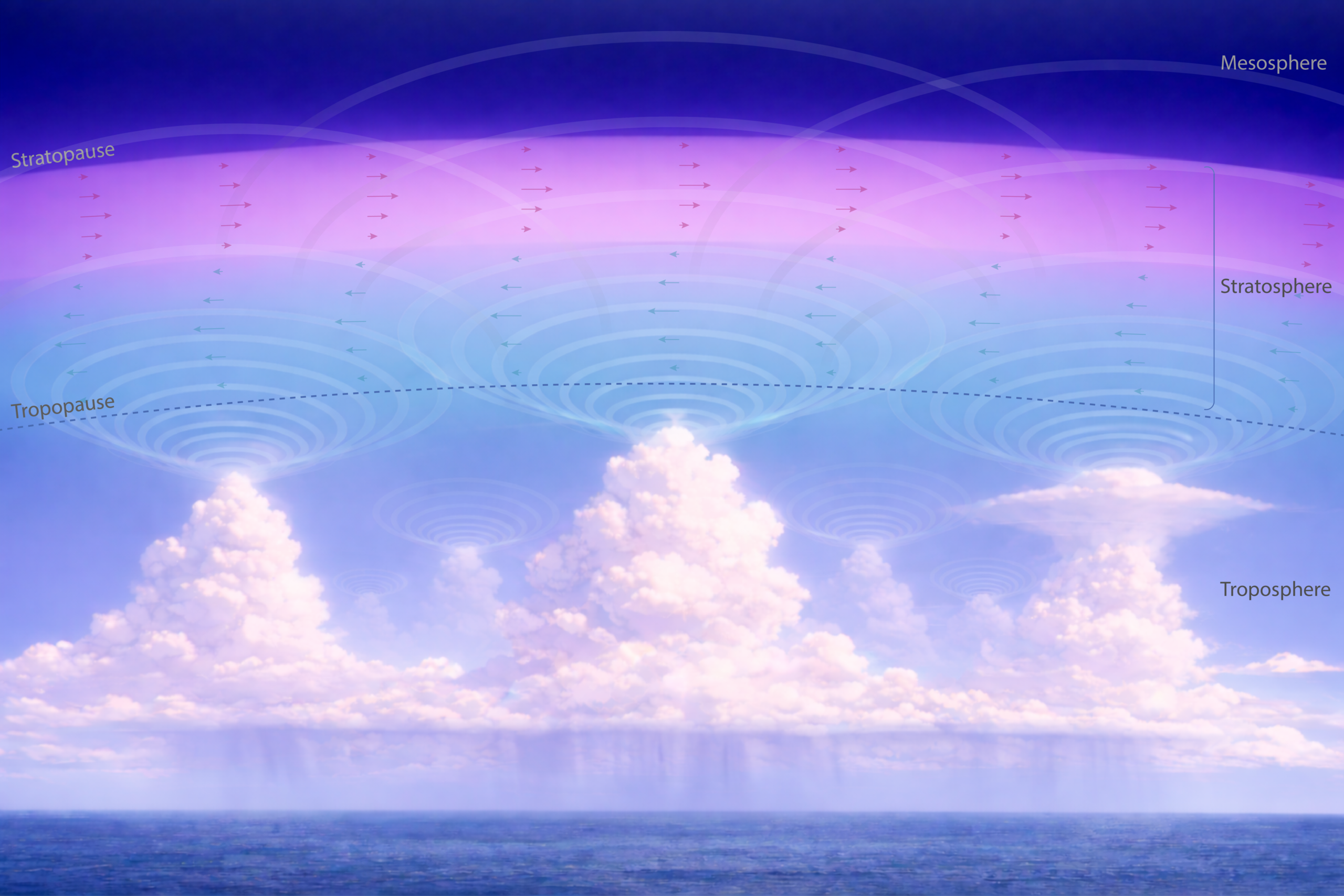
Figure 1. The quasi-biennial oscillation (QBO) is driven primarily by atmospheric waves typically associated with tropical convective disturbances across a wide range of space-time scales. These waves propagate upward from the upper troposphere into the stratosphere, break when the wave’s horizontal velocity nears a critical level (i.e., where the wave horizontal phase speed matches the background horizontal wind speed), and deposit momentum. The QBO is driven by a large spectrum of waves, spanning large-scale Kelvin and mixed Rossby-gravity waves (periods exceeding 3 days, zonal wavelengths exceeding 10,000 km) to small-scale gravity waves associated with clusters of deep convective clouds (periods of 1 day or less, zonal wavelengths 10-1,000 km). The figure schematically represents such a cluster of tropospheric deep convective clouds, with gravity waves generally emanating from the upper troposphere and propagating upward into the stratosphere and mesosphere. Within the stratosphere, the easterly wind layer (blue east-to-west vectors) underlies the westerly wind layer (pink west-to-east vectors). The spectrum of wave forcing preferentially deposits westerly momentum at the base of the westerly wind layer (pink shading), causing it to slowly descend as the easterly wind layer (cyan shading) narrows and dissipates in the lower stratosphere. The easterly wind layer later reforms in the upper stratosphere to begin its own gradual descent, driven by easterly momentum deposition at its layer base. The successive descents of westerly and easterly wind layers in the stratosphere embody the QBO.
One of many fundamental planetary-scale patterns of variability that naturally emerge in Earth’s atmosphere, the quasi-biennial oscillation (QBO; Baldwin et al. 2001) manifests as alternating eastward and westward wind layers that slowly descend through the stratosphere (~15-35 km altitude) with a period of roughly 28 months. The wind layers are confined to the deep tropical latitudes, encircling the entire equatorial belt. Despite its equatorial anchoring, the QBO modulates stratospheric chemical constituents globally, influences Arctic and midlatitude weather extremes, and regulates tropical moist convection. Although theoretical understanding and simulation capability of the QBO have steadily advanced, representation of key QBO features continues to challenge most Earth system models (ESMs; Richter et al. 2020), including past and current versions of the U.S. DOE Energy Exascale Earth System Model (E3SM). This difficulty stems chiefly from the need to accurately represent cumulus convection in the tropical troposphere (surface to ~15 km altitude), which radiates gravity waves that propagate vertically into the stratosphere where they break and impart momentum onto the mean flow, ultimately driving QBO variability (Fig. 1). Individual cumulus plumes are ubiquitous in the tropics but they are small compared to a typical ESM horizontal grid resolution (~25-100 km), requiring these convective clouds—including their complex interactions with radiation, microphysics, and circulation—to be represented statistically using imperfect “parameterizations”. Larger-scale convective systems able to be resolved by the model, like equatorial Kelvin waves and mixed Rossby-gravity waves, also propagate upward to drive the QBO. The rising gravity waves themselves require sufficient vertical grid resolution to be adequately represented, otherwise much of the QBO wind forcing is missed. This is a classic multiscale problem: if an ESM is unable to sufficiently represent wave processes from planetary to microscale, this bias will cause degradation of the larger-scale QBO and its global impacts, reducing predictive skill across scales. Any weak link in this causal chain can break the connection.
SciDAC project “Improving the quasi-biennial oscillation through surrogate-accelerated parameter optimization and vertical grid modification” aims to address these gaps in understanding and simulation capability in E3SM. The project brings together experts in applied math, statistics, and Earth system science from Los Alamos National Lab (LANL), Sandia National Labs, Lawrence Livermore National Lab (LLNL), and the National Science Foundation National Center for Atmospheric Research (NSF-NCAR) to confront these challenges. Below, some key results from the ongoing project are outlined.
Understanding QBO drivers in predecessor E3SM versions
During the earlier model development cycle between E3SM version 1 (E3SMv1) and version 2 (E3SMv2), the simulated QBO unexpectedly worsened. An early research task led by project members at NSF-NCAR focused on understanding the physical mechanisms to explain why this degradation occurred. The research findings indicate that the QBO simulated in E3SM is highly sensitive to the vertical maximum of convective latent heating calculated by the deep convection scheme. The impacts of the updated deep convective trigger (the “dCAPE-ULL” trigger) in E3SMv2—the conditions that determine when and where convection initiates— were explored by running two E3SMv2 simulations: one with the dCAPE-ULL trigger active (“CF10_dCAPEULL1”, the default E3SMv2 setting) and another with the trigger deactivated (“CF10_dCAPEULL0”).
In E3SMv2, the QBO is forced by both resolved “planetary” and unresolved “parameterized” upward-propagating, convectively generated gravity waves that transport momentum. As detailed in Li et al. (2025), the updates to the deep convection parameterization, particularly the implementation of the dCAPE-ULL trigger, have led to more intense but less frequent convection. This has enhanced the variance of the vertical maximum of convective heating, ultimately producing a stronger parameterized gravity wave drag on the zonal wind in the stratosphere and impacting the QBO.
Additionally, the project researchers propose a hypothesis that the dissipation of these parameterized gravity waves may also partially intensify Kelvin and mixed Rossby-gravity waves in the stratosphere. This interplay between tropospheric convection and stratospheric variability highlights the importance of accurately representing multiscale processes to capture the QBO. The insights from this SciDAC project are crucial for informing future improvements to the simulation of the QBO in E3SM and other Earth system models.
Dramatic QBO improvement with refined vertical grid
Recognizing that adequate representation of vertically propagating equatorial waves generated by tropical deep convection is a key ingredient required for any ESM to accurately simulate the QBO, the SciDAC team explored the impact of targeted vertical grid refinement in E3SMv2 to inform development of E3SMv3, the latest model version released in 2024. As noted in the introduction, the QBO is fundamentally a wave-driven phenomenon forced by upward-propagating equatorial waves that may be on scales large enough to be resolved on the model grid (e.g., equatorial Kelvin waves, mixed Rossby-gravity waves) or those that are smaller and must be parameterized (mesoscale convective clusters). However, successfully simulating the QBO in Earth system models hinges on adequately representing both the resolved and parameterized components of these wave processes.
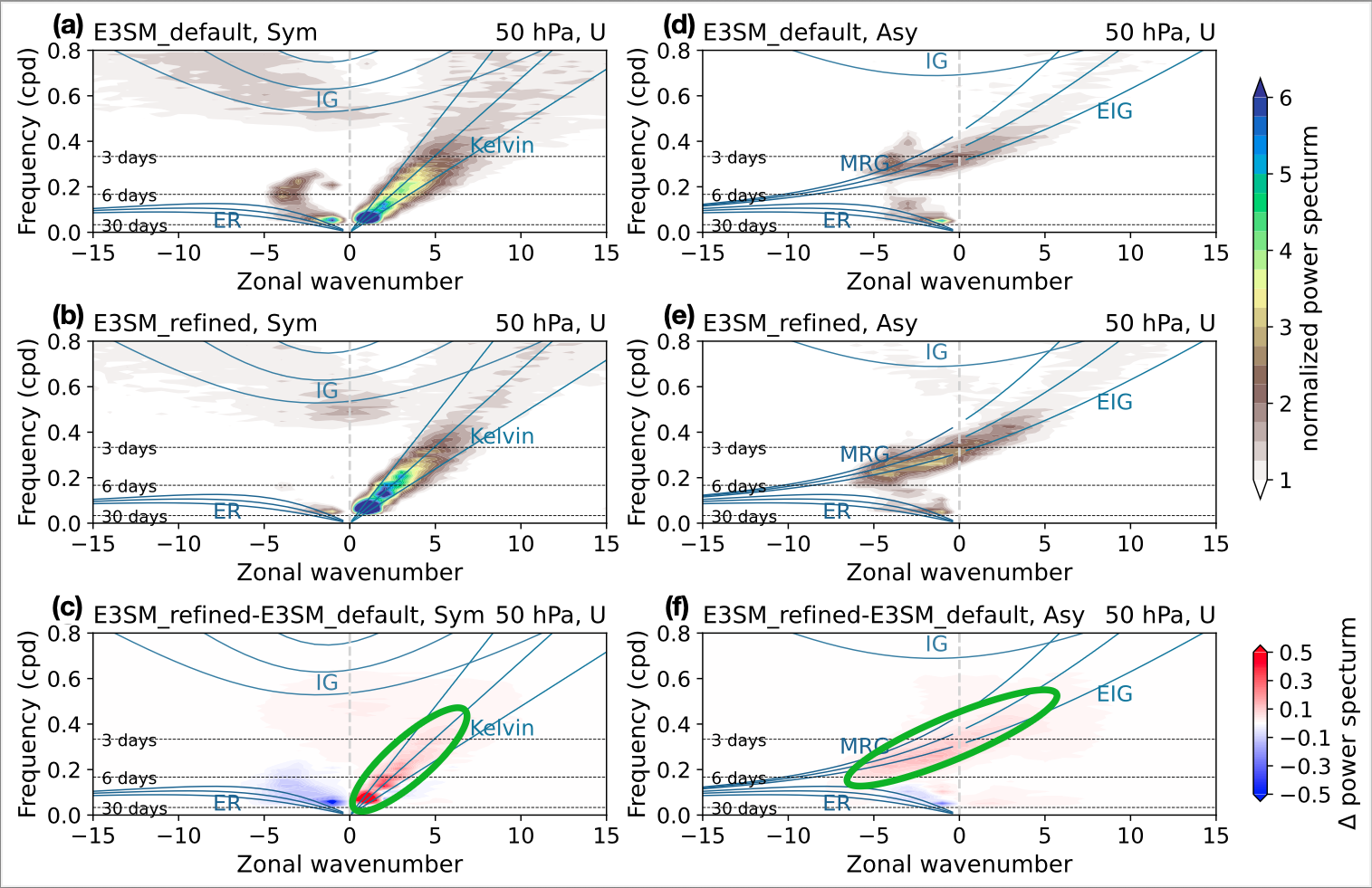
Figure 2. The zonal wavenumber-frequency power spectrum (also known as a Wheeler-Kiladis diagram) of 50 hPa zonal wind between 15°S and 15°N (that is, the west-east wind at the altitude with a pressure of 50 hPa), normalized by a background power. This power spectrum has two components: symmetric (left column) and anti-symmetric (right column). The rows correspond to (a, d) E3SM_default (version without vertical grid refinement), (b, e) E3SM_refined (version with vertical grid refinement), and (c, f) the E3SM_refined–E3SM_default difference. The blue lines show the theoretical dispersion curves for equatorial wave modes with equivalent depths of 200, 100, and 50 m. Abbreviated wave types are: IG (inertia-gravity waves), ER (equatorial Rossby waves), MRG (mixed Rossby-gravity waves), and EIG (eastward inertia-gravity waves). Kelvin and MRG waves are the dominant drivers of the QBO, and both of these wave types become stronger with vertical grid refinement, as highlighted by the green ovals.
By refining the vertical grid only in the lower stratosphere of E3SMv2 from roughly 1000 m to 500 m (increasing the number of vertical levels from the E3SMv2-default value of 72 to 80), leaving other sections of the vertical grid unchanged, the research team was able to improve the model’s representation of the resolved wave activity (Fig. 2; Yu et. al. 2025). This led to more realistic wave-mean flow interactions, with enhanced contributions from resolved Kelvin waves and small-scale waves to the QBO forcing. The improvements in the resolved wave forcing were a significant step forward, validating the team’s hypothesis that an important segment of gravity wave propagation and absorption was missing from E3SMv2. Importantly, this vertical grid refinement did not degrade the model’s depiction of the troposphere and imposed only a modest computational cost (~8% resource increase), demonstrating its potential as a viable approach for enhancing QBO simulation in E3SM and other Earth system models. Further, the team discovered that even aggressive adjustments to convective gravity wave model parameters could not adequately improve QBO without also increasing the vertical grid resolution. Given the QBO improvement and acceptable computational cost increase, the 80-layer vertical grid was adopted as the default configuration in E3SMv3. For more information, see section 2.3.1 “Vertical Resolution” of the E3SMv3 Overview of the Atmospheric Component).
Surrogate-accelerated optimization: Smart, quick, and cheap QBO fine-tuning
While the previous efforts to improve QBO representation in E3SM focused on understanding its sensitivity to convection and enhancing the model’s ability to resolve key wave processes, the SciDAC project team also explored the use of advanced uncertainty quantification (UQ) methods to further refine the QBO simulation for the latest E3SMv3 release. To address this challenge, the research team developed a novel end-to-end UQ workflow that leverages surrogate modeling and multi-objective optimization techniques. Surrogate models statistically characterize connections between key model input parameter values (here, those related to convective gravity waves) and “quantities of interest” produced by a selected set of simulations (here, QBO metrics). Because surrogates need only a targeted subset of simulations that span a defined parameter value space, large numbers of long and costly simulations are avoided.
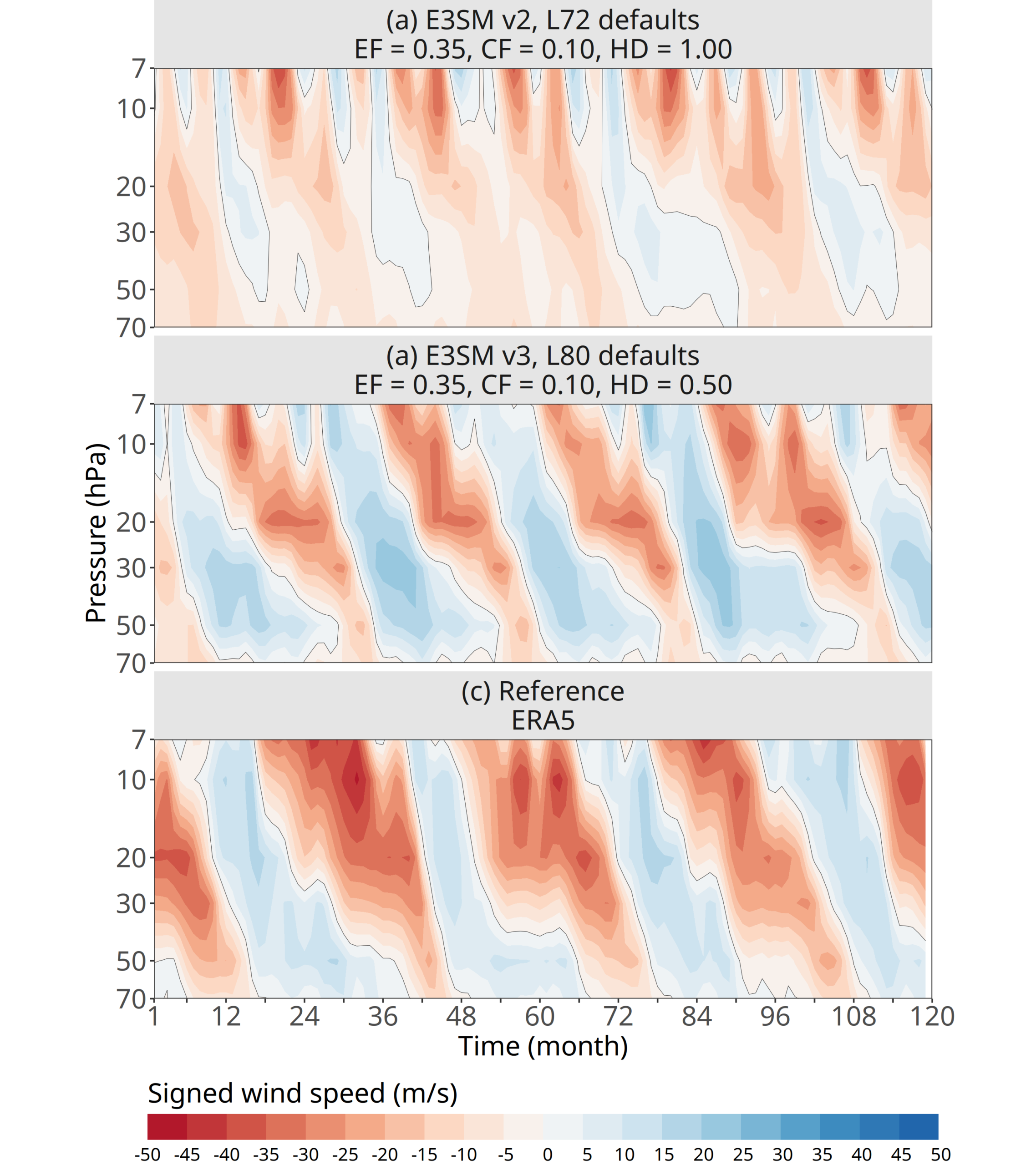
Figure 3. QBO equatorial zonal mean zonal wind pattern for (a) E3SMv2 (72 levels and its default convective gravity wave parameter values), (b) E3SMv3 (80 levels and its default convective gravity wave parameter values), and (c) ERA5. Red indicates westward winds (air motion from east to west) while blue indicates eastward winds (air motion from west to east) at the given pressure level and time. Much of the QBO improvement arises from the change from 72 to 80 levels, with additional improvement from parameter tuning. Subsequent QBO tuning, completed after the release of E3SMv3, shows further optimization (see Damiano et al. 2025, their Fig. 11 for details).
As described in Damiano et al. (2025), the team first constructed a “Fundamental Frequency Model” to efficiently extract salient QBO characteristics (period and amplitude) from the complex E3SM wind data, isolating the QBO signal from other atmospheric processes. They then trained a fast surrogate model to predict these QBO features based on convective gravity wave scheme parameters that are very poorly constrained by observational estimates. With this computationally efficient surrogate in hand, the team was able to explore a vast number of parameter configurations, identifying an optimal, balanced set that yielded a significantly improved QBO simulation in E3SMv3 (Fig. 3). Importantly, this approach revealed a fundamental “tension” in the model, where tuning parameters to improve the QBO period often degraded the amplitude, and vice versa. By mapping out the full Pareto frontier of optimal trade-offs, the researchers provided crucial guidance to model developers on navigating this complex parameter space.
This innovative UQ-driven workflow represents a major advancement, demonstrating the power of integrating advanced statistical and mathematical techniques with Earth system modeling to enhance the fidelity of critical atmospheric phenomena like the QBO. The insights gained will inform future efforts to improve QBO simulations in E3SM and other Earth system models.
On the horizon
The SciDAC team continues to investigate the recent discovery of unexpected influences from frontal systems (sharp-gradient phenomena only partially resolved on the model grid) on the QBO by expanding the parameters fed to the surrogate model. In parallel, project members are also exploring and testing machine learning-based emulators as possible substitutes for conventional gravity wave generation parameterizations, which are poorly constrained by available observational estimates.
Funding
This research was supported through the U.S. DOE Office of Science’s Scientific Discovery through Advanced Computing (SciDAC) program, the Advanced Scientific Computing Research (ASCR) program, and the Office of Biological and Environmental Research (BER) Earth System Model Development program area via SciDAC project “Improving the quasi-biennial oscillation through surrogate-accelerated parameter optimization and vertical grid modification” (award SCW1787). Project-related E3SM simulations, post-processing and data archiving used resources of the National Energy Research Scientific Computing Center (NERSC), a U.S. Department of Energy Office of Science User Facility located at Lawrence Berkeley National Laboratory and supported under Contract No. DE-AC02-05CH11231. NERSC computing resources include awards BER-ERCAP0024398, BER-ERCAP0028823, and BER-ERCAP0031947 linked to project m4310.
References
Baldwin, M. P., et al. (2001), The quasi-biennial oscillation, Rev. Geophys., 39(2), 179–229, doi:10.1029/1999RG000073.
Damiano, L., Hannah, W., Chen, C.-C., Benedict, J. J., Sargsyan, K., Debusschere, B. J., & Eldred, M. S. (2025). Improving the quasi-biennial oscillation via a surrogate-accelerated multi-objective optimization. Journal of Advances in Modeling Earth Systems, 17, e2025MS005057. https://doi.org/10.1029/2025MS005057
Li, Y., Chen, C.-C., Benedict, J. J., Huang, K., Richter, J. H., & Bacmeister, J. (2025). Mechanisms in regulating the quasi-biennial oscillation in E3SM version 2. Journal of Geophysical Research: Atmospheres, 130, e2024JD041868. https://doi.org/10.1029/2024JD041868
Richter, J. H., Anstey, J. A., Butchart, N., Kawatani, Y., Meehl, G. A., Osprey, S., & Simpson, I. R. (2020). Progress in simulating the quasi-biennial oscillation in CMIP models. Journal Geophysical Research: Atmospheres, 125, e2019JD032362. https://doi.org/10.1029/2019JD032362
Yu, W., Hannah, W. M., Benedict, J. J., Chen, C.-C., & Richter, J. H. (2025). Improving the QBO forcing by resolved waves with vertical grid refinement in E3SMv2. Journal of Advances in Modeling Earth Systems, 17, e2024MS004473. https://doi.org/10.1029/2024MS004473
