

Nephele Perturbed Process Ensemble (E3SMv3) Available for Community Use
The first Perturbed Process Ensemble (PPE) generated through the PPE Regression Optimization Center for ESM Evaluation and Development (PROCEED) is available for community use. To distinguish it from other PPE data sets, this ensemble is referred to as Nephele1. PPEs are an ensemble of model configurations where constants associated with processes are perturbed (typically randomly and simultaneously) and are frequently used for statistical constraint of model behavior as well as causal inference. An opinion and overview is provided here.
PROCEED is a DOE-EPSCoR funded project supporting researchers at University of Wyoming and University of Hawaii at Manoa to develop PPE infrastructure to improve process understanding in the Earth system. University researchers collaborate closely with scientists at Pacific Northwest National Laboratory (PNNL) and Lawrence Livermore National Laboratory (LLNL). PROCEED is focused on building out a suite of PPEs that probe different sets of Earth system processes. The seed grant phase of PROCEED supported the development of the Nephele PPE, which focused on aerosol-cloud interactions and ARM observations from the ENA atmospheric observatory supported by preliminary LASSO-ENA data. The PPE overview publication is in press at JAMES and is available as a preprint. Initial work carried out leveraging Nephele include exploring the impacts of the diurnal cycle of cloud on top of atmosphere flux; constraining how much anthropogenic aerosol emissions changed droplet number using ARM data; and probing the impacts of pre-industrial emissions on the historical record.
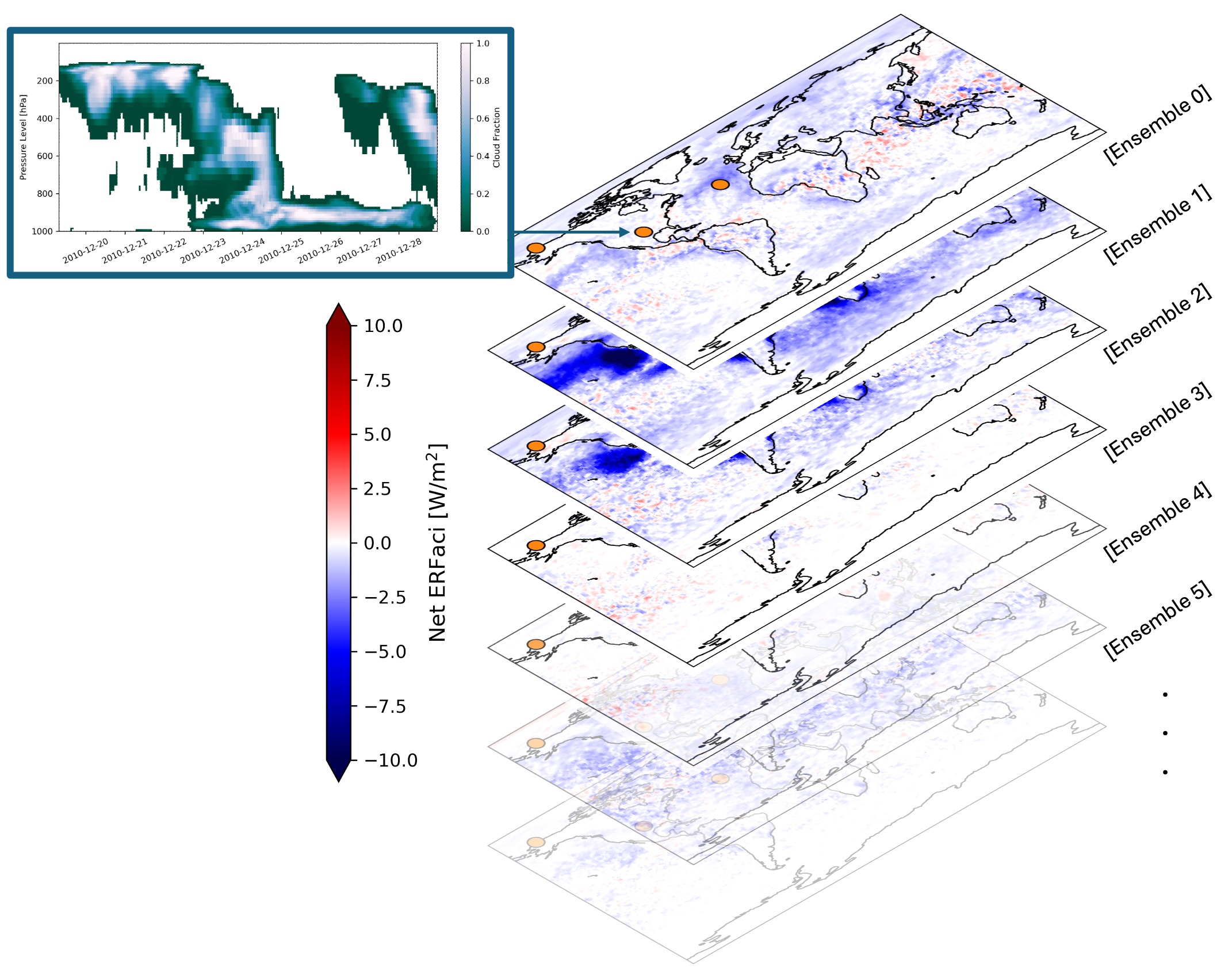
Figure 1. A schematic representation of the data available online from Nephele with global mean quantities from the preindustrial and present day as well as high temporal resolution outputs at ARM sites.
At present, data from Nephele is provided on ARM Data Discovery (a schematic is provided in Fig. 1). An abbreviated list of outputs has been made available and the PROCEED team is excited to add additional data outputs as users reach out. The posted Nephele data includes global-mean preindustrial and present day quantities (radiative fluxes, cloud properties, precipitation) as well as high temporal resolution outputs from the SGP, NSA, and ENA sites with vertically resolved data (clouds, temperature, winds, aerosol, precipitation). Future development efforts will include EMC2 simulator output for each site. Data is available here.
Please reach out to daniel.mccoy@uwyo.edu with any requests for additional output.
1Νεφέλη (ancient Greek: ’cloud, mass of clouds’); also two figures in Greco-Roman mythology associated with clouds.
Funding
- PROCEED is supported by the Established Program to Stimulate Competitive Research (EPSCoR) through the U.S. Department of Energy (DOE) and Biological and Environmental Research through grant number DE-SC0024161.
Contact
- Daniel McCoy, University of Wyoming
