

BER Highlights of the 2025 SciDAC PI Meeting: Bridging Scales and Pushing Boundaries
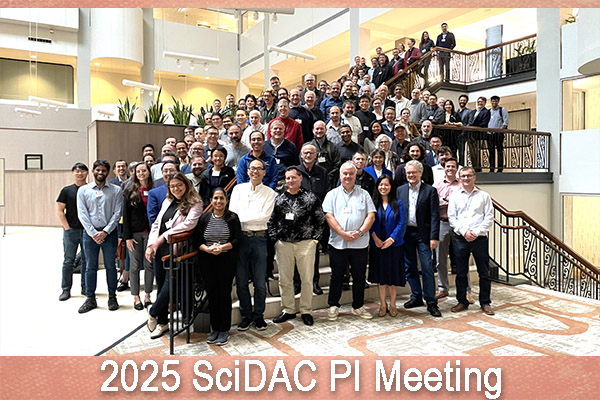
On September 16-18, 2025, the US Department of Energy (DOE) Office of Science Advanced Scientific Computing Research Program (ASCR) held the Scientific Discovery through Advanced Computing (SciDAC) Program Principal Investigator (PI) Meeting in Rockville, Maryland. Reflecting the spirit of the SciDAC program and continuing its long-standing tradition, the PI meeting aimed to inspire and facilitate deep interdisciplinary collaborations across projects and research topics supported by SciDAC. Two Biological and Environmental Research (BER) breakout sessions spotlighted recent advances and synergies in the seven partnership projects co-funded by BER and ASCR programs. The projects were all centered around the Energy Exascale Earth System Model (E3SM) (Fig. 1), addressing computational challenges in different components of the Earth system.
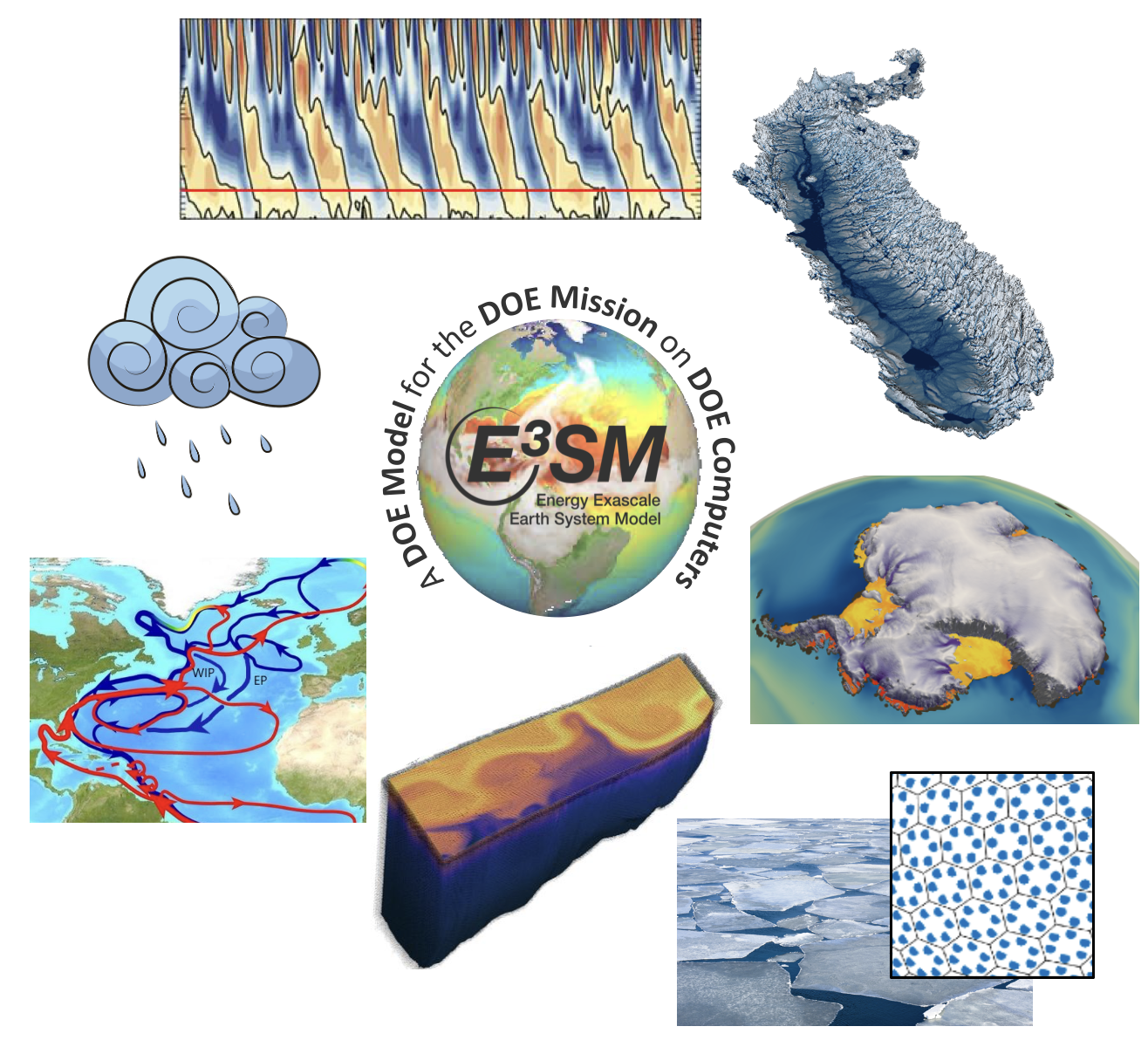
Figure 1. The seven BER-ASCR SciDAC Partnership projects are addressing computational challenges related to various components of the E3SM model.
The first breakout session focused on exchanging updates among the seven projects. Artificial Intelligence (AI) and emulation were cross-cutting topics, with most of the SciDAC teams incorporating AI into their work. Projects are exploring emulators at multiple levels, from individual physics parameterizations to whole-model surrogates, aiming at improving model efficiency and accuracy as well as facilitating automatic tuning and parameter optimization. Discussions emphasized the need for coordination on training frameworks, target resolutions, and comparisons between E3SM and regionally focused models. The group also discussed model adjoints, uncertainty quantification, and optimization, touching upon novel approaches ranging from neural-network-based gradients to automatic differentiation in Fortran. The importance of interpretability, trustworthiness, and retaining traditional algorithmic expertise alongside AI developments was underscored. Gary Geernaert, the Division Director of the Earth and Environmental Systems Sciences Division (EESSD), pointed out the important role that the BER-ASCR SciDAC partnership continues to play in further advancing E3SM to support the evolving EESSD science priorities such as the digital testbeds under development with AI as an essential component.
Since the projects had completed Year 3 of their 5-year term, the second breakout session focused on transition planning and integration to E3SM over the next five years. BER Associate Director Dorothy Koch emphasized SciDAC’s unique value as a high-risk, high-reward program that feeds innovative capabilities into E3SM while also generating transferable technologies. Luke Van Roekel, a member of the E3SM Leadership Team and the PI of a SciDAC project, was invited to provide a high-level overview of the newly developed high level strategic plan and near-term priorities that have direct relevance to the SciDAC5 projects for future coordination and integration. He presented the roadmap for E3SM, including highlights from the recently released version 3 model as well as the new emphasis on high-resolution seasonal-to-decadal prediction (S2D) and AI.
At the same time that E3SM is under transition, the SciDAC Institutes funded by ASCR are in the process of recompetition this year, introducing additional changes and opportunities to the SciDAC ecosystem. To leverage efforts between projects, each BER–ASCR Partnership project presented a flash talk highlighting capabilities that might be of interest to other projects and to E3SM. These included new features or improvements in E3SM as well as tools external to the E3SM code that were developed for building emulators and uncertainty quantification, visualization, solver auto-tuning, and utilizing novel languages like Julia.
The meeting closed with a strong sense of momentum and open-mindedness. While AI tools offer powerful new capabilities, the attendees acknowledged the value of traditional physics-based model systems, the complexity of scale-aware modeling, the importance of preserving low-resolution workflows, and the need to maintain clear scientific goals. As E3SM and its ecosystem move toward new frontiers in S2D prediction, energy-water interactions, and human system coupling, the SciDAC collaboration continues to serve as a vital incubator for the next generation of Earth system science.
Additional information regarding the BER Breakout, including overall planning, capabilities developed through the partnership, and presentations, is available here. Further descriptions of the seven BER-ASCR SciDAC Partnership projects can also be accessed here.
