

How future changes in an S2S mode of variability (BSISO) intensify heat and wildfire extremes
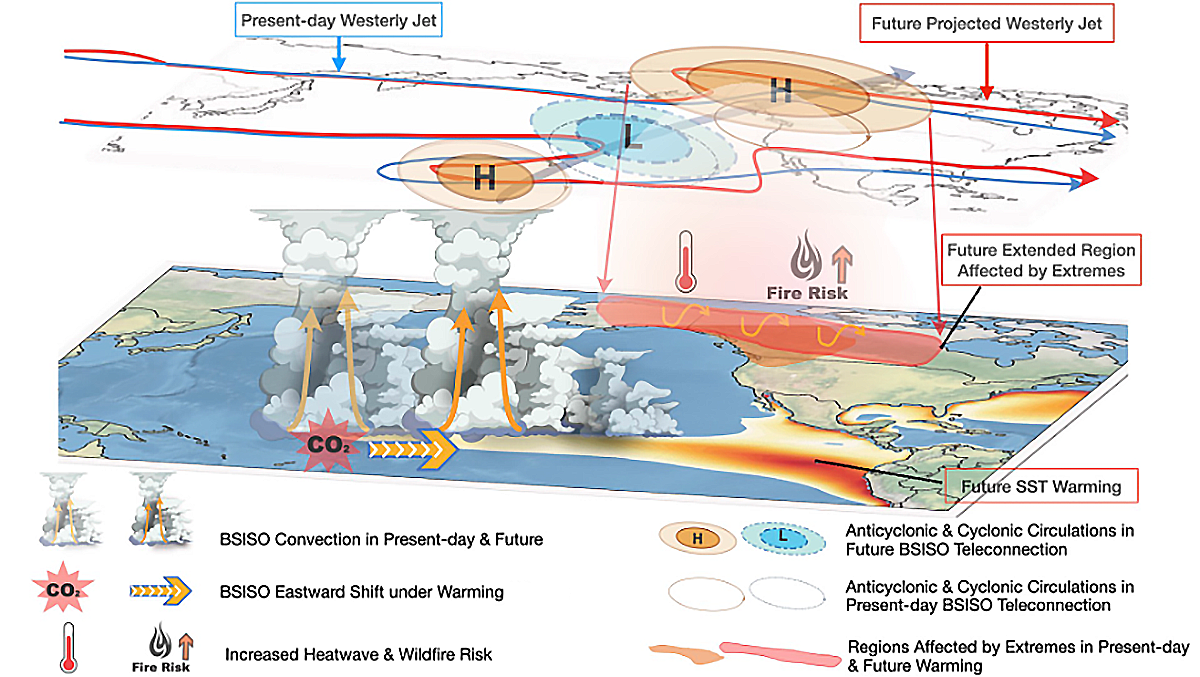
Figure 1. Schematic diagram illustrating projected changes in the boreal summer intraseasonal oscillation (BSISO) convective system and its teleconnection influence on downstream heatwave and wildfire risks in the future.
Shift in Eastward-Moving Tropical System Amplifies Future Risk in Seasonal Extremes
The Science
The boreal summer intraseasonal oscillation, or BSISO, is a large-scale tropical weather system that influences conditions around the globe, triggering heatwaves and wildfires in regions as far away from the tropics as Alaska and the Pacific Northwest.
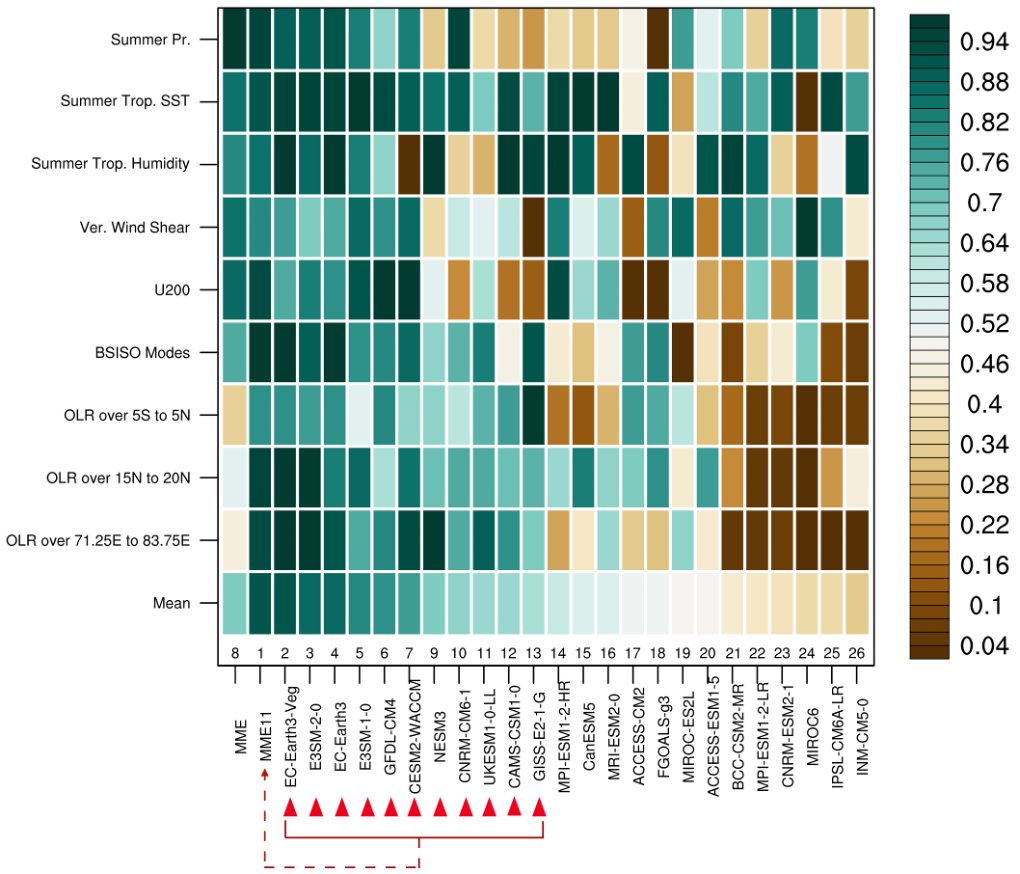
Figure 2. A comprehensive evaluation of Earth System Models (ESMs) based on their skill scores. The performance of mean-state patterns, BSISO mode, and BSISO life cycle among 24 ESMs is evaluated. The bottom row (Mean) denotes the weighted-mean skill scores based on the metric numbers of large-scale patterns (top five metrics: summer precipitation, summer tropical sea surface temperature, summer tropical humidity, vertical wind shear, zonal wind at 200 hPa) and BSISO mode as well as the life cycle, the outgoing longwave radiation (OLR) metrics. The number above each model indicates the model skill ranking based on the weighted mean skill score across the model ensembles. The first eleven models with high simulation skills on large-scale patterns and BSISO characters are selected (red triangles). MME11 and MME represent the multi-model ensemble means of the eleven selected models and all models, respectively.
The Impact
This study provides new insight into how future changes in tropical systems influence remote regions and underscore the value of subseasonal forecasts for managing seasonal extremes. It is the first to show that eastward shift of the BSISO in the future will intensify extreme summer weather risks across a broader area of northern North America. The findings show that during certain BSISO phases (specifically phases 6-7), heatwave frequency could increase by 23% over high-latitude North America, and the probability of large fire potential rises by a factor of 3.5. The work also highlights how tropical weather variability contributes to long-range predictability and should be considered in risk analysis and early warning systems. These insights support improved forecasting and preparedness across fields, including wildfire management, public health, and emergency response.
Summary
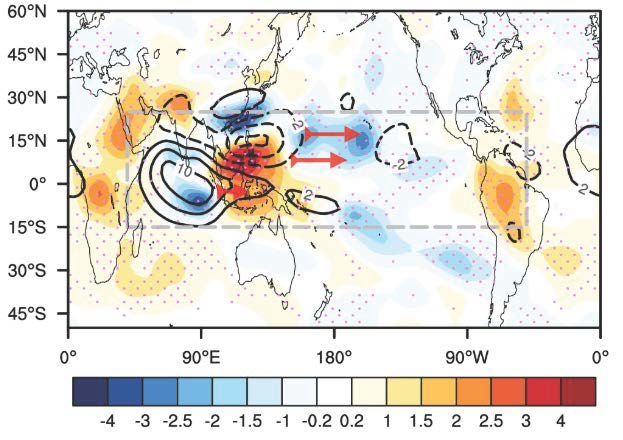
Figure 3. Projected changes in OLR anomalies in BSISO phases 6 and 7 for the future. Contours denote the present-day composite of OLR anomalies in the historical run. Interval levels of present-day OLR anomalies are –10, –6, –2, 2, 6, 10 W m–2. Stippling denotes consistent sign of projected changes across >70% of the models. Gray box refers to the longitude range where BSISO eastward shift occurs as indicated by the red arrows.
This study explored how changes in the BSISO in the coming decades will affect the risk of extreme summer events in North America (Fig. 1). Researchers selected a set of 11 Earth system models (Fig. 2), including two versions (v1 and v2) of the Energy Exascale Earth System Model (E3SM), from a total of 24 models that rank highest in terms of their performance in simulating mean-state patterns, BSISO mode, and BSISO life cycle. They found that BSISO convection extends farther eastward in the tropical Pacific Ocean by approximately 3° in longitude, or roughly 300 kilometers (Fig. 3). This eastward shift is driven by increased moisture and changes in sea surface temperature across the tropical central-to-eastern North Pacific. The shift leads to stronger convection in the tropical central-to-eastern North Pacific, which generates powerful atmospheric waves that interact with large-scale atmospheric flow over North America, reaching farther into the northern latitudes. These effects enhance the formation of high-pressure heat domes and reduce soil moisture across wide regions.
Publication
- Chen, Z., S.W. Lubis, J. Lu, C.-C. Chang, H. Huang, W. Zhou, B. Harrop, and L. R. Leung. 2025. npj Clim Atmos Sci 8, 317, doi:10.1038/s41612-025-01196-5
Funding
- This work was supported by the Office of Science, U.S. Department of Energy (DOE), Biological and Environmental Research as part of the Regional and Global Model Analysis program area through the Water cycle: Modeling of Circulation, Convection, and Earth system Mechanisms (WACCEM) scientific focus area. The Pacific Northwest National Laboratory (PNNL) is operated for DOE by Battelle Memorial Institute under contract DE-AC05-76RL01830
Contact
- L. Ruby Leung, Pacific Northwest National Laboratory
