

Updated Sunlight Spectral Distribution Improves Polar Simulations
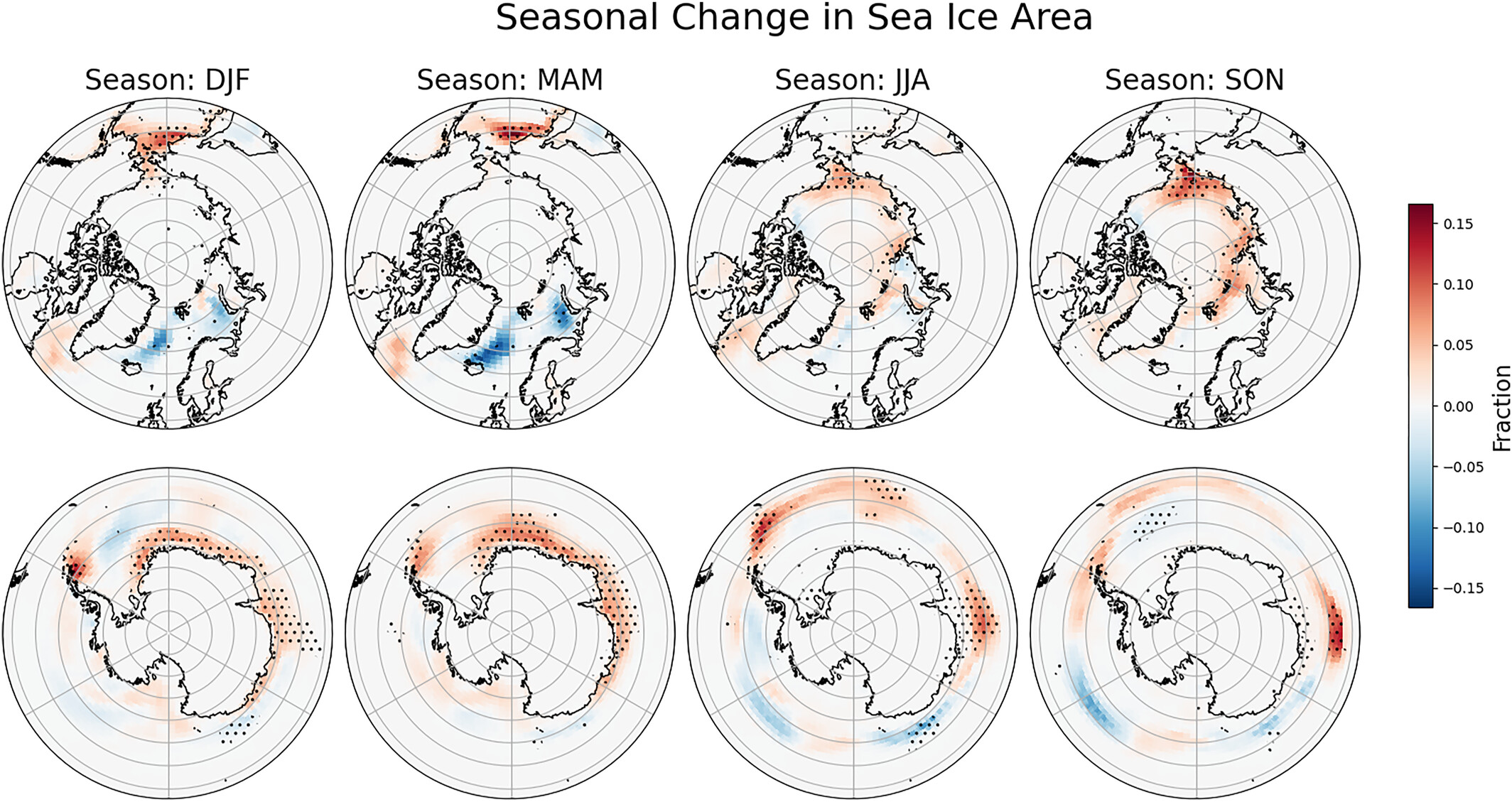
Figure 1. Seasonal average change in sea ice area fraction, due to improved spectral albedos. Stippled regions show changes within the 95% compatibility interval.
More accurate mix of red and near-infrared light causes greater reflectance, increased sea-ice formation, and cooler polar temperatures
The Science
Sunlight is the primary energetic driver of the polar system. The correct representation of the spectral distribution of sunlight over cryospheric surfaces is crucial because the reflectance of snow and ice changes dramatically near the boundary of the visible (VIS) and near-infrared (NIR) spectral regimes. For simplicity, many Earth system models divide solar flux from an atmospheric spectral band evenly between the VIS and NIR coupling bands, leading to an overestimate of NIR surface flux, and an underestimate of VIS flux.
The Impact
Researchers found that the simulated behavior of polar regions respond most strongly to correcting the proportion of red to near-infrared sunlight because snow reflectance changes dramatically in exactly this spectral region. The improved spectral blend of sunlight at the surface causes greater snow and ice reflectance, increased atmospheric transmission and cooling, and more productive sea-ice formation near Greenland and Antarctica (Fig. 1). This reduces the polar warm bias seen in E3SM and other coupled Earth system models, thus improving the observational fidelity of E3SM simulations in polar regions.
Summary
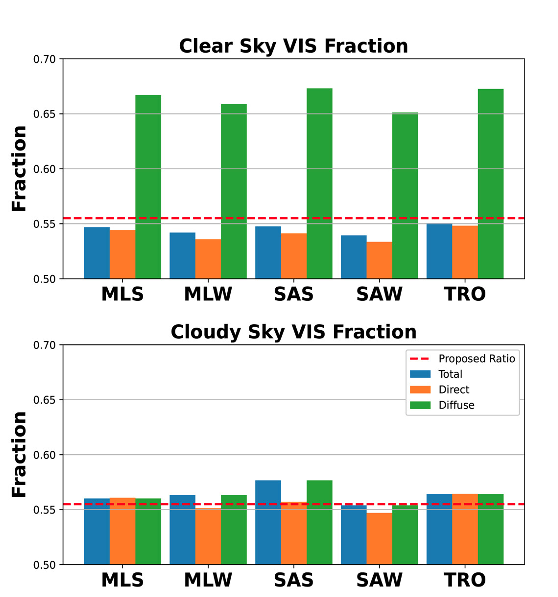
Figure 2. Fractional VIS surface insolation within the split band for the Mid-Latitude Summer (MLS), Mid-Latitude Winter (MLW), Sub-Arctic Summer (SAS), Sub-Arctic Winter (SAW), and tropical (TRO) atmospheric profiles. Each profile shows the VIS fraction of the total split-band insolation (blue), and VIS fractions of the direct and diffuse components (orange and green, respectively). Original partition value was 0.5, an even split between VIS and NIR. Proposed new asymmetric partition value of 0.555 is shown as a red dashed line.
The team improved the current 50:50 partition of solar flux within the atmospheric “red band” (0.625–0.778 µm) in the Energy Exascale Earth System Model, into more accurate VIS and NIR bands exchanged between model components. The improved spectral partition, based on hyperspectral SWNB2 model simulations, splits this insolation 55.55:44.45 VIS to NIR (Fig. 2). This shifts up to 4.3 Wm-2 from NIR to VIS and causes cryospheric surfaces to reflect more VIS light and to absorb less NIR light. The team implemented the refined partition into E3SM and ran a fully coupled pre-industrial simulation to assess the polar response. The improved partition creates forcing that brightens cryospheric surface, reducing absorption up to 0.9 Wm-2. Polar responses amplify forcing via increased sea ice area (up to 5%) and reduced snow metamorphic rates. Polar surfaces are highly sensitive to proposed correction, as surface net flux forcing is amplified up to a factor of 10. The cooling tendency increases sea-ice formation and reduces snow aging (darkening). Combined, these effects reduce polar temperatures in E3SM by as much as 1.5 K.
Publication
- J. Tolento, C. Zender, A. Roberts, E. Thomas. J. Geophys. Res. Atm., 130(17), e2025JD043796, (2025). [10.1029/2025JD043796]
Funding
- This research was supported as part of the Energy Exascale Earth System Model (E3SM) project, funded by the U.S. Department of Energy, Office of Science, Office of Biological and Environmental Research (DE‐SC0019278). Juan Tolento also gratefully acknowledges support from the University of California, Irvine‐Los Alamos National Lab SoCal Hub Fellowship. Support for Charles Zender and Chloe Whicker-Clarke was provided through the Scientific Discovery through Advanced Computing (SciDAC) program. Los Alamos National Laboratory is operated by Triad National Security, LLC, for the National Nuclear Security Administration of U.S. Department of Energy (Contract No. 89233218CNA000001). This research used resources of the National Energy Research Scientific Computing Center (NERSC), a U.S. Department of Energy Office of Science User Facility located at Lawrence Berkeley National Laboratory.
Contact
- Juan Tolento, University of California, Irvine
- Charlie Zender, University of California, Irvine
