

Wave-State–Dependent Surface Fluxes Improve MJO Representation in E3SM
The Science
Ocean surface gravity waves, driven by energy and momentum from steady winds blowing over the ocean surface, influence numerous physical processes at the air–sea interface, including momentum and energy fluxes, gas fluxes, upper-ocean mixing, sea spray production, ice fracture, coastal inundation, and surface albedo. Recent studies have shown that wave-induced changes in surface flux calculations have significant global and regional impacts. However, ocean waves are poorly represented or often neglected in Earth system models (ESMs) due to their small scales and high computational cost of wave models. Given these limitations, current ESMs model turbulent air–sea fluxes based on surface winds alone, which implicitly assumes that waves and winds are in equilibrium. When the ocean surface wave field is fully developed and steady, the wave field does not modify the wind stress across the air-wave-sea interface and thus waves can be ignored. In reality, wind wave equilibrium is rarely observed in the ocean and as waves grow or decay, the stress on the ocean decreases or increases due to the presence of an evolving wave field.
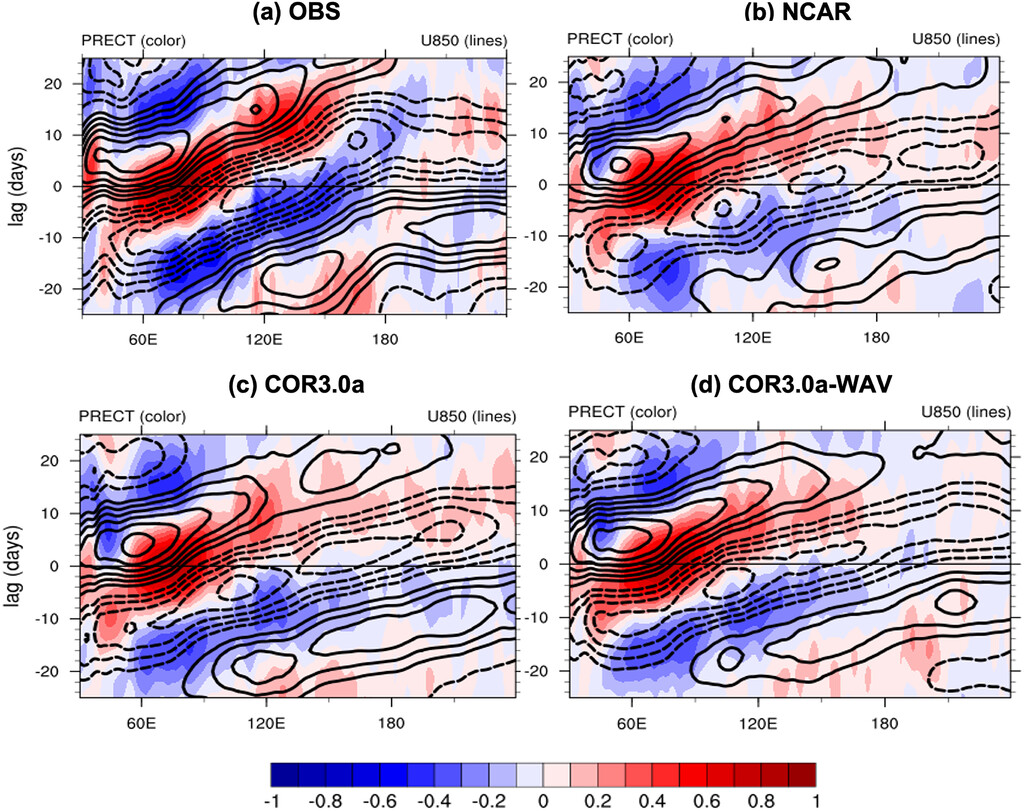
Fig. 1. Lag–longitude diagram of 10°N–10°S-averaged precipitation (color) and 850 hPa zonal wind (contour) correlated against precipitation anomaly averaged over the reference region the Indian Ocean (10°N–10°S, 75°–100°E) during the extended boreal winter (November–April) for (a) Tropical Rainfall Measuring Mission (TRMM) precipitation and ECMWF Reanalysis 5 (ERA5) wind 1998–2010 observations and experiments – (b) NCAR (Large and Yeager 2009), which is the default E3SM configuration, (c) the Coupled Ocean Atmosphere Reference Experiment (COARE)-3.0a bulk flux scheme (Fairall et al 2003) option in E3SM and (d) E3SM COARE-3.0a + waves.
The Impact
In this study, the WAVEWATCH III wave model was coupled to the atmospheric and ocean model components of the Energy Exascale Earth System Model (E3SMv2) to investigate how wave-induced changes in surface turbulent air–sea fluxes affect the Madden–Julian Oscillation (MJO), which is the dominant mode of intraseasonal variability in the tropics. Figure 1 shows the eastward propagation of the active convective center, which can be seen in the figure as the precipitation anomalies (colored contours) propagating toward the upper right of the plots. The convective center is an important feature of MJO activity which provides a key metric for assessing the model’s skill in simulating the MJO. Figure 1 shows results for observations in panel (a) and three configurations of E3SM. Panel b is the default configuration of E3SM, Panel c tests the sensitivity to the change in surface flux routine and panel d includes wave effects. In E3SM there is too much precipitation east of the International Dateline (red contours). Comparison of Figure 1b and c show this is not related to the chosen surface flux scheme. When wave-induced effects on the bulk parameterization are included in E3SM, the simulation is closer to observations. While biases remain even with wave effects (e.g. the MJO propagation is too slow, evident by the slope of the precipitation anomalies), the proper treatment of wave effects can reduce a standing bias within E3SM. This is the first study to investigate the impacts of ocean surface waves on large scale intraseasonal modes of atmospheric variability.
Summary
Results from a fully coupled ocean–atmosphere–wave model reveals that wave-state-dependent flux improves the MJO representation over the default wind-dependent bulk algorithm in E3SM. Strong anomalous easterlies over the Pacific Ocean in the wind-dependent algorithm enhance the latent heat flux and thus are responsible for anomalous MJO propagation after the date line. When using a wave-state-dependent flux, waves reduce the anomalous easterlies, leading to a decrease in the latent heat flux and dissipates the MJO west of the international date line. These findings highlight the role of surface fluxes in MJO simulation fidelity.
Publication
- Ikuyajolu, O. J., L. Van Roekel, S. R. Brus, E. E. Thomas, Y. Deng, and J. J. Benedict, 2024: Effects of Surface Turbulence Flux Parameterizations on the MJO: The Role of Ocean Surface Waves. J. Clim. 37, 3011–3036, https://doi.org/10.1175/JCLI-D-23-0490.1
Funding
- This research was supported as part of the Energy Exascale Earth System Model (E3SM) project, funded by the U.S. Department of Energy, Office of Science, Office of Biological and Environmental Research. This research used resources from the Argonne Leadership Computing Facility at the Argonne National Laboratory, which is supported by the Office of Science of the U.S. Department of Energy under Contract DE-AC02-05CH11231. This research used resources of the National Energy Research Scientific Computing Center (NERSC), a U.S. Department of Energy Office of Science User Facility located at Lawrence Berkeley National Laboratory, operated under Contract DE-AC02-05CH11231.
Contact
- Olawale James Ikuyajolu, Los Alamos National Laboratory
- Luke van Roekel, Los Alamos National Laboratory
- Erin E. Thomas, Los Alamos National Laboratory
- Steven R. Brus, Argonne National Laboratory
