

10 Years in the Making: E3SM-GCAM coupling
Key points
- After 10 yrs of work, a novel E3SM Human Component (EHC) that incorporates the Global Change Analysis Model (GCAM) has been developed to allow dynamic, synchronous interactions between human and Earth systems.
- A paper has recently been published in the Jounal of Advances in the Modeling of Earth Systems documenting this new component and performing the first scientific research with it.
- Making EHC a component on par with the atmosphere, land, and ocean provides a framework for adding new feedbacks between human and Earth systems related to energy production and use. This facilitates continuous advancement and coupling with the other Earth system components
Background
Humans are a critical component of the Earth system, yet traditionally they are not represented in Earth system models. Manufacturing, agriculture, energy systems, and other human systems appear in these models only via prescribed boundary conditions. This lack of human systems in these models fails to represent human responses to variable conditions. this is analogous to running the atmosphere model with data land and ocean inputs, which fails to represent land-atmosphere and ocean-atmosphere interactions.
Similarly to simulating dynamic coupling between environmental components, incorporating human systems in an Earth system model improves realism and robustness of model predictions by enabling dynamic feedbacks that are present in the real world. For example, weather variability influences land use, which can significantly impact regional weather and further affect land use. Weather-induced reductions in crop yield could lead to cropland increases at the expense of forest, which can affect regional to local temperature and precipitation patterns. Energy use for heating and cooling is also driven by and affects weather patterns. Water management is essential for both energy production and use, and depends on ever-changing water availability. Irrigation, power plant cooling, and other human uses compete for varying water supply, thus affecting land use, physical land-atmosphere interactions, and and energy production and use, which in turn contribute to variability in precipitation, water availability, and temperature. Some human activities, such as the growth of data centers, can create positive human-environment feedbacks through increased energy demand for cooling and an increase in localized heating (e.g., adding to the urban heat island effect) that in turn requires more cooling. Such feedbacks are crucial for understanding the evolution of the human-Earth system.

Figure 1. The effects of including human-environment feedbacks on select crop prices for select years. The bar represents the median change in regional prices, the box represents the quartiles, the whiskers represent 1.5 times the interquartile range, and the points are outliers.
Adding a human component has been a major goal for E3SM since its inception 10 years ago, but this goal was only realized in the last few months (see reference below). Currently, this component includes land use responses to weather variability. The referenced article shows (among other things) that including human-environment feedbacks substantially affects pricing of key agricultural commodities (see Fig. 1). Proposed advances to the EHC include the additions of energy and water demand responses to variable conditions, which will further affect predictions. These proposed capabilities will improve understanding of water-energy relationships in the context of variable conditions by enabling model experiments with self-consistent representations of drivers and responses. Some questions include: How do regional energy demands vary over time in response to dynamic conditions? How does water supply influence water demand, land and energy use, and the key drivers of Earth system dynamics? With both energy and water capabilities enabled the model could be used to assess more intricate relationships between water management and energy production and use, such as the interplay between increased energy demand in places where water scarcity may affect energy production via limited cooling capacity.
Overview of E3SM-GCAM coupling
The E3SM human component (EHC, Figure 2) comprises translation software and a core human systems model. The core human systems model is the Global Change Analysis Model (GCAM), a state-of-the-science multisector dynamics model that simulates energy, land, and water sectors and their interconnections via economic markets and supply/demand.
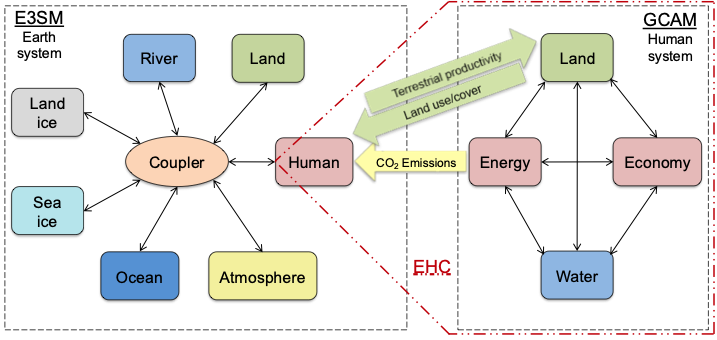
Figure 2. The new Energy Exascale Earth System Model (E3SM) human component (EHC). The Global Change Analysis Model (GCAM) is the core human system model of the EHC.
GCAM operates on an unstructured grid delineated by the intersection of 32 regions and 235 water basins, and provides boundary conditions to the land and atmosphere components with a five year timestep. In addition to interpolating between different spatial grids and handling vastly different timesteps for different components, the coupling layer of the EHC also needs to translate between different definitions for plant functional types and other variables.
E3SM-GCAM is run like any other E3SM simulation in that it is configured by compset and namelist and compiled/submitted by the standard commands. Before running E3SM-GCAM for a new scenario, however, a standalone GCAM simulation is needed to provide non-interactive human forcings to the model, such as aerosol emissions. Future development could reduce the amount of non-interactive human forcings, thus simplifying this two-step process for running E3SM-GCAM.
Next Steps
The Human-Earth System (HES) team continues to develop, improve, and expand this new EHC framework. Direct linkages between the Earth and the energy system can be implemented by passing surface temperature information to GCAM’s heating/cooling demand calculations. Water availability from the land and river components can inform GCAM’s water supply and demand predictions, which will affect irrigation and land use, energy production and use, and water availability via water management in the river module. Improvements in the land coupling to include detailed crop and irrigation data will enable full use of GCAM water demands by the land component crop model. These and additional developments will enable groundbreaking analyses of other human-Earth interactions involving the energy system, agroecosystems, and how they respond to changes in temperature, water availability and use, and dynamic energy production and use.
Reference
Di Vittorio, A. V., Sinha, E., Hao, D., Singh, B., Calvin, K. V., Shippert, T., Patel, P., and Bond-Lamberty, B.: E3SM-GCAM: A Synchronously Coupled Human Component in the E3SM Earth System Model Enables Novel Human-Earth Feedback Research, J. Adv. Model. Earth Syst., 17, e2024MS004806, 2025. https://doi.org/10.1029/2024MS004806
