

The ACE Emulator for EAMv3 is Now Available
 Slow throughput and computational expense severely limit progress in Earth system research. AI-based emulators of traditional earth system models promise to provide the same answers, but much faster and cheaper. E3SM has recently committed to including an emulator with each future major release of its physical model. Initially, such emulators will be experimental and have limited scope, but through continued development over the next few years they should speed up and simplify a broad range of useful modeling tasks.
The Allen Institute for Artificial Intelligence (Ai2) has developed an emulator called ACE to enable fast, seamless emulation of a global atmosphere model across a wide range of timescales. Through a collaboration between Ai2’s Elynn Wu, Chris Bretherton and James Duncan, and LLNL’s Peter Caldwell, Finn Rebassoo, Chris Golaz, and Aaron Donahue, ACE has been trained to emulate recent versions of the E3SM Atmosphere Model (EAM). The first version of ACE was trained on EAMv2 reference simulations featuring a repeating annual cycle with seasonally-varying distributions of sea-surface temperature (SST) and sea-ice (https://doi.org/10.1029/2024JH000136).
Continuing this collaboration, the team has trained version 2 of ACE to emulate the E3SM Atmosphere Model version 3 (EAMv3, https://doi.org/10.22541/essoar.174456922.21825772/v1), and invites the E3SM community to experiment with it. This emulator was trained on an AMIP-style EAMv3 simulation forced by observed sea surface temperature varying continuously between 1970 and 2010. Annually-repeating but seasonally-varying aerosols and precursor emissions representative of year 2010 conditions were used. Well-mixed gases were also held constant at 2010 values. A manuscript by Wu et al. evaluating this new emulator in the context of a Green’s Function decomposition of SST response has been submitted to JGR-Machine Learning and Comp. and is available at https://arxiv.org/abs/2505.08742. The ACE2-EAM3 emulator has a 6-hour timestep, runs 1000 years per day on a A100 GPU at 1 degree lat/lon grid resolution (90x faster than EAMv3 itself run on 22 CPU nodes of Perlmutter), and faithfully reproduces EAMv3 behavior over multi-decade simulations. It accurately simulates the 1970-2020 mean, trends, and ENSO-related variability of a comprehensive set of surface, vertically resolved and top-of-atmosphere fields. For example, Fig. 1 shows that a 1970-2020 rollout of the emulator accurately simulates sensitivity of outgoing longwave radiation to Nino3.4, an index of ENSO, vs. the reference EAMv3.
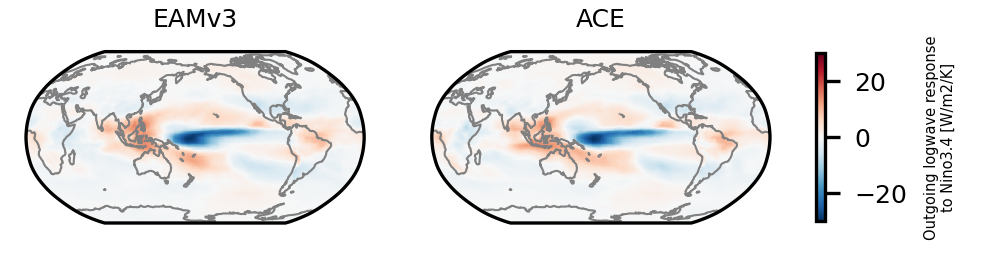
Figure 1. Maps of regression coefficients of ACE-EAMv3 and EAMv3 top-of-atmosphere outgoing longwave against the Niño 3.4 index over 1970-2020.
Because ACE-EAMv3 was only trained on historical conditions, it isn’t expected to provide accurate answers for far-future simulations or aerosol-sensitivity experiments, but subsequent model releases should have more and more emulator functionality useful to the E3SM user community. In particular, the team is now working on an emulator for coupled atmosphere-ocean simulations.
Instructions for using the model can be found here.
This article is a part of the E3SM “Floating Points” Newsletter, to read the full Newsletter check:
