

Drivers and Impacts of Sediment Deposition in Amazonian Floodplains
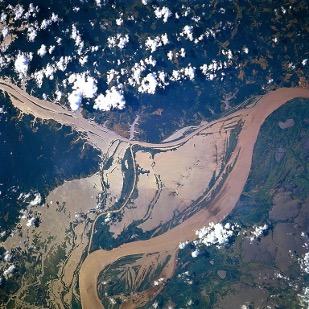
Photo by the National Aeronautics and Space Administration (Wikimedia Commons)
High-resolution modeling reveals detailed impacts of dam construction and deforestation.
The Science
A major open question in large river dynamics is what processes control the deposition of river sediment on floodplains. Quantifying this sediment deposition across time and space has been an additional challenge. Sediment deposition significantly shapes landscapes and ecosystems, playing a crucial role in the generation and severity of river flooding. The Amazon floodplain (Fig. 1), due to its complex topography, extensive measurements, and critical sediment dynamics relevant to U.S. river systems serves as an ideal testbed.
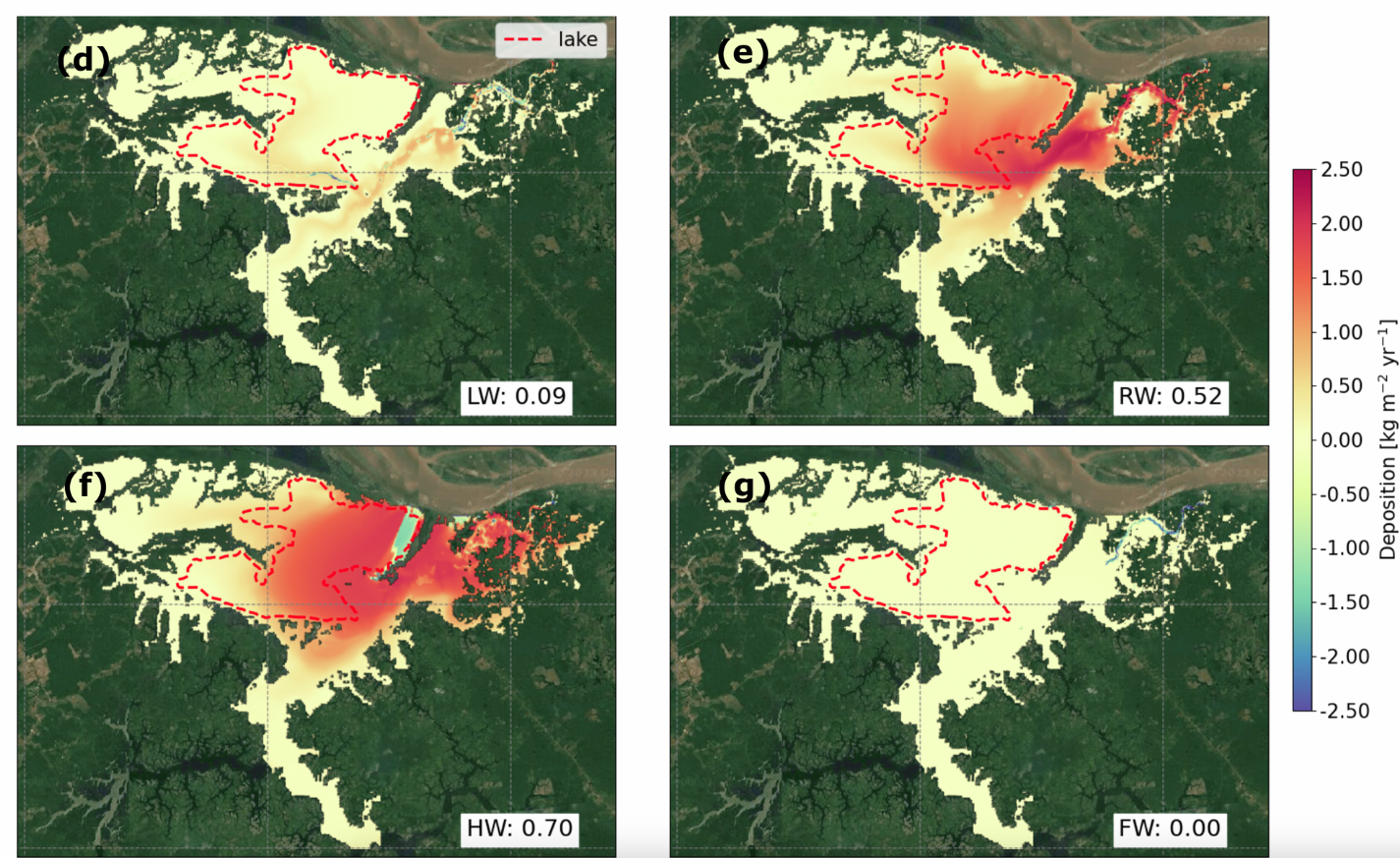
Figure 1. Spatial distributions of the modeled average deposition rate in four hydrological periods (LW: low water; RW: rising water; HW: high water; FW: falling water) and the corresponding floodplain-averaged deposition rate [kg m−2 yr−1]. Sediment deposition shows large and distinct spatial variability during the four periods.
The Impact
This research develops an unprecedented high-resolution hydrodynamic-sediment model for Amazonian floodplains, simulating how sediment moves and is deposited. This is important for managing and preserving these unique ecosystems, as understanding how sediment moves isn’t achievable using only observations. This research found that sediment deposition in Amazonian floodplains depends jointly on three key factors: river flooding (inundation), the amount of sediment carried by the Amazon River water, and how water moves within the floodplain. It thus provides the first detailed picture of how these three factors together control sediment deposition. Using targeted sensitivity analyses, human actions – such as building dams and removing forests – were found to significantly affect sediment deposition, altering the natural balance of these important environments. Additionally, the deposition of sediment-associated organic matter was found to play a minor role in fueling carbon dioxide and methane emissions in the Amazon. Findings from this study directly enhance understanding of how human activities shape these processes in the Amazon and similar regions worldwide, providing valuable insights for both refining global Earth system models and managing river systems facing similar pressures worldwide.
Summary
This study used a high-resolution numerical model that simulates sediment deposition in detail for a representative Amazonian floodplain, Janauacá (Fig. 1). Total sediment deposition over the lower Amazonian floodplains was estimated by upscaling the area-specific deposition rate. Simulations showed that sediment deposition is driven jointly by river inundation, suspended sediment concentration in the Amazon River, and floodplain hydrodynamics. Sediment deposition showed a stronger relationship with sediment concentration in the river rather than with the flooding magnitude itself. Additionally, this study evaluated how human activities — particularly dam construction and deforestation — impact sediment dynamics. Because reservoirs capture sediments and prevent their passage downstream, dams reduce sediment supply, and thus sediment deposition, in the floodplain. However, while widespread deforestation initially boosts sediment deposition, it ultimately decreases floodplain trapping efficiency over time.
Publication
- Feng, D., Tan, Z., Pinel, S., Xu, D., Amaral, J.H.F., Fassoni-Andrade, A.C., Bonnet, M.-P., and Bisht, G. 2025. “Drivers and impacts of sediment deposition in Amazonian floodplains.” Nature Communications 16: 3148. [DOI: 10.1038/s41467-025-57495-1]
Funding
- This work was supported by Scientific Discovery through Advanced Computing (SciDAC) Partnership Program, through the project “Capturing the Dynamics of Compound Flooding in E3SM”, funded by the U.S. Department of Energy, Office of Science, Biological and Environmental Research program, Earth System Model Development Program Area and the Office of Advanced Scientific Computing Research (ASCR). Pacific Northwest National Laboratory is operated by Battelle for the U.S. Department of Energy.
Contact
- Zeli Tan, Pacific Northwest National Laboratory
This article is a part of the E3SM “Floating Points” Newsletter, to read the full Newsletter check:
