

Improving the Representation of Methane Dynamics in Global Lake Models

Figure 1. Schematic of the improved Advanced Lake Biogeochemistry Model (ALBM) developed in this study. This figure illustrates the numerous complex, methane-involved processes that occur in lakes. Accurately capturing methane (CH₄) emissions from lakes is important to constrain the CH4 feedback in Earth system models but has thus far been a missing component. Figure from Tan et al. (2024). | Figure from Tan et al. (2024)
Study paves the way towards accurately representing methane emissions from lakes in Earth system models.
The Science
Current lake methane (CH₄) models either miss key processes or haven’t been tested with observations from diverse environments. Further, no Earth system model (ESM) has yet represented lake CH₄ dynamics. This study, therefore, improved the Advanced Lake Biogeochemistry Model (ALBM) by including new modeling methods for CH₄ production, oxidation, and transport (Fig. 1). The team also created a new dataset of CH₄ emissions from 106 lakes worldwide for model validation. The results indicated that oxic methane production (OMP) — a process not currently included in lake CH₄ models, whereby methane is generated in the surface waters of a lake — plays a significant role in overall CH₄ diffusion. The improved model showed overall strong performance (Fig. 2) in simulating observed emissions at seasonal and inter-annual timescales and from the lakes on different continents.
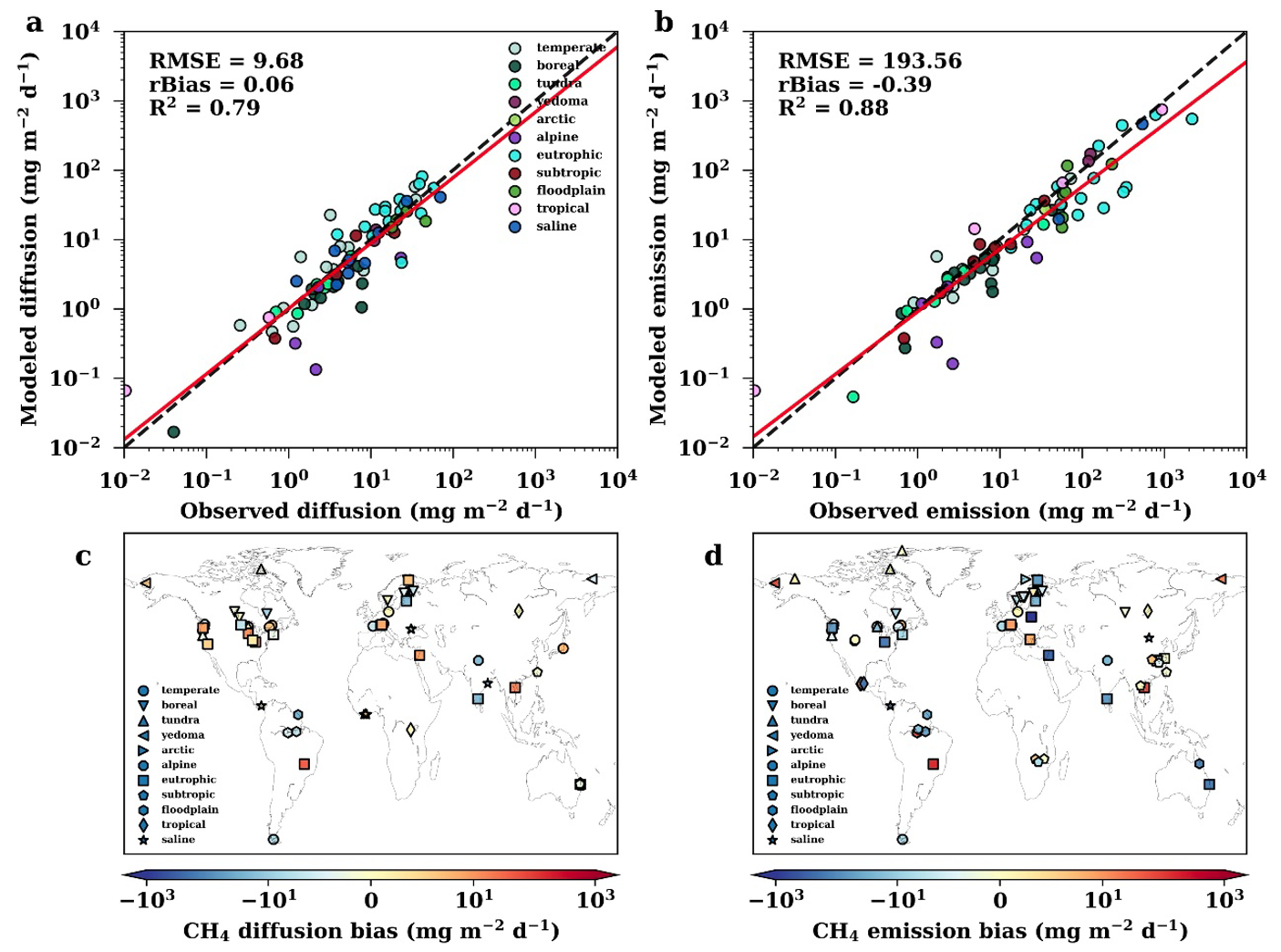
Figure 2. The improved ALBM shows excellent performance in simulating the total CH4 emission (a) and CH4 diffusion (b) of the 106 lakes in the validation dataset, with moderate model biases (c, d).
The Impact
Lakes are highly sensitive to earth and environmental changes and can produce over 30% of natural CH₄ emissions, which affect global warming levels and the ozone layer. Despite its importance, lake emissions are one of the most uncertain CH4 sources in the global CH₄ assessment and have not been represented in any ESMs. By reproducing the observed CH₄ emissions from 106 lakes in diverse environments, the improved ALBM could become the first lake CH₄ model that can be integrated into ESMs to constrain global lake CH₄ emissions and earth system-CH₄ feedback. The study also develops several new modeling methods for CH₄ production, oxidation, and transport that can help improve the global applicability of other lake CH₄ models.
Summary
Lakes are important sentinels of earth and environmental changes and contribute significantly to the emissions of the second most important greenhouse gas after CO2: CH₄. However, no ESM has represented lake CH₄ dynamics. To fill this gap, this study improved the process-based ALBM. This included adding and/or refining the representation of lake bathymetry, OMP, the effect of water level on ebullition (bubbles), new non-linear CH₄ oxidation kinetics, and the coupling of sediment carbon with lake primary production and upstream carbon loadings. Researchers also compiled a global dataset of lake CH₄ emissions for model validation. The improved ALBM reproduces the seasonal and inter-annual variabilities of CH₄ emissions at 10 representative lakes for different lake types and the variations in mean annual CH₄ emissions from 106 lakes across the globe. The results suggest that OMP, a newly discovered process, could play an important role in surface CH₄ diffusion, and its relative importance is higher in less productive and/or deeper lakes. The effect of water level on ebullition is important for CH₄ outgassing in lakes of significant water level fluctuations, such as floodplain lakes. Future research will be conducted to integrate the model into the Energy Exascale Earth System Model (E3SM) to constrain global lake CH₄ emissions and earth system-CH₄ feedback.
Publication
- Tan, Zeli, Huaxia Yao, John M. Melack, Hans‐Peter Grossart, Joachim Jansen, Sivakiruthika Balathandayuthabani, Khachik Sargsyan, and L. Ruby Leung. 2024. “A Lake Biogeochemistry Model For Global Methane Emissions: Model Development, Site‐Level Validation, And Global Applicability”. Journal Of Advances In Modeling Earth Systems 16 (10). American Geophysical Union (AGU). doi:10.1029/2024ms004275.
Funding
- This work was supported by the Earth System Model Development program area of the Department of Energy, Office of Science, Biological and Environmental Research program.
Contact
- L. Ruby Leung, Pacific Northwest National Laboratory
This article is a part of the E3SM “Floating Points” Newsletter, to read the full Newsletter check:
