

Uncovering the Substantial Predictability of the 2003 European Summer Heatwave Linked to the Tibetan Plateau
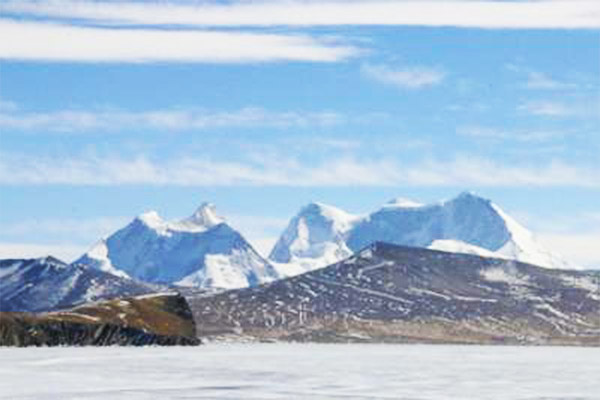
Interannual variability of the Tibetan Plateau spring snow cover anomalies can be used to enhance prediction of European heatwaves using Earth system models with a weakly coupled land data assimilation system. | Photo by Mars You via Pexels
Leveraging Tibetan Plateau land surface conditions to enhance subseasonal-to-interannual predictions of European heatwaves.
The Science
A big challenge in earth system science is predicting extreme events, like heat waves, well in advance. This research focuses on the 2003 European heatwave, one of the most severe and deadliest heat waves in Europe’s recorded history. The researchers found that by assimilating the Tibetan Plateau’s soil conditions that influence snow cover into Earth system models, they could predict the 2003 European summer heatwave two years ahead. The Plateau influences weather patterns by affecting atmospheric circulation patterns, known as Rossby waves, which can travel far and impact distant regions like Europe and the Atlantic and Pacific Oceans. This discovery shows the Tibetan Plateau’s potential to improve the prediction of extreme events worldwide.
The Impact
This research uncovers how the Tibetan Plateau (TP) can help predict extreme events, like the 2003 European heatwave, years in advance. This is important because it can improve the ability to forecast and prepare for such events, potentially saving lives and resources. This study is among the first to show the TP’s role in subseasonal-to-interannual prediction. By using innovative data assimilation in Earth system models and land surface data from the TP, scientists can now better understand and predict global weather patterns. This research not only aids earth system scientists but also influences various fields such as agriculture and disaster management, which are affected by extreme events.
Summary
The research delves into the under-explored potential of the Tibetan Plateau (TP) as a significant source of predictability for extreme events, focusing on the 2003 European summer heatwave. Using coupled earth system simulations and hindcast experiments produced by the Energy Exascale Earth System Model (E3SM) and the Flexible Global Ocean-Atmosphere-Land System model (FGOALS) (Fig. 1), the researchers demonstrate that the TP’s spring snow cover anomalies play a crucial role in influencing atmospheric circulation patterns, such as Rossby waves, which contribute to extreme temperature events in Europe. The findings reveal that these anomalies can be predicted up to two years in advance, highlighting the TP’s remote influence on global earth system systems, including the Atlantic and Pacific Oceans.
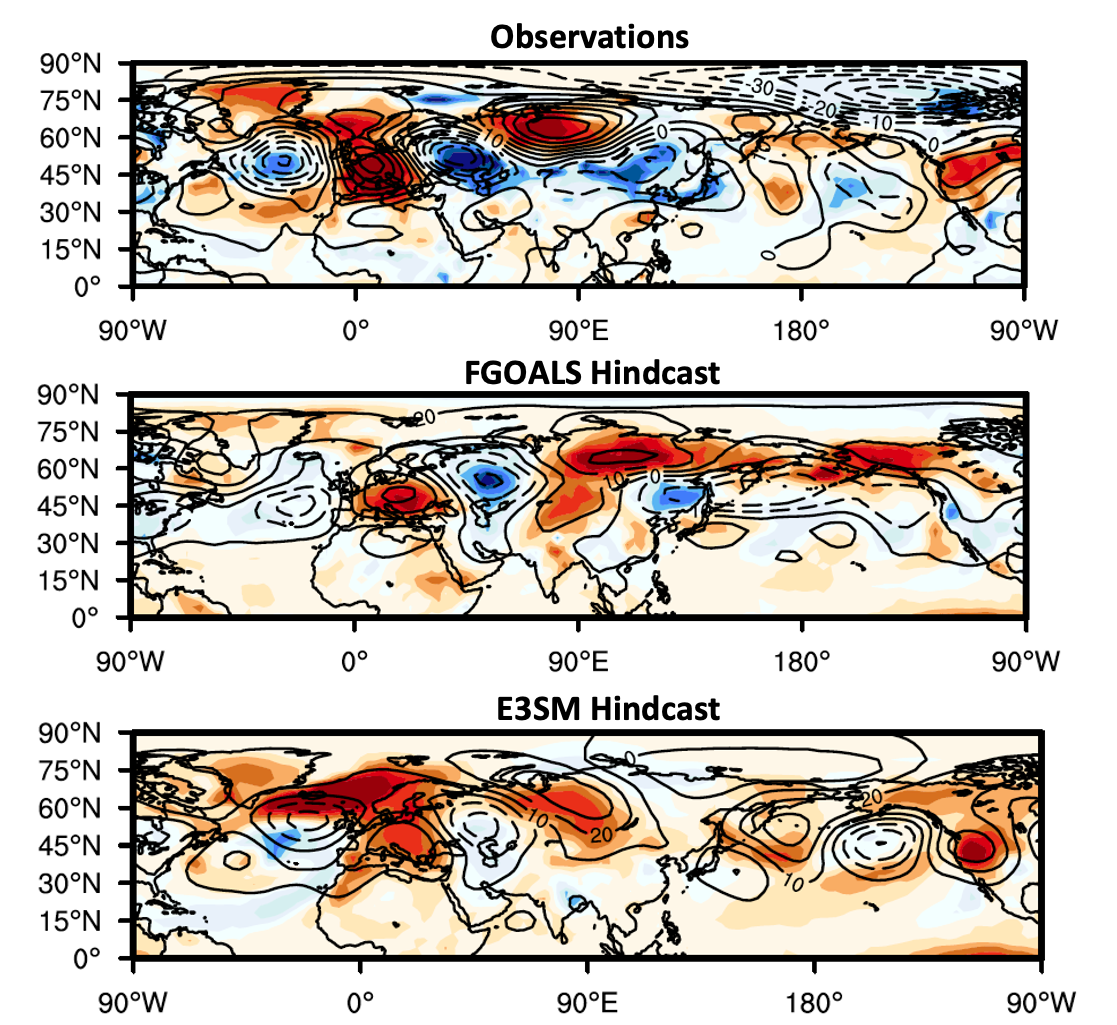
Figure 1. Surface temperature (color shading) and 500 hPa (contour) anomalies during June-July-August 2003 from observations (top) and hindcasts initialized from fully coupled simulations (middle and bottom) with a weakly coupled land data assimilation system.
By employing a weakly coupled data assimilation (WCDA) system in E3SM and FGOALS-g2, we incorporate soil moisture and temperature data from the Global Land Data Assimilation System (GLDAS) into the earth system models, significantly enhancing the prediction skill for the 2003 heatwave. This approach underscores the TP’s pivotal role in modulating interannual earth system variability and emphasizes the importance of realistic land state initialization for improving the predictability of extreme events. The study not only advances understanding of the TP’s influence but also sets a foundation for utilizing its potential to improve predictability in global weather and earth system models.
Publication
Funding
- This work was supported by the Regional and Global Model Analysis (RGMA) program area of the Department of Energy, Office of Science, Biological and Environmental Research program.
Contact
- L. Ruby Leung, Pacific Northwest National Laboratory
This article is a part of the E3SM “Floating Points” Newsletter, to read the full Newsletter check:
