

2026 INCITE award enables unprecedented simulations
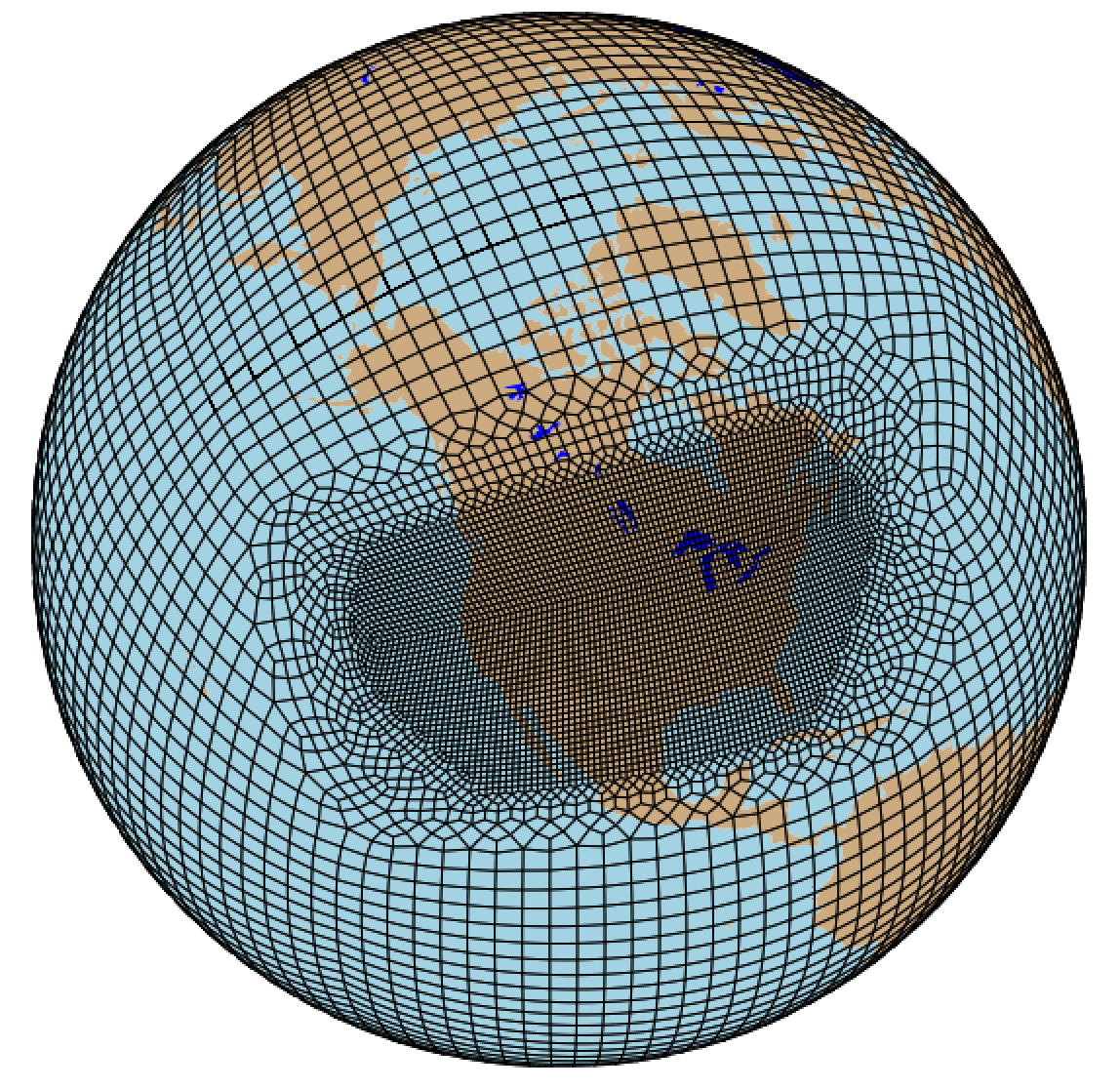
Figure 1. CONtinental U.S. regionally-refined model (RRM) mesh, showing refinement from ne30 (~100 km) down to ne120 (~25 km). The CONUS 200 m mesh uses refinement over this same area, but from ne1024 (~3.25 km) to ne16384 (~200 m).
This year, one of the Innovative and Novel Computational Impact on Theory and Experiment (INCITE) simulation campaigns will focus on advancing the Simple Cloud-Resolving E3SM Atmosphere Model (SCREAM), a next-generation model designed for highly efficient, ultra-high-resolution simulations on GPU-based exascale systems such as Frontier and Aurora. The campaign continues E3SM’s multi-year streak of winning INCITE proposal hours to facilitate cutting edge computational experiments on the fastest computers in the Department of Energy (DOE) enterprise. Using these powerful computing platforms, the project will carry out unprecedented global simulations with regional refinement down to 200 meters over the continental United States (CONUS), as shown in Figures 1 and 2. These capabilities will support detailed studies of hazardous weather events and their impacts on critical infrastructure and communities.
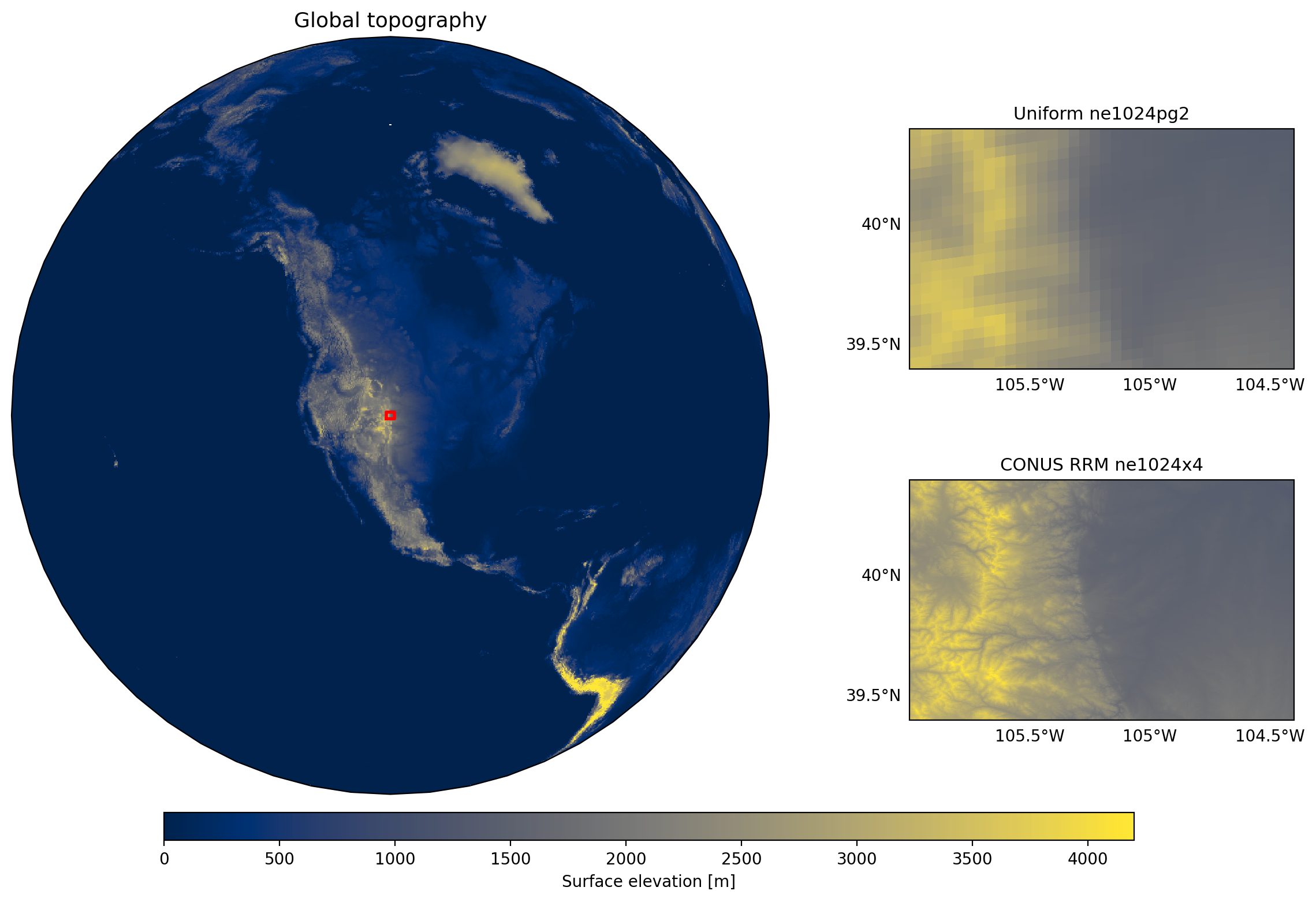
Figure 2. Topography (surface elevation) for global 3.25 km mesh (left), and comparison of topography over a section of the Rocky Mountain front range (outlined in red) at 3.25 km (ne1024) and 200 m (CONUS RRM ne1024x4).
The campaign’s primary objectives are to simulate three to four recent high-impact hazardous weather events across the United States using regionally refined meshes at 800-meter, 400-meter, and 200-meter resolution. Together, these studies will help determine the model resolution required to accurately represent extreme weather phenomena and improve understanding of land-atmosphere interactions. E3SM is uniquely positioned to carry out this ambitious effort, which will push the frontiers of Earth system modeling while directly supporting the Department of Energy’s mission in infrastructure resilience and energy security.
Contact
- Aaron Donahue, Lawrence Livermore National Laboratory
- Ben Hillman, Sandia National Laboratories
This article is a part of the E3SM “Floating Points” Newsletter, to read the full Newsletter check:
- E3SM Floating Points, May ’26: Looking Forward to the Summer All-Hands
